

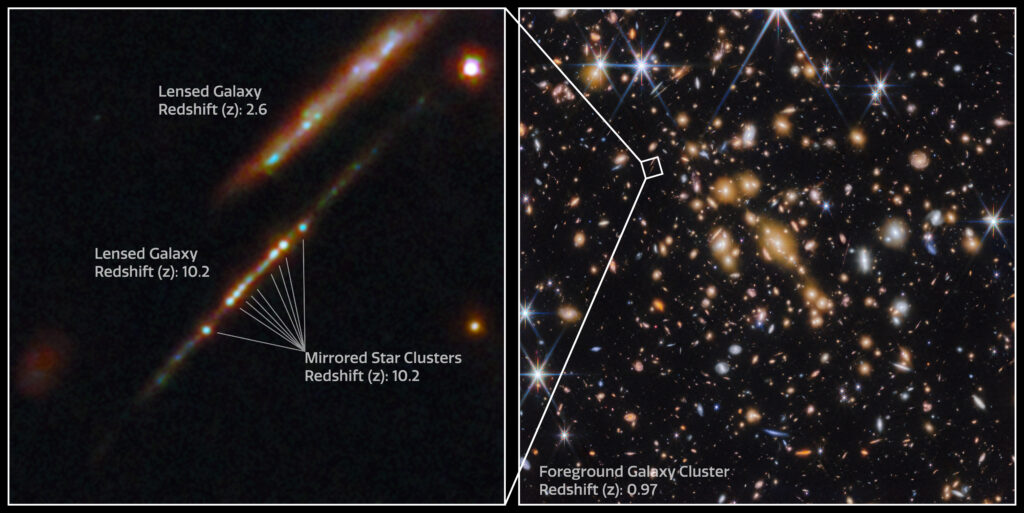
The James Webb Space Telescope (JWST) has a counting problem. When it looks back to the first few hundred million years after the Big Bang, it finds more bright galaxies than models of galaxy formation predicted. Young galaxies should be wrapped in the gas and dust they are built from, and that shroud ought to dim them. A new study argues that the light of newborn stars blows much of the shroud away, through a form of radiation pressure that most simulations have struggled to include, and that this could help explain why bright early galaxies are so easy for Webb to see.
Shyam Menon of the Flatiron Institute’s Center for Computational Astrophysics and Aaron Smith of the University of Texas at Dallas published the work in The Astrophysical Journal on 4 November 2026. It concerns Lyman-alpha radiation, the ultraviolet light hydrogen gives off when its electron drops from the first excited state to its lowest energy level. Hydrogen is the most common element in the universe, so young star-forming regions glow strongly at this wavelength. This is a modelling result, not a new observation.
Their starting point is what Webb has seen through gravitational lenses, where a foreground galaxy cluster magnifies a far more distant object. In the Cosmic Gems arc, a galaxy seen about 460 million years after the Big Bang, Webb picked out five young, massive star clusters, each tightly bound by its own gravity. Galaxies at this cosmic dawn appear to build much of their stellar mass in compact, crowded clusters like these. That crowding is exactly where Lyman-alpha starts to matter.
A Lyman-alpha photon rarely travels in a straight line. Hydrogen atoms absorb it and re-emit it in a random direction, again and again, so the photon rattles around inside a gas cloud until it escapes or is swallowed by a dust grain. Each encounter hands the gas a small shove. Smith, in the university’s announcement, compares the photon to a ping-pong ball “transferring momentum with every collision”. Because one photon pushes many times, its total force can far exceed that of light passing straight through. The same scattering makes it very hard to simulate, which is why many models leave it out.
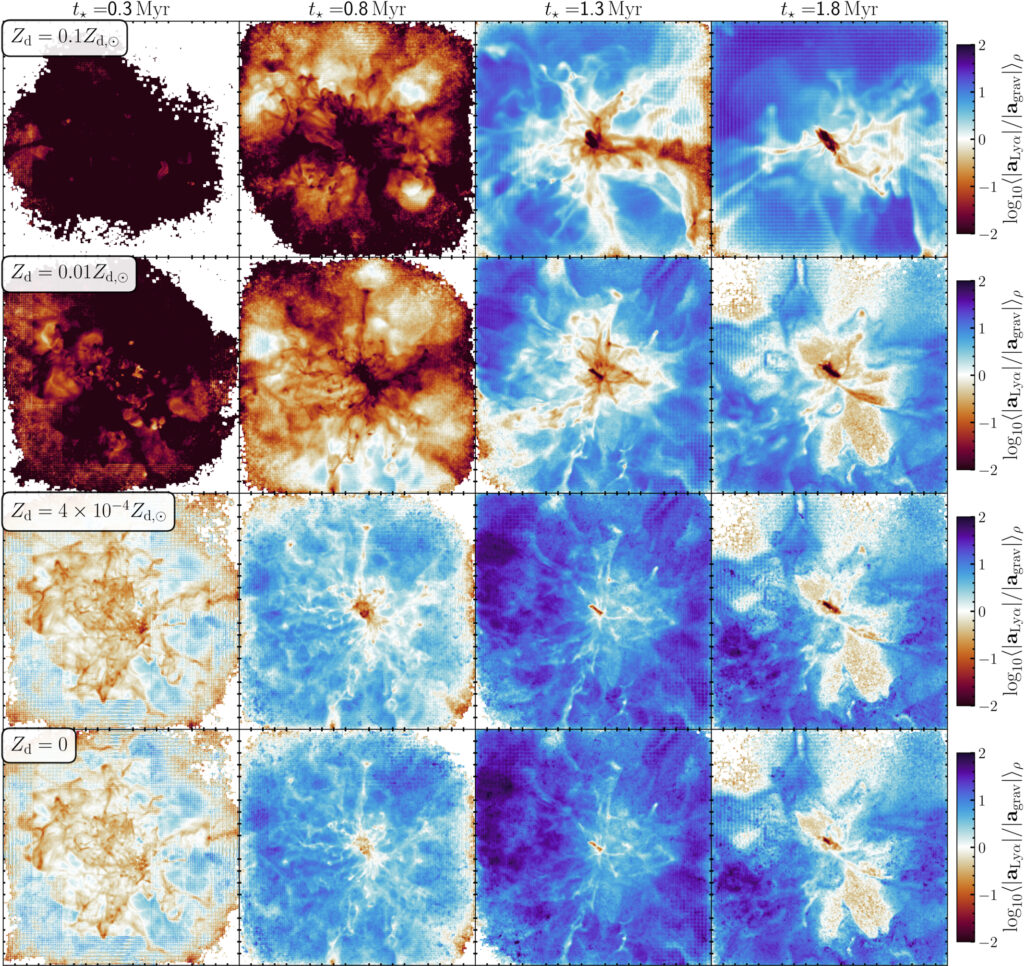
Rather than build a new simulation, the pair took snapshots from existing ones of a cloud of a million solar masses with a radius of 10 parsecs (about 33 light-years), dense enough to hold roughly 3,000 Suns’ worth of gas in every square parsec. They traced Lyman-alpha photons through each snapshot with COLT, a code written by Smith that follows huge numbers of individual photon paths, and compared the resulting push with the pull of gravity. They repeated the exercise at four dust levels, from none at all up to a tenth of the dust content of gas near the Sun.
The answer splits cleanly by density. In the dense filaments that funnel gas into the growing cluster, where most of the stars actually form, gravity wins. Star formation carries on regardless: with dust at even a hundredth of the solar level, Lyman-alpha trims the share of gas turned into stars by only about 10%, leaving efficiencies above 60%. Even in dust-free gas the figure stays above 25%. Star-forming regions in today’s universe typically manage 10% or less.
Thinner gas around those filaments is another matter. Across most of the cloud’s volume the push from Lyman-alpha beats gravity, in places by a factor of 10 or more. That is enough to drive winds out of the cluster within about four million years, roughly when the first massive stars begin exploding as supernovae. Across the dust levels studied, Lyman-alpha outpushed ordinary ultraviolet and infrared radiation pressure by factors of about three to 500. Smith’s analogy is a leaf blower: it will not shift a tree, but it clears loose leaves very well.
Put together, the result offers a tidy account of Webb’s surplus. Clusters can turn gas into stars efficiently, building up plenty of starlight, then quickly clear the surrounding fog so that light reaches our telescopes. The same winds could also affect how much ionising radiation leaks out of young galaxies, a question tied to how the early universe became transparent. The authors say their findings reinforce an emerging picture of star formation at cosmic dawn as locally efficient and bursty, with rapid outflows.
The catch is in the method. Lyman-alpha was added after the fact to simulations that did not include it, so the gas never got to respond to the push as it would in reality. The model also leaves out stellar winds, magnetic fields and supernovae. The outcome depends heavily on how much dust is present and how that dust absorbs Lyman-alpha, which is poorly known for galaxies this young, and the authors note that their photon sampling may overstate the push by a factor of a few in some cases. Smith’s group now plans to let light and gas evolve together in full three-dimensional simulations and test the predictions against Webb data.
For now, the idea has a pleasing economy. The hydrogen that hides a young galaxy is also the source of the light that clears it. Webb may see these galaxies at all because their own stars opened the curtains.
