

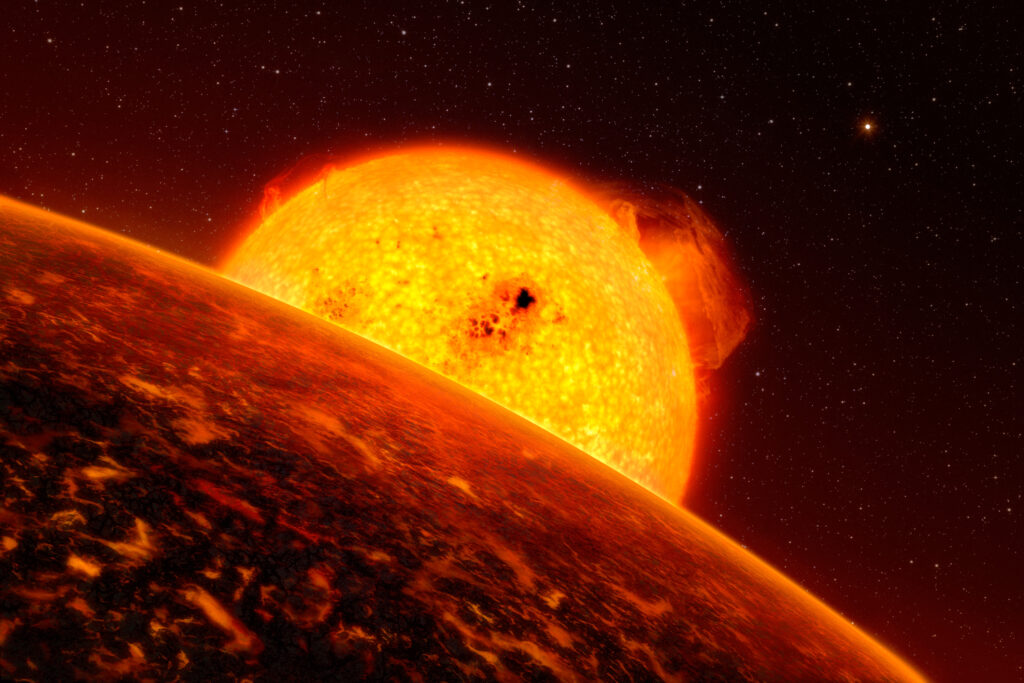
Most of the scorching rocky planets astronomers have studied turn out to be cooler than they ought to be. Something on them, whether a bright surface, a layer of cloud or winds carrying heat to the night side, takes the edge off the starlight. A planet called TOI-2431 b appears to have none of that protection. New Hubble Space Telescope observations of this rocky exoplanet show its dayside glowing at almost exactly the temperature expected of a bare, dark rock that keeps every scrap of heat where it lands.
The result, published in The Astrophysical Journal Letters on 30 October 2026 by a team led by Sebastian Zieba, is the first time Hubble has detected a secondary eclipse from a rocky exoplanet. TOI-2431 b was first spotted by NASA’s Transiting Exoplanet Survey Satellite (TESS) and lies about 117 light years away, circling a small, cool K dwarf star. According to the discovery study, it is about 1.5 times the width of Earth and roughly six times its mass, a density consistent with an Earth-like mix of rock and iron. Its year lasts 5.4 hours.
A secondary eclipse happens when the planet slips behind its star. While it is hidden, the telescope sees starlight alone, so the small dip in brightness measures how much light the planet itself was giving off. Here the dip is tiny. In Hubble’s Wide Field Camera 3, which works in the near infrared, it came to 69 parts per million. In the visible light recorded by TESS it was 37 parts per million. Hubble watched the system for 11 consecutive orbits on 4 February 2022, long enough to follow the planet round its star several times.
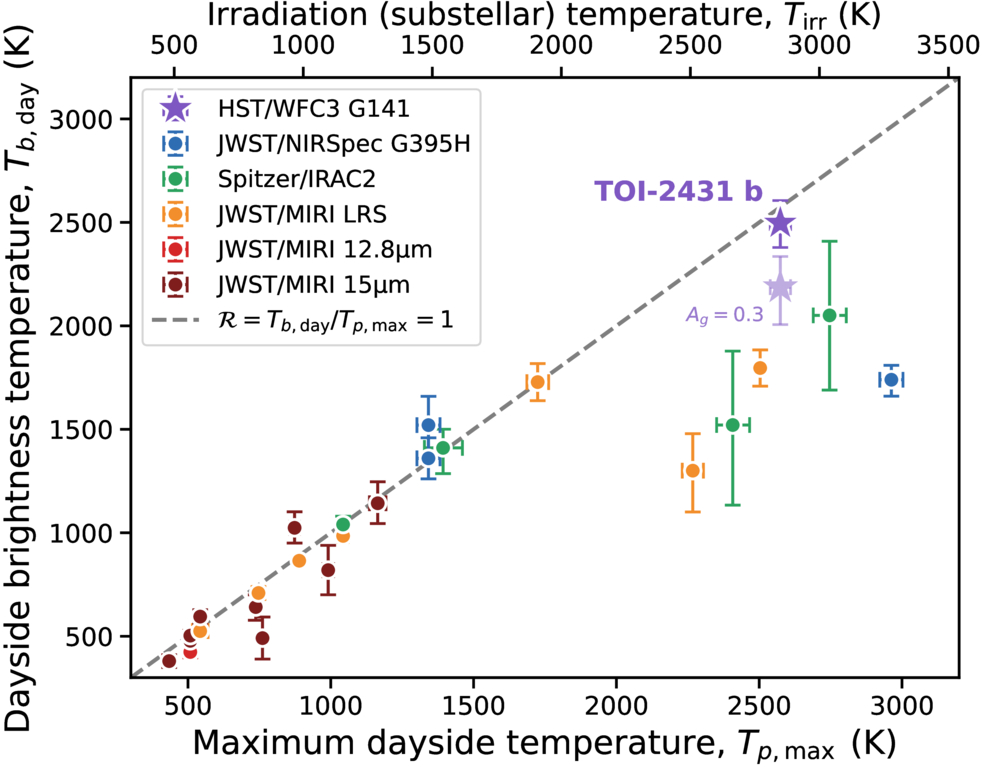
Combining the two measurements gives a dayside brightness temperature of about 2,524 K (roughly 2,250°C). The theoretical ceiling, for a planet that absorbs all the light it receives and sends none of the heat round to its night side, is about 2,574 K. The two figures agree within the uncertainties. Hubble also found no measurable glow from the night side and no shift of the hottest spot away from the point directly beneath the star. Both clues point the same way. The heat is not going anywhere.
That makes TOI-2431 b an outlier. The team compared it with other lava worlds measured so far, including 55 Cancri e, K2-141 b and TOI-561 b, and found those planets well below their own ceilings. Each has been explained by some mix of reflective ground, clouds or an atmosphere that moves heat around; TOI-561 b, for one, appears to be wrapped in a thick blanket of gas. A planet sitting right at the limit gives researchers a clean reference point: what a molten world looks like when nothing gets in the way.
Its future is short. The orbit is only about 30% wider than the Roche limit, the distance at which the star’s tides would pull the planet apart, and the discovery team estimated that tides are shrinking it on a timescale of roughly 31 million years. By planetary standards, that is a blink.
The catch is that a hot glow and reflected starlight are hard to separate at the wavelengths Hubble and TESS used. If the surface reflects even a modest share of the light falling on it, with a geometric albedo of 0.1, part of the signal would be reflection and the temperature would drop to about 2,407 K. A thin atmosphere of vaporised rock, which a surface this hot could plausibly support, would also look almost identical to bare rock in the current data. The authors say the observations fit a planet with no atmosphere, but they cannot rule one out.
Longer wavelengths should settle it, because reflected starlight fades there while heat glow does not. A James Webb Space Telescope (JWST) programme led by Lisa Dang will use the Mid-Infrared Instrument to follow the planet for 10.6 hours, covering two full orbits and two secondary eclipses at wavelengths of about 5 to 12 micrometres. If the bare rock reading holds, astronomers gain a benchmark. If it does not, they learn what a rock vapour sky looks like from 117 light years away.
Hubble was launched in 1990, five years before the first planet around a Sun-like star was found. It has now taken the temperature of a world smaller than Neptune from a dip of less than one part in 10,000. Whatever JWST finds, TOI-2431 b will not keep its secrets for long, and in a few tens of millions of years it will not keep itself at all.
