

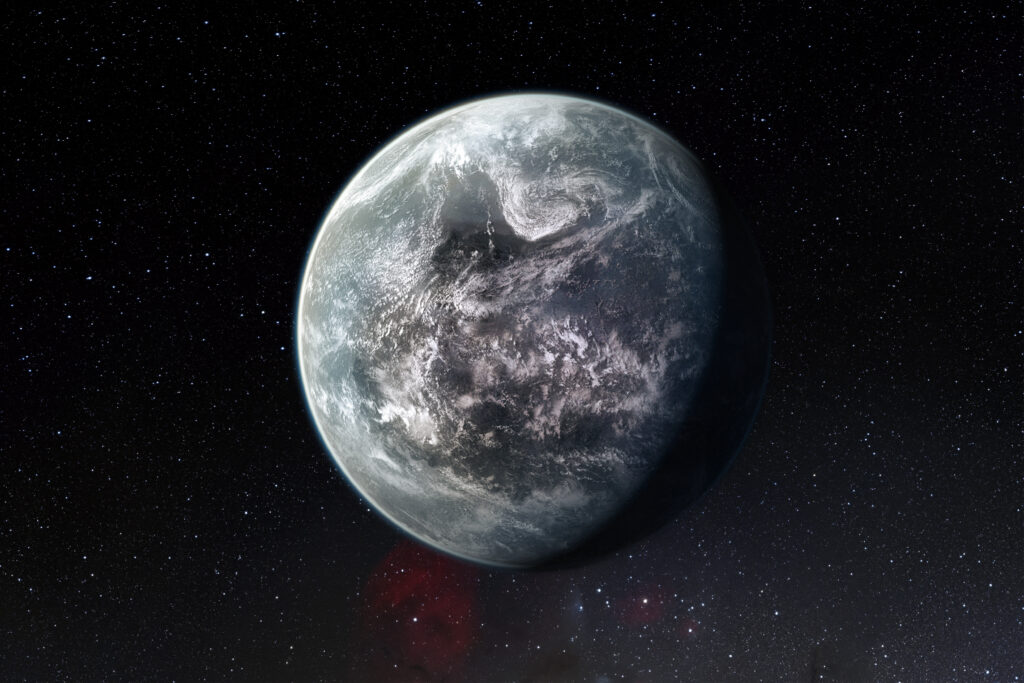
Planet formation theory sets a weight limit on rocky worlds. Once a growing planet passes roughly 10 times Earth’s mass, its gravity should pull in hydrogen and helium from the surrounding disc of gas until it swells into something closer to Neptune. Yet astronomers have reported a handful of planets that seem to break the rule: dense, rock-like and far heavier than the limit allows. A new study argues that these giant rocky planets, nicknamed mega-Earths, are probably not what they seem, and that the culprit is the restless behaviour of their stars.
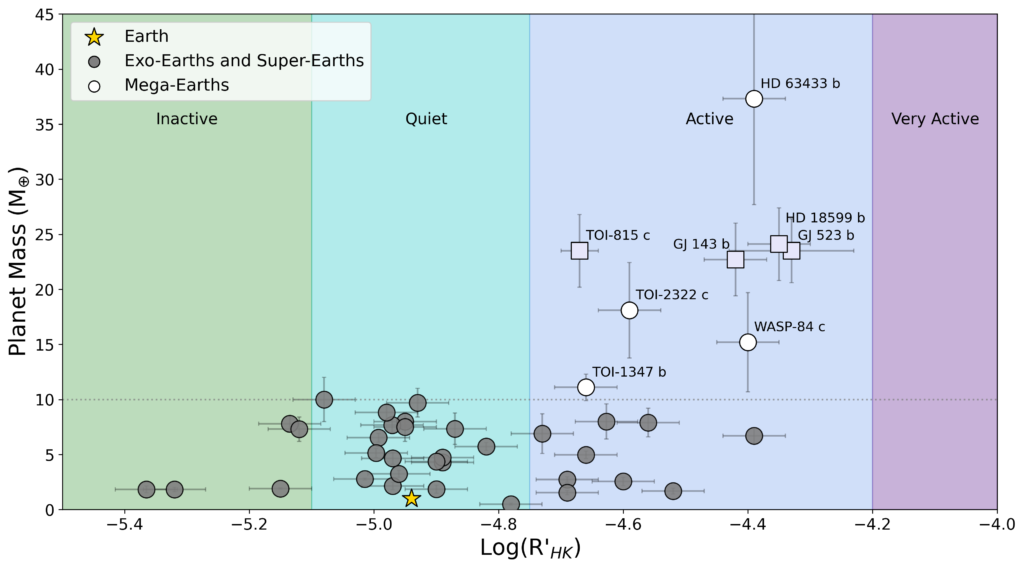
The work, by Casey Brinkman and Nicolas Cowan of McGill University’s Trottier Space Institute, was published in The Astrophysical Journal Letters on 6 November 2026, after first appearing as a preprint in October. The pair began with the NASA Exoplanet Archive, keeping planets smaller than four times Earth’s radius whose masses came from the radial velocity method with uncertainties below 50 per cent. That left 333 worlds. Four combined a rocky density with a mass above 10 Earth masses: WASP-84 c, TOI-1347 b, TOI-2322 c and HD 63433 b. Four more, including GJ 143 b and TOI-815 c, were heavy and dense enough to raise the same question.
Radial velocity measurements weigh a planet by watching its star wobble. As the planet orbits, it tugs the star towards and away from us by a few metres per second, shifting the lines in the star’s spectrum back and forth. A bigger tug means a heavier planet. The trouble is that stars have weather. Dark starspots and bright magnetic patches rotate in and out of view, distorting those same lines and producing a false wobble that can bury a small planet’s signal or inflate it.
The telling detail is where the mega-Earths live. Using the strength of two calcium emission lines, a standard gauge of a star’s magnetic activity, the authors compared 37 planets with rocky densities whose host stars have activity measurements. Only 13 of those stars counted as active. All eight heavyweights orbit active stars. If the four clear mega-Earths had been scattered at random, the chance of every one landing around an active star is about 1 per cent; include all eight and the odds become far smaller.
Could young, active stars simply be better at making heavy rocky planets? The authors find no reason to think so. Building a ball of rock well past 10 Earth masses needs either an unusually long run of collisions after the gas disc has cleared, or a gas giant that later loses its atmosphere. Both routes take time, and both would probably require the planet to migrate inwards from where it formed. If anything, such worlds should turn up more often around older, calmer stars.
Several individual cases already looked shaky. HD 63433 b, the heaviest at about 37 Earth masses, circles its star every 7.1 days while the star spins once every 6.45 days, so planet and star keep almost the same rhythm. A separate team using a different spectrograph found no clear signal from the planet and set an upper limit of 21 Earth masses. TOI-2322 c takes about 20 days to orbit a star that rotates in about 21. Picking out a planet under those conditions is like listening for one drum in a band playing the same beat.
The result reaches beyond eight planets. Most of the original mass measurements relied on Gaussian processes, a flexible statistical technique that models a star’s noise so it can be subtracted from the planet’s signal. The authors argue that a model loose enough to follow the star can also absorb or exaggerate the planet, even when it is guided by the star’s measured brightness changes. Many small planets around young stars are weighed this way, so the paper is a caution about a widely used tool as much as a verdict on a few odd worlds.
There is a catch. The study is a statistical argument, not a fresh measurement. It shows that mega-Earths cluster suspiciously around active stars, but it does not prove that any single mass is wrong, and a genuine ultramassive rocky planet could still exist. The sample is small, and the activity level of one host star, GJ 523, had to be estimated because no published value existed. Settling each case will need new observing campaigns, which the authors suggest should sample the star more often, with shorter gaps, so that its rotation and the planet’s orbit can be pulled apart.
For now, the weight limit for rocky planets appears to hold. The heavyweights that seemed to defy it may simply be smaller planets seen through the flicker of a spotty star. Before rewriting the theory of how planets grow, astronomers may first need to take a closer look at the stars doing the wobbling.
