

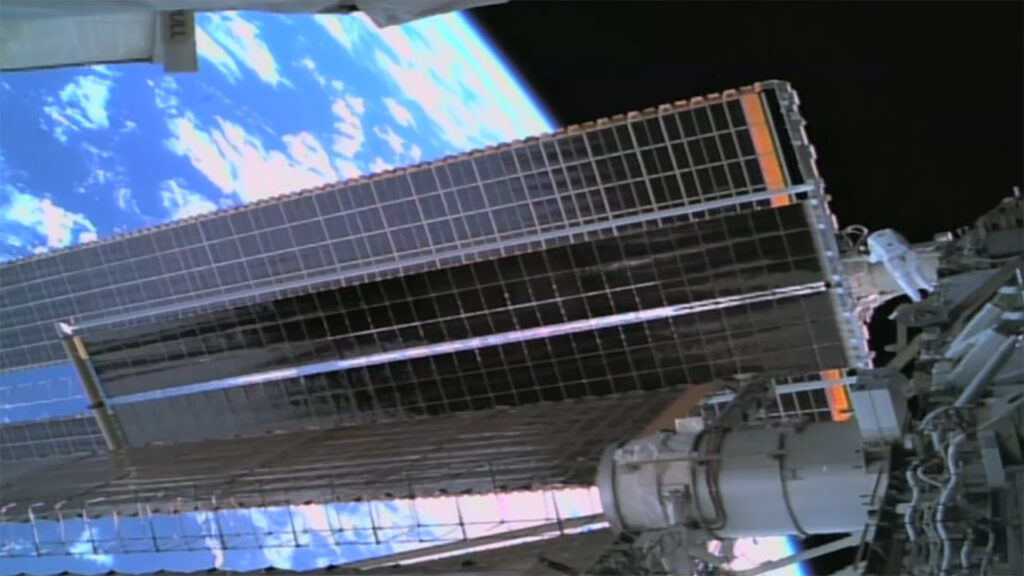
Solar panels age like anything else left out in the sunshine, and the International Space Station’s original wings were designed for a 15-year service life. On 5 November 2026, two spacewalkers fixed the last of eight new space station solar arrays in place, completing a power upgrade that began in February 2021. The outpost can now generate up to 30% more electricity than before, just as it enters its final years.
NASA astronaut Anil Menon and Canadian Space Agency astronaut Joshua Kutryk spent 6 hours and 59 minutes outside, according to NASA’s account of the spacewalk. They installed and unfurled the array on the circuit known as power channel 3B. It was Menon’s fifth spacewalk, Kutryk’s second, and the 286th in support of station assembly, maintenance and upgrades. The same pair had fitted the seventh array on channel 2A a week earlier, in an outing of 7 hours and 11 minutes.
The name describes the trick. Each array travels as a compact roll and spreads out flat once attached, a larger version of a design first tested on the station in June 2017. Rather than tearing down the ageing wings, NASA mounted the new arrays in front of them, so each shades slightly more than half the length of the panel behind it, as the agency explained when the programme began. The uncovered sections keep working. Together, old and new hardware raise generating capacity from 160 kilowatts to about 215 kilowatts.
Getting there took 18 spacewalks, spread across more than five years, to prepare the power channels and install all eight arrays. Electricity is the station’s real budget. Every experiment, pump, heater and computer draws on it, and an orbiting laboratory with a shrinking supply spends its days deciding what to switch off.
There is a sober side to the upgrade. Because the new arrays partly cover the old ones, eight fresh wings add roughly 55 kilowatts rather than doubling the supply. NASA is also frank about what some of that margin is for: the extra power supports critical operations, including a safe and controlled deorbit when the station’s working life ends.
So the last array is, in a sense, a retirement gift. The station now has the electricity to keep its science running and, when the time comes, to steer itself down carefully.
