

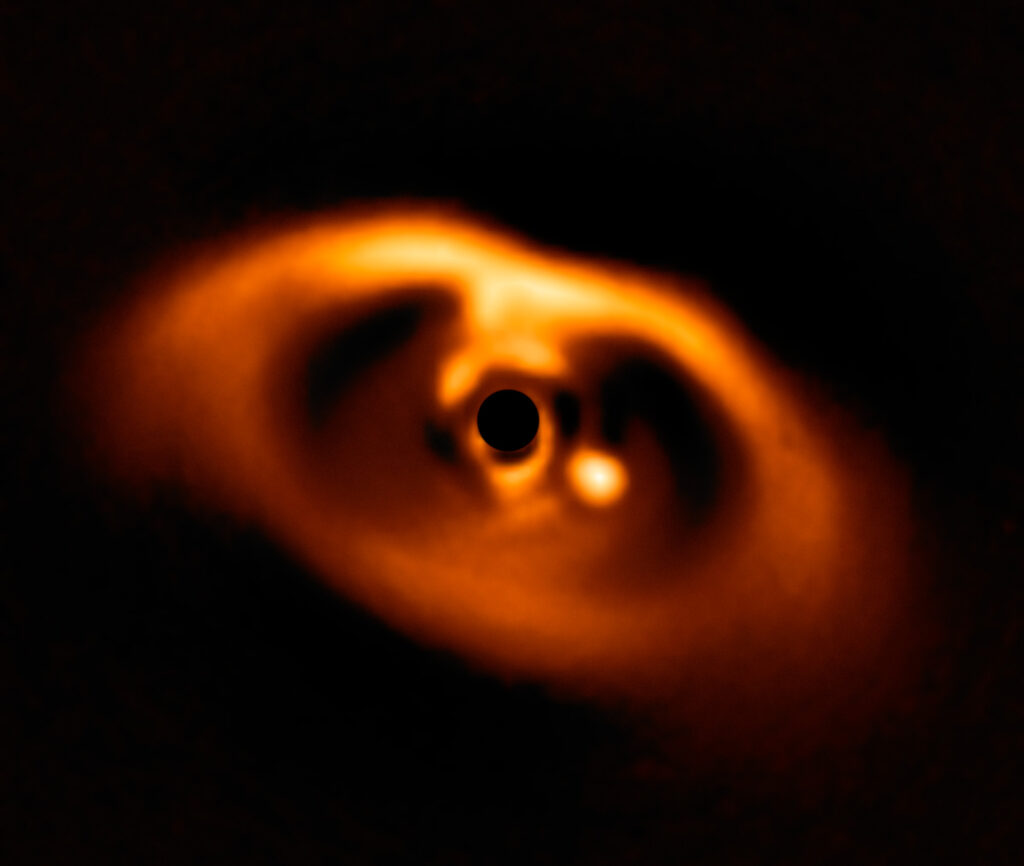
Catching a planet while it is still being built is one of the hardest jobs in astronomy. Young planets sit buried in the gas and dust of the disc that feeds them, a fraction of an arcsecond from a star that easily outshines them. Only two such systems are widely accepted so far. A team led by Felipe Alarcón at the University of Milan now proposes a new protoplanet candidate, and it found the object without new observations: it was sitting in archive data around EK Chamaeleontis (EK Cha), a small red star about 320 light years away.
The work appears as a Letter in Astronomy & Astrophysics, published online on 9 November 2026, with a preprint on arXiv. The authors, from Milan, the University of Michigan and the University of Zürich, combined images already held in public archives. These included Hubble Space Telescope data from 2017, images from the European Southern Observatory’s Very Large Telescope (VLT) and radio data from the Atacama Large Millimeter/submillimeter Array (ALMA).
EK Cha is an unusual place to look. It is a red dwarf of spectral type M5, with just 0.11 times the mass of the Sun, and it is roughly eight million years old. It belongs to the Eta Chamaeleontis association, a young group of stars in the southern sky. Its dusty disc is compact, extending no more than about 8 au (one au is the distance from Earth to the Sun), although its gas reaches much further out.
The candidate, EK Cha b, sits about 46 au from its star, beyond the dust but inside the gas. It shows up in three independent ways. Hubble caught it in near-infrared light at a wavelength of 0.82 microns. ALMA picked up a faint, compact patch of millimetre emission from cold dust at the same spot. In the same ALMA data, carbon monoxide gas at that position produces a broad spectral line with two peaks, the pattern expected from gas spinning in a small disc around the object itself. Astronomers call this a circumplanetary disc, and it is where moons could eventually form.
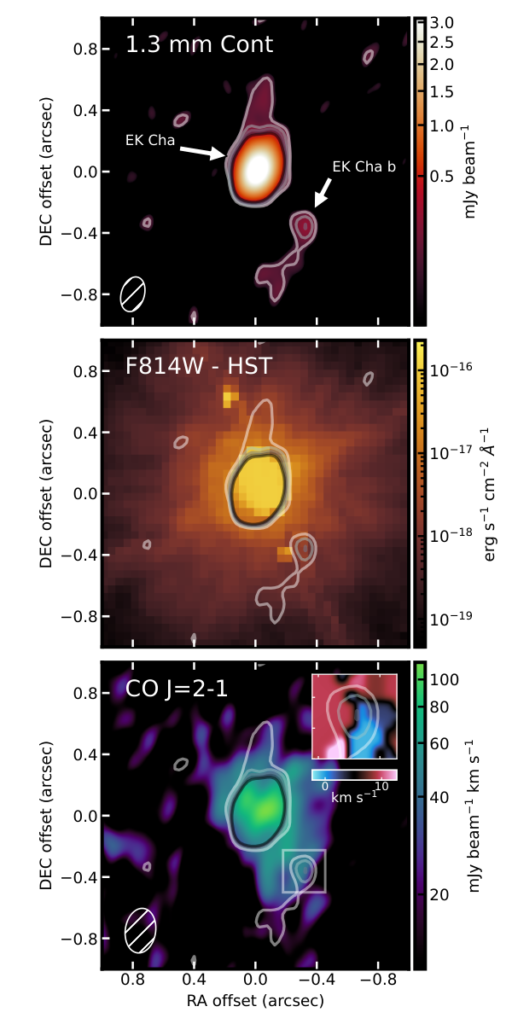
That gas line does a second job. Its velocity matches the motion of EK Cha’s own disc, so the source appears to travel with the star rather than lying far behind it. A distant background galaxy would show no such link. Comparing the object’s brightness with models of young giant planets gives a mass of about 8.5 times that of Jupiter, a temperature near 2,100 kelvin and a radius 1.7 times Jupiter’s. The team puts roughly 80 per cent confidence on the mass falling below 13 Jupiter masses, the threshold above which an object can fuse deuterium and is usually classed as a brown dwarf.
A third example matters because two cannot show a pattern. PDS 70, whose young planet the VLT imaged directly in 2018, remains the textbook case. Giant planets are uncommon around red dwarfs, yet red dwarfs host the most planets overall and have been largely skipped in protoplanet searches. If a world several times Jupiter’s mass can assemble 46 au from a star a ninth the mass of the Sun, models of how giant planets grow in small, thin discs will have to account for it.
The case is not closed, and the authors say so plainly. Each ALMA detection sits only just above five sigma, a statistical bar meaning the signal stands clear of the noise but not by a wide margin. The data have low resolution and come from a single epoch. The Hubble and ALMA positions also differ by about 80 milliarcseconds, a small offset but not zero. The object shows no hydrogen alpha emission, the red glow usually taken as a sign that a young planet is still swallowing gas; the team suggests dust or irregular feeding could hide it. Finally, the mass estimate shifts with the models used, and its upper range crosses into brown dwarf territory.
A decisive test needs only patience. EK Cha drifts slowly across the sky, so a fresh high resolution image compared with the 2017 Hubble frame should show whether the companion has travelled with it. Deeper ALMA observations could resolve the disc around it directly. The authors argue that the coming generation of extremely large telescopes will make small, faint systems like this routine targets.
For now, EK Cha b is a planet in the conditional tense. It is also a reminder that some discoveries do not wait at the end of a new observing run. They sit on a server, in data taken years ago for other reasons, until someone looks at the right pixels twice.
