

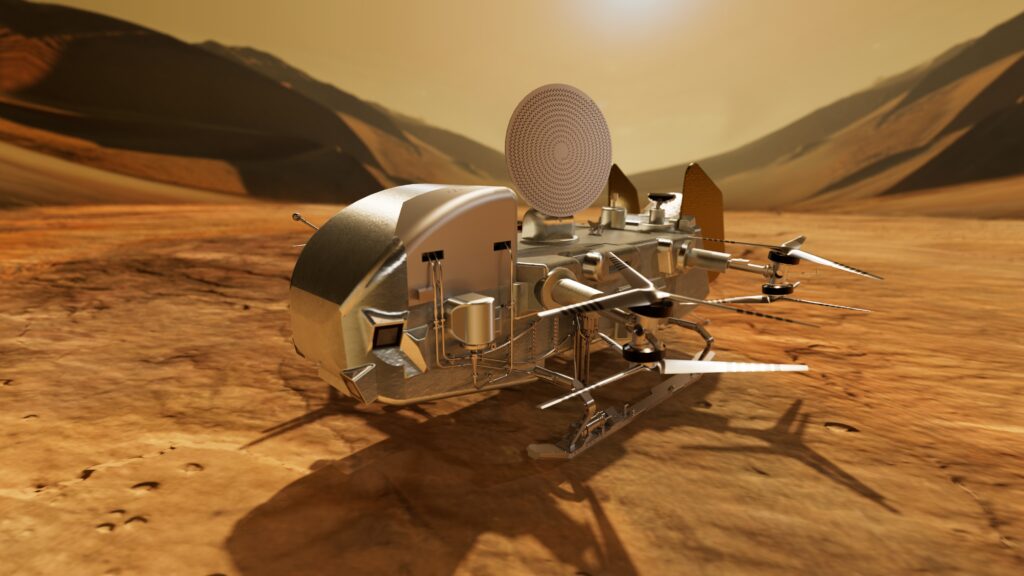
Flying a drone on another world is hard enough. Flying one with no pilot, on a moon too far away for anyone on Earth to steer it in real time, is the problem NASA’s Dragonfly mission must solve before it reaches Titan. A Dragonfly simulated flight run this month suggests the rotorcraft can, at least inside a computer, find its own landing site and touch down.
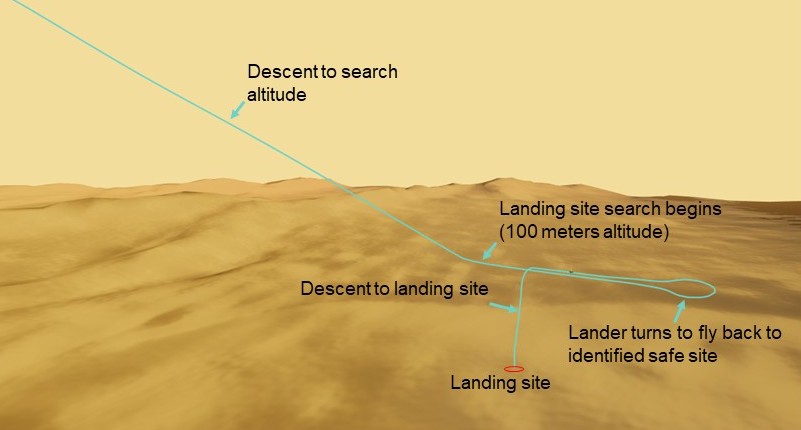
NASA reported on 23 October 2026 that engineers at the Johns Hopkins Applied Physics Laboratory (APL) had completed the most comprehensive rehearsal yet of Dragonfly’s first flight on Saturn’s largest moon. It ran in real time on flight-like avionics, the computers and electronics that will fly the craft, and covered most of the manoeuvres it will use after arriving in 2034. In the simulation, Dragonfly left its protective backshell, sped over sand dunes, picked a safe spot, circled back and landed.
The trick was giving the software convincing senses. Simulated data stood in for the navigation cameras, the inertial measurement units that track motion and orientation, and the lidar, a laser system that measures the height and slope of the ground and flags hazards. A custom emulator running on graphics processors drew each Titan scene in roughly 20 to 70 milliseconds, matching the exposure times of the real cameras. Lidar was the final piece. Earlier tests had built up from spinning a single rotor to a short hop and a partial scouting flight.
Titan rewards the effort. Its air is about four times denser than Earth’s and its gravity about one seventh as strong, which according to APL makes flight there easier than at home. The 953 kg rotorcraft, lifted by eight rotors in four coaxial pairs, should make one flight every one or two Titan days, each about 16 Earth days, over a planned 3.3-year mission that takes in dunes and Selk Crater. Its goal is the chemistry behind life’s origins. It cannot ask Earth for help mid-flight: as APL engineer Zach Putnam put it, “Everything we do on Titan has to happen autonomously.”
This was still a testbed, not the spacecraft. The team next plans to run the same flight on Dragonfly’s own avionics, try other profiles and inject faults to check that the craft recovers alone. Engineers at Lockheed Martin are testing the “pose” mechanism that must lower the rotorcraft out of its backshell, under a swinging parachute, before it can fly at all. Launch is no earlier than 2028, followed by a six-year cruise.
For now, Dragonfly has landed on Titan only inside a computer. That is exactly where a first landing should go wrong, if it is going to go wrong at all.
