

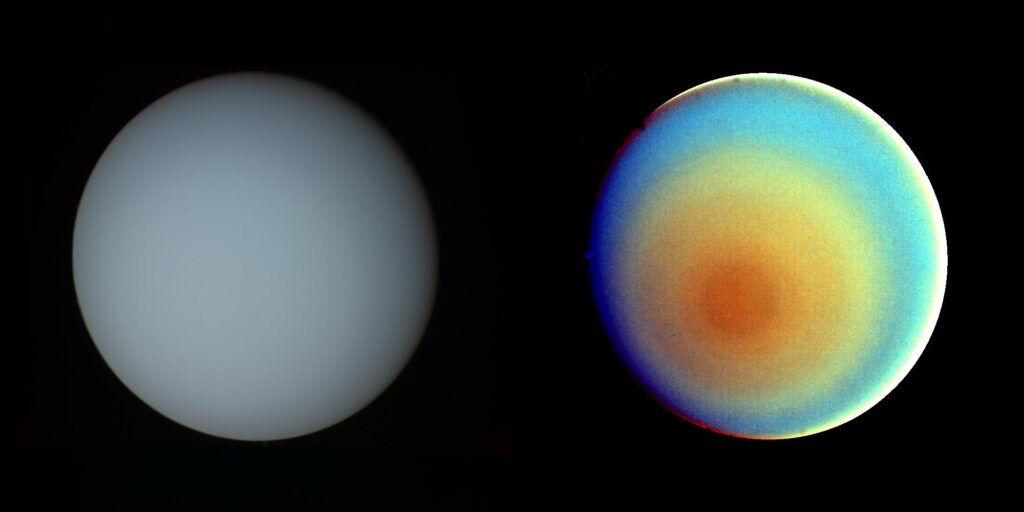
From a distance, Uranus and Neptune look like a matched pair. Both are blue, both are about four times the width of Earth, both wrap thick hydrogen and helium atmospheres around interiors thought to be rich in water and other ices, and both have been visited only once, by Voyager 2 in the 1980s. Astronomers file them together as the ice giants. A new study of the carbon monoxide in their skies suggests the family resemblance between Uranus and Neptune may be skin deep, and that the two planets were assembled from material gathered in quite different parts of the young Solar System.
Led by Tom Briand at the Laboratoire d’Astrophysique de Marseille (LAM), with colleagues at the Southwest Research Institute (SwRI) in Colorado and institutions in France, China and Ireland, the study was published in Astronomy & Astrophysics on 19 October 2026. It tackles an old obstacle. The quantity that would say most about how an ice giant formed is the oxygen locked up as water deep inside it, and nobody can see that far down. Infrared instruments reach only a few bars of pressure, while the water clouds may sit at hundreds of bars.
The workaround uses carbon monoxide as a messenger. Deep in the atmosphere, where gas is hot and dense, carbon monoxide is held in chemical balance with water, so the amount of one depends on the amount of the other. As gas rises and cools, those reactions slow until they effectively stop, and the carbon monoxide level is frozen in. Measure it high up, model the chemistry and mixing below, and the deep water content follows. Observations of Uranus with the Atacama Large Millimeter/submillimeter Array (ALMA) in 2022 found about 5.6 parts per billion; Neptune holds about 0.20 parts per million, roughly 35 times more.
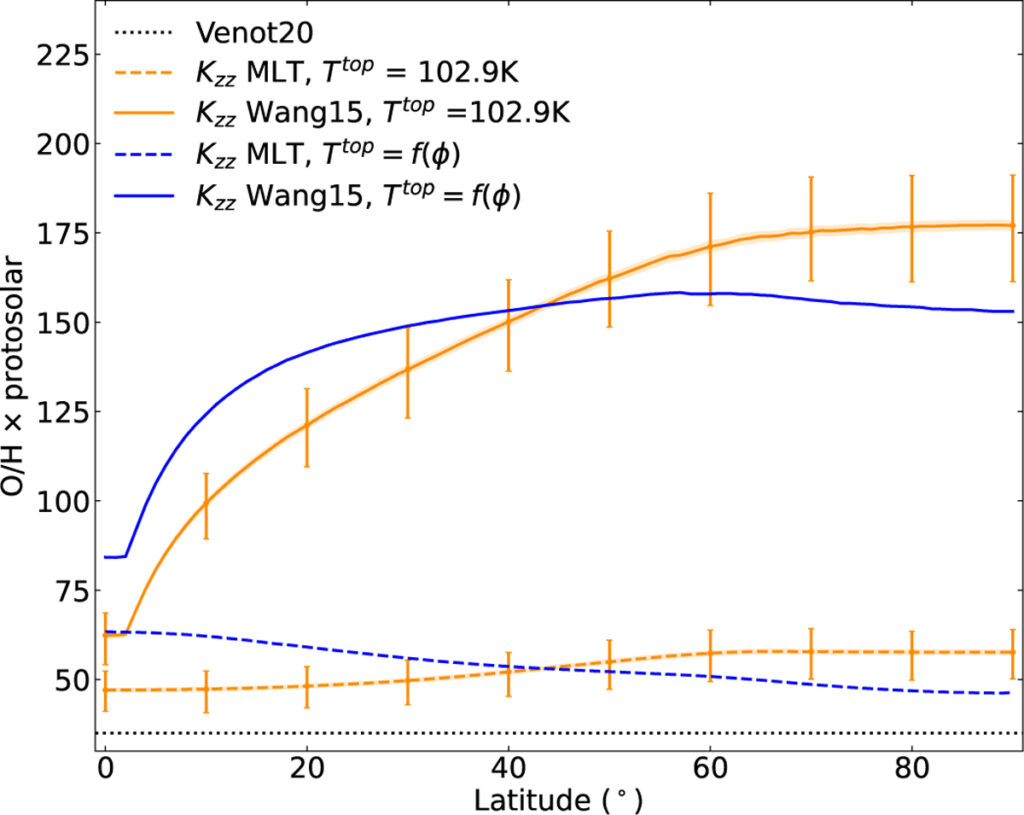
Earlier models treated each planet as a single column of air. Briand’s team let conditions change with latitude, in particular the methane content and the strength of vertical mixing, which varies from equator to pole on these fast spinning worlds. Mixing turns out to dominate the whole calculation. Allowing it to vary, Uranus comes out with between 62 and 177 times the oxygen of the protosolar mix (the blend of elements in the cloud that formed the Sun). Neptune lands between 222 and 342 times. Uncertainties in the chemistry itself shift those ranges by about 10 per cent at most.
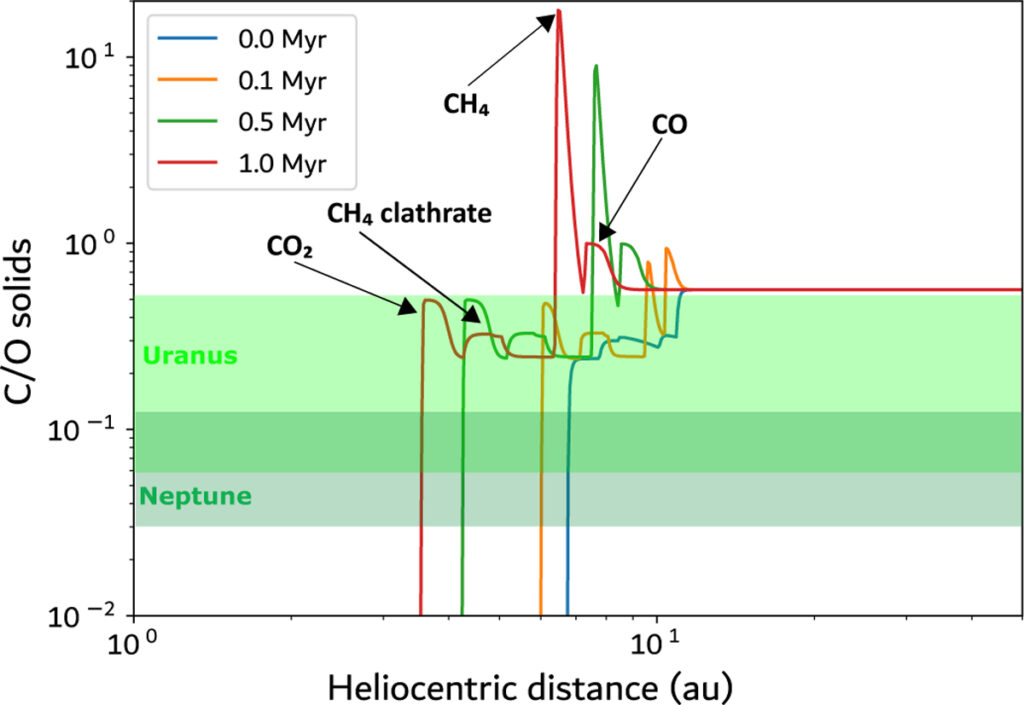
The revealing number is the ratio of carbon to oxygen, because it records where a planet’s building blocks condensed. In the disc of gas and dust around a young star, each ice freezes out at its own distance: water closest in, then carbon dioxide, then methane, with carbon monoxide furthest out. Solids gathered at different distances therefore carry different recipes. Combining the new oxygen figures with carbon abundances, the team finds a carbon to oxygen ratio of 0.06 to 0.52 for Uranus and just 0.02 to 0.12 for Neptune. SwRI’s Olivier Mousis describes the pair as “more like cousins with very different histories”.
In the team’s disc model, icy pebbles at the planets’ present distances of 20 to 30 astronomical units (one unit is the average distance between Earth and the Sun) should carry roughly the Sun’s own carbon to oxygen ratio. Uranus is broadly compatible with that, or with building blocks that formed just inside the methane ice line. Neptune is harder to place. Its low ratio fits better with material assembled near the water ice line, much closer to the Sun, followed by a long migration outwards. On this reading, Neptune is an immigrant.
The catch is that the result rests on modelled mixing in layers no instrument has ever reached. The authors call vertical mixing the largest uncertainty, note that deep methane may in fact be uniform with latitude rather than varying as assumed, and point out that sulfur and phosphorus chemistry is not yet fully included. The two ratio ranges also overlap between about 0.06 and 0.12, so a shared history is not ruled out. The formation story leans on a single disc model with uncertain settings. The paper’s own title ends in a question mark, which is the right punctuation.
Settling it means going to taste the air. The Uranus Orbiter and Probe, the flagship mission recommended by the US planetary science decadal survey for 2023 to 2032, would drop a probe able to sample down to about 10 bars. The new work, also described in a LAM release, gives mission planners a practical steer: enter near the equator, where mixing is strongest and the deep chemistry is carried upwards most faithfully.
Four decades after Voyager 2 flew past, the next close look at Uranus may decide something simple and old. Were these two blue worlds raised side by side, or did one of them move in from much closer to the Sun?
