

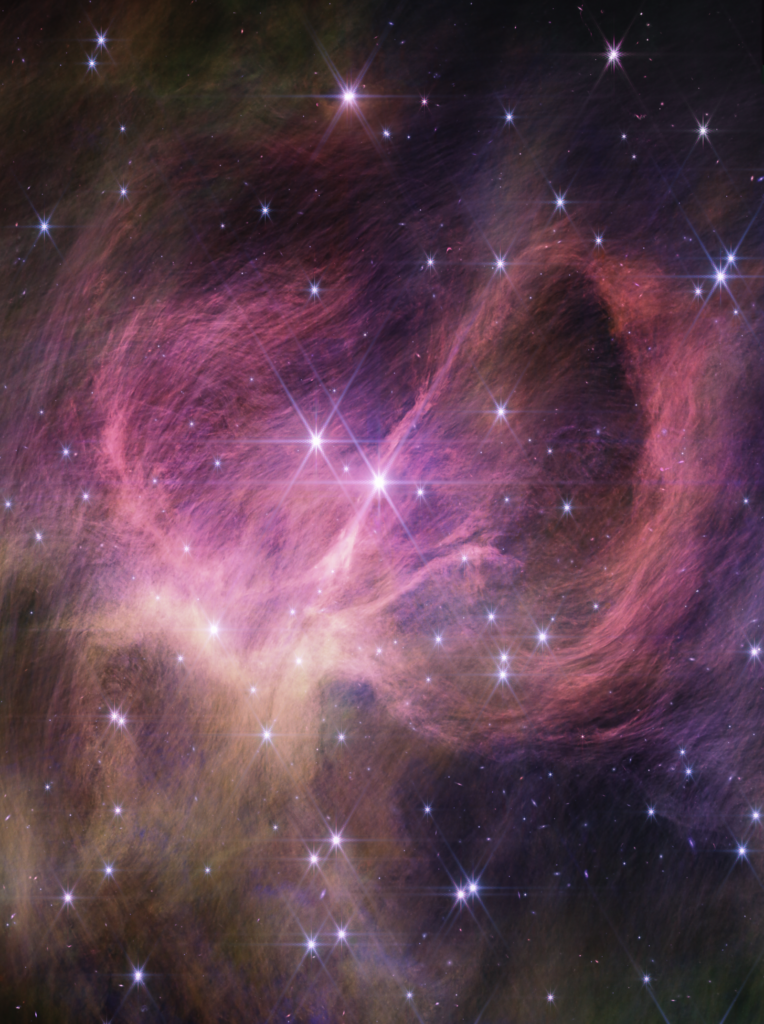
Most of what astronomers know about the atmospheres of brown dwarfs, objects too heavy to be planets and too light to shine as stars, comes from reading shadows. Molecules in the cooler upper air absorb light rising from the hotter layers beneath, carving dark bands into the spectrum. So when a band that should be dark turns up bright, something about the atmosphere is upside down. The James Webb Space Telescope (JWST) has now caught exactly that on a young brown dwarf about 1,000 light-years away, where methane appears to be glowing rather than absorbing.
The object, LRL 11001, sits in IC 348, a cluster roughly five million years old in the constellation Perseus. It weighs about six times as much as Jupiter. Kevin Luhman of Penn State and colleagues observed it with Webb’s NIRSpec spectrograph on 23 August 2025, and their letter in Astronomy & Astrophysics was published on 19 October 2026. The team reports the methane signal as the first of its kind from a young brown dwarf.
This target came with a puzzle attached. In a 2024 survey of IC 348, the same group used coarse Webb spectra to find an absorption band near 3.4 micrometres in the light of two brown dwarfs. That band belongs to an aliphatic hydrocarbon, a chain-like molecule of carbon and hydrogen, of a kind previously seen only in interstellar space and in the atmospheres of Saturn and its moon Titan. No model of brown dwarf atmospheres had predicted it. LRL 11001 is the brightest object in the cluster with a strong version of the band, so it was the obvious place to look closer.
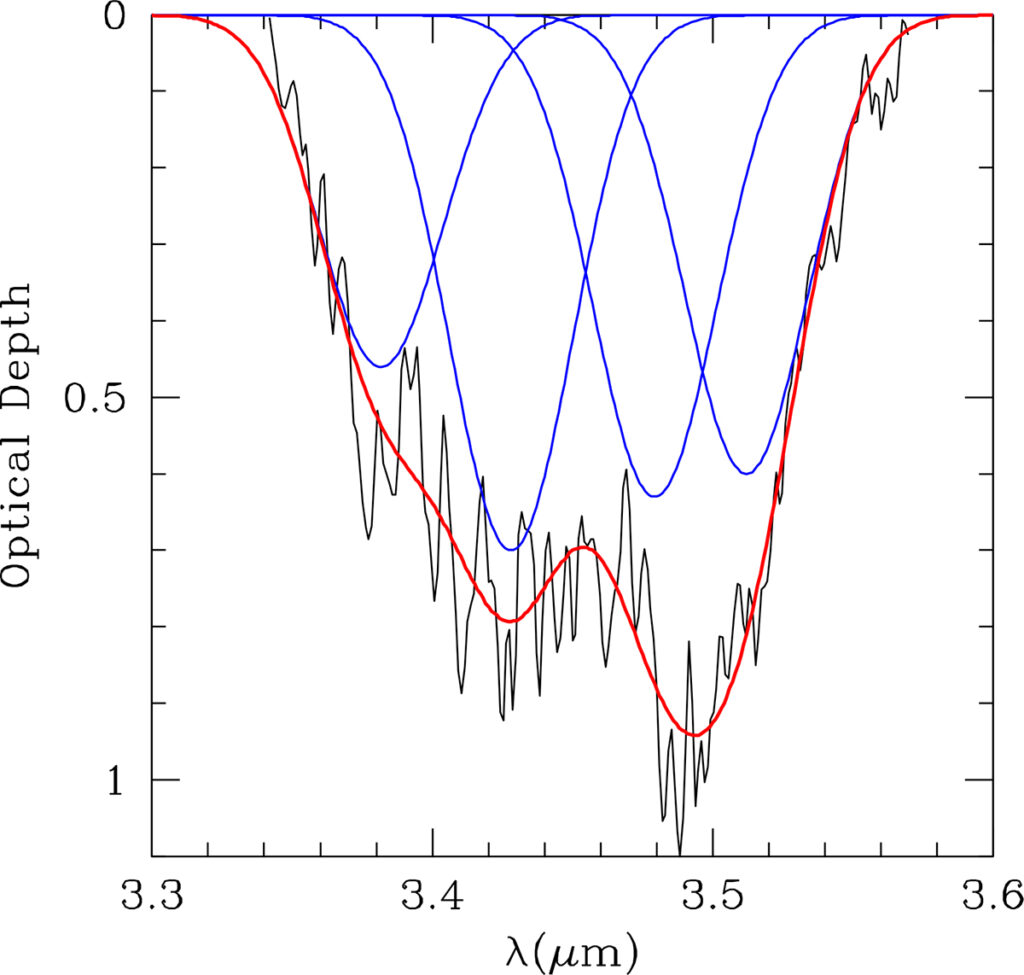
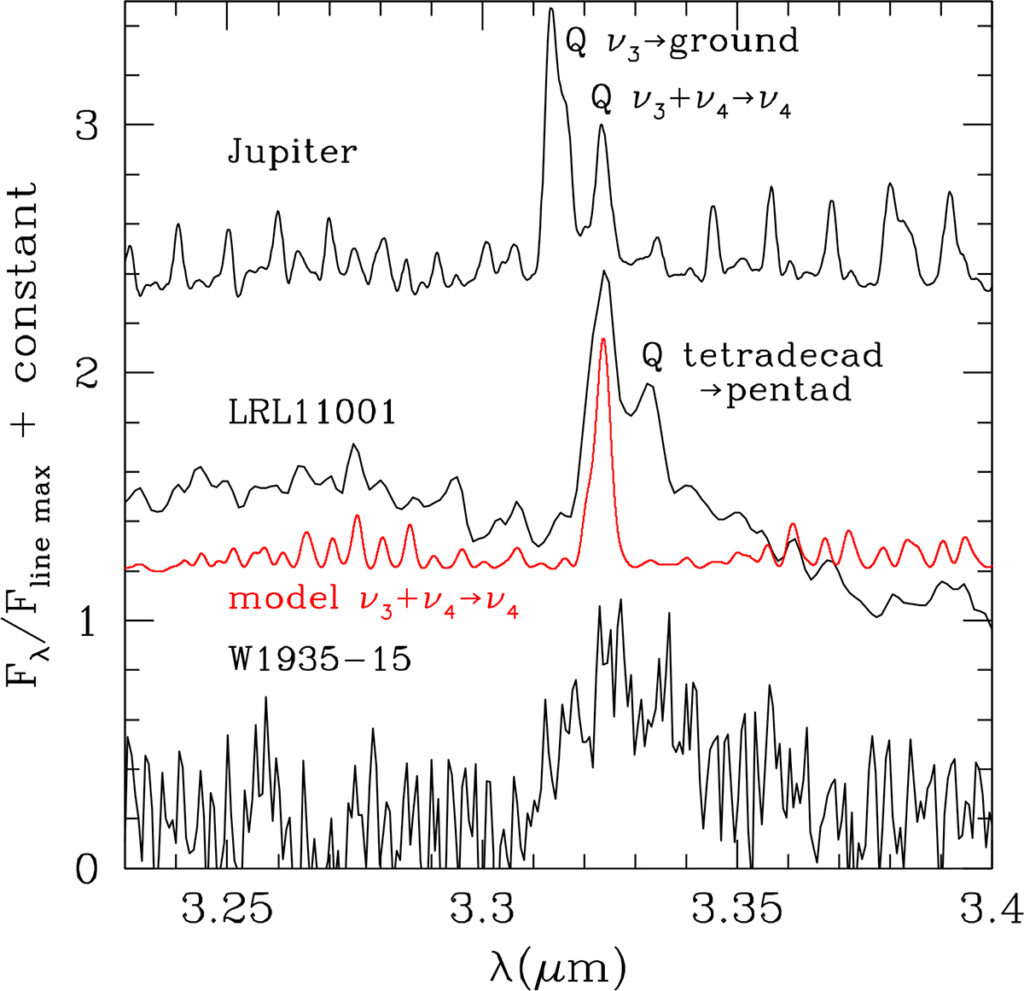
Webb’s new spectrum is roughly ten times sharper: its resolving power, a measure of how finely the light is split into colours, is about 1,000 compared with about 100 before, and it covers 1.7 to 5.1 micrometres. At that detail the 3.4 micrometre band separates into four overlapping components that match the stretching vibrations of the CH2 and CH3 groups found in alkanes. The fit points to a molecule at least as large as propane. Sitting on that absorption, though, are two narrow bright lines at 3.324 and 3.333 micrometres. They are methane, and they are in emission.
Emission lines carry a specific message. For methane to glow at these wavelengths against the brown dwarf’s own bright light, its molecules must either sit in a layer hotter than the one below, a temperature inversion, or be excited by radiation arriving from outside. The particular lines matter too. They are hot bands, transitions that begin from a molecule that is already vibrating, while the basic transition from the resting state is missing. That pattern implies an unusual population of excited molecules, and the authors argue it does not fit the methane glow previously traced to discs of gas around young stars and brown dwarfs.
There is one precedent: in 2024 a team led by Jacqueline Faherty, a co-author on the new paper, found methane emission from W1935, a far colder brown dwarf about 47 light-years away with no host star. Its upper atmosphere looked heated, and aurorae were the leading suspect, which was odd for a body with no star to supply a wind. LRL 11001 is a very different object. At about 1,500 to 1,600 kelvin (roughly 1,230°C to 1,330°C) it is around three times hotter than W1935, and it is young and still embedded in a crowded cluster. Two such unlike objects now show emission at the same pair of wavelengths, which makes the effect harder to dismiss as a quirk.
What drives the glow is still open. The authors list two candidates: heat from an accretion shock, where infalling material slams into the brown dwarf, or radiation from neighbouring cluster members exciting the methane directly. They do not choose between them and say modelling is needed. They favour an origin in the brown dwarf’s own atmosphere rather than a surrounding disc, partly because Webb sees no excess disc heat between one and five micrometres. A cooler disc glowing at longer wavelengths, which this spectrum does not reach, cannot yet be ruled out.
On the chemistry, the authors are more tentative still. They suggest that vertical mixing, the churning that carries gas up and down through the atmosphere, may suppress methane in the photosphere (the layer whose light we see) while building up larger alkanes, leaving methane to survive higher up where it can shine. They present this as speculation. External radiation could also break methane apart and assemble heavier hydrocarbons, but that would not explain why methane absorption is weaker in younger brown dwarfs in general.
A census comes next. Sharper spectra of other IC 348 brown dwarfs that show the 3.4 micrometre band, and observations beyond five micrometres to hunt for discs, should reveal whether the glow follows the radiation around each object or something inside it.
For now, a body six times the mass of Jupiter has packed two surprises into one narrow window of its spectrum. It holds a hydrocarbon no model expected. Above that, methane is shining where it should be casting a shadow.
