

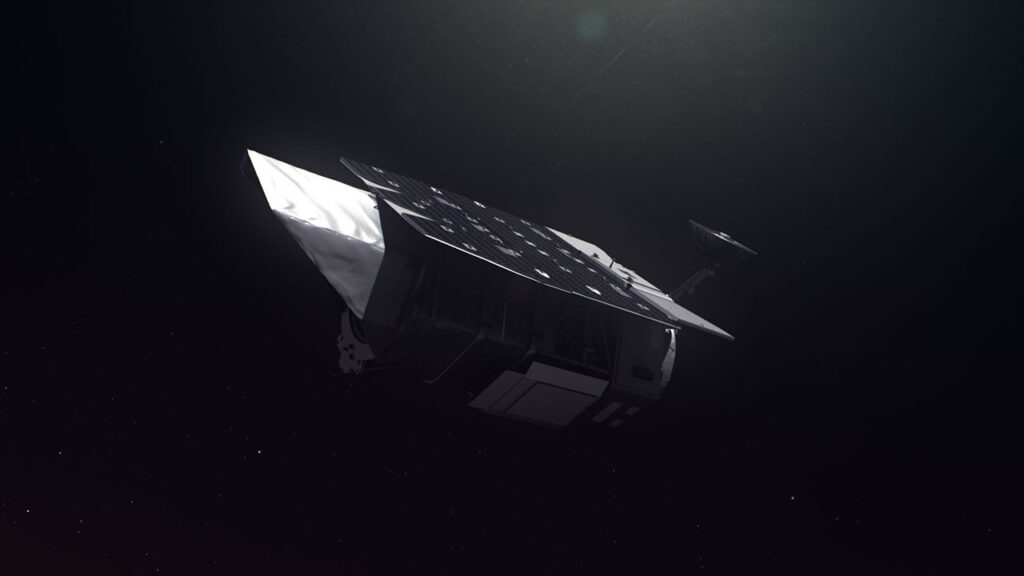
Building a space telescope is the expensive part. Proving that it works is the slow part, and NASA’s Nancy Grace Roman Space Telescope has now come far enough through that process to enter its last stage of commissioning, the months of testing that turn a functioning machine into a calibrated scientific instrument.
NASA announced on 22 October 2026 that Roman had moved into science commissioning after a full checkout of the observatory and its main camera. The telescope launched on 30 August. Since then it has shown that it can guide, take exposures, slew between targets and send its data home. “We’ve established that the observatory is fully functional,” said Julie McEnery, Roman’s senior project scientist.
That camera is the Wide Field Instrument, a 300-megapixel infrared imager built from 18 detectors. Roman’s mirror is 2.4 metres across, the same as Hubble’s, but its field of view is at least 100 times larger. Getting the focus right took a very small push: the team moved the secondary mirror by roughly a sixteenth of the width of a human hair. The camera’s optical error now sits at about 63 nanometres, against a requirement of about 90. Guiding in crowded star fields and dusty nebulae had worried the team. It passed.
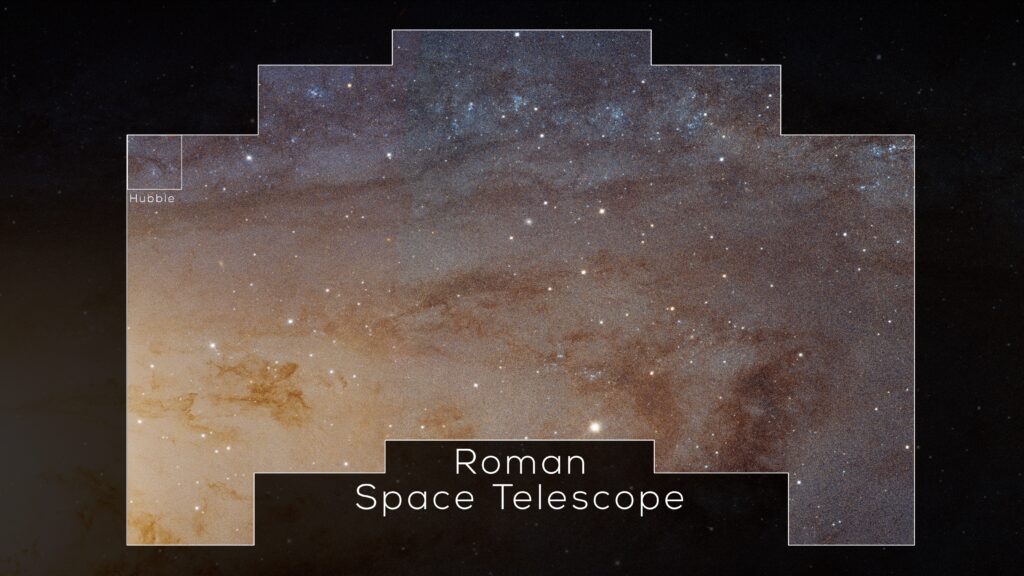
The point of all that sky is statistics. Over its mission, Roman should measure light from about a billion galaxies to study dark energy, and its survey of the inner Milky Way is expected to find more than 1,000 exoplanets through microlensing, the brief brightening of a background star when a foreground star and its planet bend its light. Hubble is already doing the groundwork. On the same day, NASA released a Hubble image of a gravitational lens, a galaxy about 4.5 billion light-years away bending the light of another almost twice as distant. Hubble studies such lenses one at a time; Roman should find them in bulk.
Commissioning is not finished. Image quality is still being refined, and Wide Field Instrument scientist Josh Schlieder has stressed that even tiny flaws could hide the faint signals the surveys are designed to catch. The coronagraph, which blocks starlight to reveal planets, has yet to show its light-blocking ability, and full science operations are expected by early 2027.
Hubble began its career famous for a flawed mirror. Roman’s headline so far is that its focus needed a nudge smaller than a hair. For a telescope built to measure faint distortions across a billion galaxies, that is exactly the right kind of dull news.
