

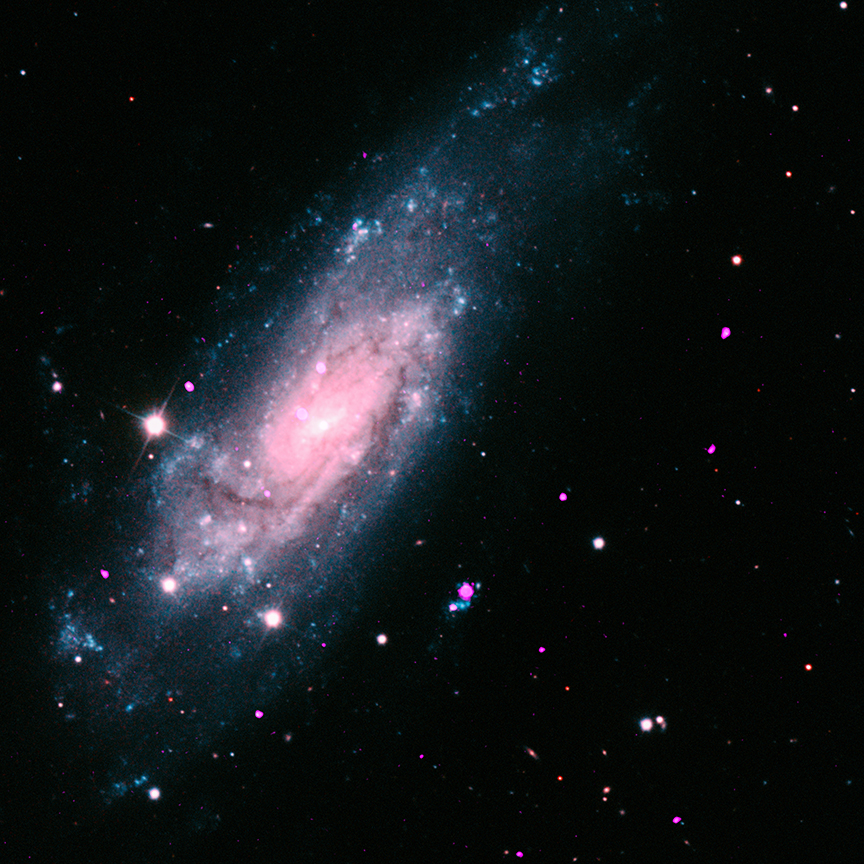
A star that seems to explode three times a year, every year, is an awkward thing to have in the catalogue. Since 2012 a massive star called AT 2016blu, in the spiral galaxy NGC 4559 about 30 million light-years away, has flared at least 27 times, each burst arriving roughly 113 days after the last. Astronomers class it as a supernova impostor: an object that brightens like a dying star and then carries on living. New X-ray observations now show what keeps setting it off. A hidden companion, either a black hole or a neutron star, is feeding on it.
Led by Mojgan Aghakhanloo of the University of Virginia, the work was published on 9 November 2026 in The Astrophysical Journal and announced the same day by NASA; a preprint version appeared in August. The optical record behind it is a patchwork. Professional telescopes, including the Katzman Automatic Imaging Telescope and the Las Cumbres Observatory network, shared the watch with more than 30 amateur astronomers reporting through the American Association of Variable Star Observers. That record let the team time a request for NASA’s Chandra X-ray Observatory to catch the March 2026 outburst. Chandra observed five times over a few days, for about 26 hours in all. No other X-ray telescope is sharp enough to separate AT 2016blu from a far brighter X-ray source sitting beside it in the same galaxy.
AT 2016blu itself is a luminous blue variable, a rare type of very massive, unstable star that sheds its outer layers in fits. The paper puts its mass at no less than about 33 times the Sun’s and its luminosity above roughly 500,000 Suns. The companion follows an oval orbit, and each close pass carries it through the dense gas the star has thrown off. Material it captures spirals inward and grows hot enough to shine in X-rays. Those X-rays in turn heat the surrounding gas, which glows in visible light. That glow is the outburst ground-based observers have been logging for years.
Its X-ray numbers are hard to explain any other way. Archival Chandra images from 2001 and 2002, taken a decade before the first recorded outburst, show nothing at the star’s position. In March 2026 the source was at least 100 times brighter, giving out about 100,000 times the Sun’s total power in X-rays alone. Eta Carinae, the best known luminous blue variable in our own galaxy, produces X-rays when its winds collide with those of a partner star, and at its peak it manages roughly 2,000 times less. Colliding winds cannot reach that output. Gas falling on to a compact object can.
That makes AT 2016blu the first impostor of its kind known to be powered by accretion, the infall of matter on to a dense object. In effect it is a high mass X-ray binary, a massive star paired with a black hole or neutron star, that happens to throw regular tantrums. Its closest known relative, SN 2010da, follows a similar pattern with a red supergiant as the donor. The result also links two puzzles. Ultraluminous X-ray sources (ULXs) are objects that shine brighter in X-rays than a stellar mass black hole should comfortably allow, and AT 2016blu sits just below the usual ULX threshold, so the team lists it as a candidate. Some massive stars also brighten erratically for years before they finally explode, and close partners of this kind may explain part of that behaviour.
The obvious gap is the companion’s identity. Chandra caught too few X-ray photons to search for pulsations, the steady ticking that would mark out a spinning neutron star. If it is a neutron star, it is shining well past its Eddington limit, the brightness at which outward radiation should choke off the inflow; the measured output matches that limit for an object of about 3.5 solar masses. Neutron stars have broken the limit before, so this settles nothing. The orbit has not yet been confirmed by measuring the star’s motion directly, and the short run of observations means the true X-ray peak may have slipped between them.
Deeper X-ray observations should help, and the authors suggest a tidy test. If the star contracts and its unstable phase ends, the X-rays should switch off. Until then AT 2016blu will keep its appointments. Its next flare is never more than about 113 days off, and this time astronomers know who is behind it.
