

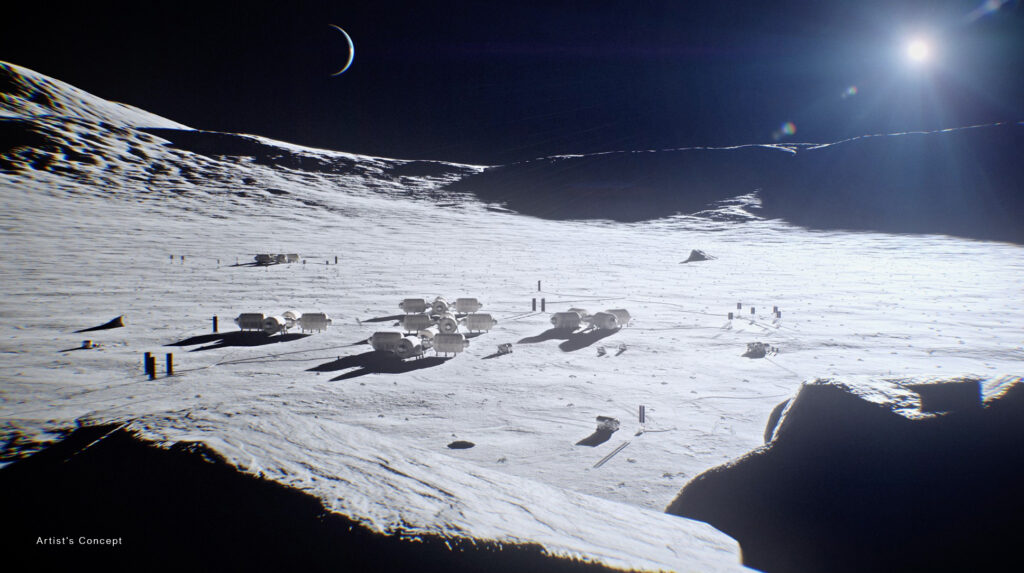
The Moon’s South Pole is where every lunar programme wants to go, and it is one of the worst places imaginable to run a machine on sunlight. The Sun skims the horizon, some crater floors have sat in shadow for billions of years, and each lunar night lasts about 14 Earth days. NASA’s answer, announced on 7 November 2026, is a nuclear-powered rover called PROMISE, assembled largely from hardware left over from its Mars programme.
NASA unveiled the rover at Kennedy Space Center in Florida, as one of several awards supporting Moon Base, its planned outpost at the lunar South Pole. PROMISE, short for Polar Rover for Observation, Mapping, and In-Situ Exploration, will be managed by the Jet Propulsion Laboratory (JPL), according to the agency’s announcement. Blue Origin won a $94 million base contract to carry it to the surface on its Mark 1 lander, with an option worth up to $140 million more depending on performance. Launch is targeted for late 2028, followed by an 18-month mission.
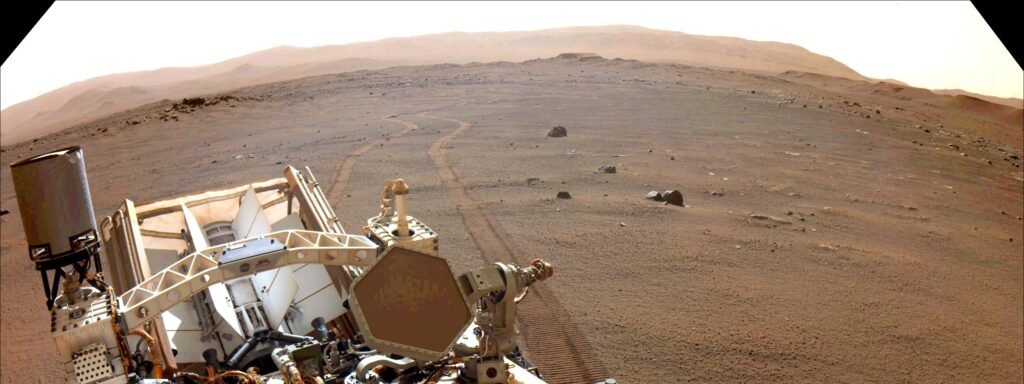
Much of the design leans on parts that have already been built and tested. JPL will put the six-wheeled rover together from spare flight components and engineering test models made for Curiosity and Perseverance, which NASA says lowers cost and shortens the schedule. A drill will pull up regolith, the loose rubble that blankets the lunar surface, from about 1 metre (3 feet) down. Spectrometers will read the chemistry of what comes up. Temperature and radiation sensors, visible-light cameras, NASA’s High Performance Spaceflight Computing processor and a set of autonomy sensors and algorithms complete the payload.
Power is the real story. NASA says only that PROMISE is nuclear-powered and able to keep working through the lunar night and inside permanently shadowed regions, the crater floors that sunlight never reaches and where water ice may survive. It has not said which power source the rover will carry. The Mars rovers that donated the spares each run on a Multi-Mission Radioisotope Thermoelectric Generator, which turns heat from decaying plutonium-238 into about 110 watts of electricity at the start of a mission, according to JPL’s Perseverance press kit. That is modest. It is also steady, and it does not care whether the Sun is up.
The contrast with NASA’s previous polar prospector is sharp. VIPER, a solar-powered rover, was planned for a mission of about 100 Earth days spanning three lunar days, and it carried the first headlights fitted to a lunar rover so it could drive into shadowed craters (NASA’s mission overview has the details). Sunlight set the clock for everything it did. An 18-month mission, by comparison, would run through more than a dozen cycles of lunar day and night, and a rover with its own heat could stay inside a cold trap rather than make brief raids on one.
Behind the rover sits a much longer shopping list. NASA chose eight companies, among them Blue Origin, Firefly Aerospace, Intuitive Machines, Lockheed Martin Space and SpaceX, for CLPS 2, the next round of its Commercial Lunar Payload Services deliveries, under a 10-year contract with a combined ceiling of $10 billion. It raised the ceiling on the original CLPS contract from $2.6 billion to $4.2 billion and issued six launch and transport task orders worth about $1.3 billion, which include the CAPSTONE 02 navigation test and flights for JPL’s MoonFall scouting drones. SpaceX will also launch communications satellites on Starship in 2028 to cislunar space, the region between Earth and the Moon.
The catch is the calendar. A contract ceiling is a limit, not a budget, and $10 billion guarantees no particular number of landings. VIPER shows how lunar schedules tend to behave: planned for late 2023, it slipped to late 2024 and then to a readiness date of September 2025 before NASA ended the project in July 2024, citing cost increases, delays and the risk of further cost growth. Reusing Mars hardware saves time, but pairing it with a nuclear power source, a new drill and a commercial lander is still new engineering, and late 2028 is barely two years away.
None of that makes the idea less sound. VIPER was built to visit the dark and hurry back to the light. PROMISE is being built to stay there, warmed by a small and patient source of heat that keeps going long after sunset.
