

Liquid water does not last long on the surface of Mars. The air is too thin for an exposed puddle to survive, which is why the search for life there today has moved underground, into pockets of salty water that might sit sealed inside ice and salt. A new experiment asks a narrower and more practical question: if such a Martian brine exists, could anything actually live in it? For one salt-loving microbe, kept for 160 days in a chamber built to imitate those conditions, the answer appears to be a cautious yes.
The study, led by Adam Robinson at the University of Florida’s Space Life Sciences Lab, was published on 5 November 2026 in Applied and Environmental Microbiology. Its subject is Haloferax volcanii, an archaeon (a single-celled organism from a branch of life separate from bacteria) that thrives in brines that would kill most cells. Colleagues from St. Petersburg College, the Natural History Museum of Los Angeles County and the Blue Marble Space Institute of Science joined the work, which first appeared as a preprint earlier this year.
Inside a vacuum chamber held at 24 millibars, filled with carbon dioxide and scrubbed of oxygen, the team kept its cultures at a steady 21°C. Each brine carried 225 grams of salt per litre. With no oxygen to breathe, the microbes were offered two substitutes: nitrate, and perchlorate, a reactive salt already known from Martian soil. Cells can use either one in place of oxygen to burn their food. Cultures given neither did not grow. Those given nitrate or perchlorate did, and the chemistry backs that up. Nitrate levels fell by about 15 to 29% and perchlorate by about 16 to 29%, while cell-free controls showed no such drop.
Three other results make the case stronger. The brine barely evaporated, losing less than 4% of its volume over more than five months, which is what made such a long run possible at low pressure. Electron microscope images of the growing cultures showed cells bound together in a slimy matrix resembling a biofilm, the sort of shared coating microbes build to protect themselves. The team also looked for carotenoids, the pigments these cells make, which have been proposed as a biosignature (a chemical trace that life leaves behind). Raman spectroscopy, which identifies molecules by the way they scatter laser light, still found them, though the signal was weaker than in cultures fed on oxygen.
That last detail has a twist. Under Martian pressure, cultures living on nitrate kept stronger pigment signals than those living on perchlorate. The authors suggest that chlorite, a harsh byproduct of breaking perchlorate down, may damage the pigments. If that holds, a microbe could survive on perchlorate while slowly erasing the very evidence a rover would hope to find.
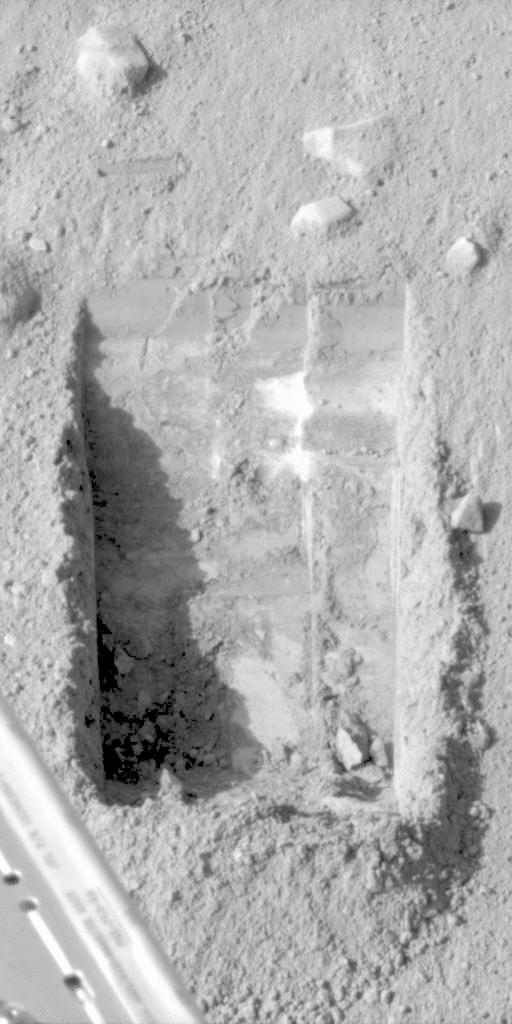
Testing several Martian stresses at once, rather than one at a time, is what gives the work its weight. Plenty of microbes tolerate salt, and some tolerate perchlorate, but low pressure, heavy salt, no oxygen and oxidising chemistry together are a much harder combination. The authors say no salt-loving archaeon had previously been shown to grow actively under that full set. Mars supplies the raw ingredients. NASA’s Phoenix lander, which dug into the Martian arctic in 2008, found water ice 5 to 15 cm below the soil and showed that most of the soluble chlorine at its site was perchlorate. Salts like these lower the freezing point of water, so a shallow pocket sealed in salt or ice is a reasonable place for a brine to persist.
The catch is that the chamber was kinder than Mars. Curiosity’s weather station recorded surface pressures of about 6.9 to 7.8 millibars at its landing site, so 24 millibars is roughly three times the real thing. The team chose that figure to represent brine trapped below ground, an environment that has been proposed but never observed. The cultures also sat at room temperature, with no freeze and thaw cycles and no radiation, and fed on a nutrient broth far richer than anything Martian soil is likely to offer. Growth was significantly slower than in identical cultures at Earth pressure. Because opening the chamber would have let oxygen in, each culture could only be measured at the start and the end.
There is a practical lesson for sample return too. The authors point out that liquids handled at low pressure can break up into fine aerosols, so any attempt to grow living material from Mars on Earth would need containment comparable to the highest biosafety levels. It is a sensible warning for a field that hopes, one day, to need it.
None of this shows that anything lives on Mars, and the authors say so plainly. What it does show is narrower and more useful. A cell from Earth can keep a slow metabolism going in thin carbon dioxide, heavy salt and perchlorate, and still leave behind pigments that an instrument could detect. If anything does live on Mars today, the place to look may be no grander than a sealed bead of brine a few centimetres below the dust.
