

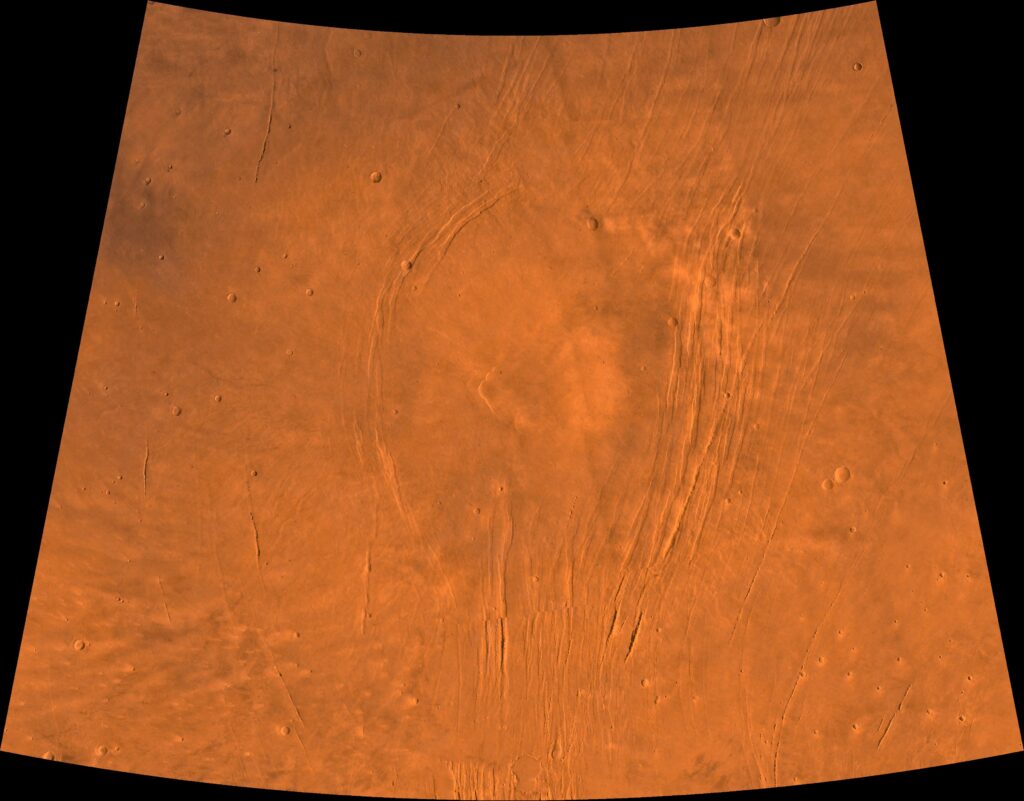
Mars looks like a planet that finished its geological life long ago. Its giant volcanoes are cold, its plains are pocked by billions of years of impacts, and no spacecraft has ever caught lava on the move. Yet a faint trace of hydrogen chloride, a gas that on Earth leaks from magma, keeps turning up above the same cracked ground on Alba Mons, a shield volcano more than 1,000 km across. A new study reads it as a sign of magma still at work below the surface, and as the latest hint of volcanic activity on Mars in the recent past or even today.
The work, published on 4 November 2026 in Science Advances, draws on ESA’s ExoMars Trace Gas Orbiter (TGO). A team led by Alexander Trokhimovskiy, with Daniel Mège of the Space Research Centre of the Polish Academy of Sciences as co-lead author, used the orbiter’s Atmospheric Chemistry Suite, a set of infrared spectrometers that identify gases by the wavelengths of light they absorb. They found hydrogen chloride (HCl) above volcanic fissures on the northern flanks of Alba Mons, at a season when the gas should be all but absent.
Those amounts are tiny. ESA’s account of the study puts the concentration at about two parts per billion by volume, roughly two HCl molecules for every billion molecules of air, in an atmosphere that is 95% carbon dioxide. What makes the signal stand out is its timing and place. Across most of Mars, HCl peaks in northern winter and largely disappears in summer. Above Alba Mons it shows up in early northern summer, and it returns to the same spot in the same season.
Images help explain why. The orbiter’s CaSSIS camera found fresh, narrow fissures on the volcano’s flanks, some hundreds of metres long, with discoloured ground beside them. One CaSSIS frame from 3 February 2023, covering about 20 km by 20 km, shows white spots that may be mineral deposits around vents, much like the crusts that build up around fumaroles on Earth. The proposed mechanism is seasonal: in winter, when temperatures drop to around -120°C, ice seals the cracks, and ice particles readily absorb HCl. When that ice turns straight to vapour in early summer, the trapped gas escapes.
The result is a small reversal. When TGO first detected HCl on Mars, in work published in 2021, the instrument team argued against a volcanic source. The gas appeared at widely separated places at once, rose and fell with the dusty season, and arrived without other volcanic gases, so they tied it to salty dust reacting with water vapour. The Alba Mons signal breaks that pattern: it is local, it repeats, and it sits on top of the kind of cracks that rising magma produces. Mège notes that HCl is mainly a magmatic gas and is almost absent from hydrothermal systems, which makes it a useful marker for molten rock at depth.
It also fits what geologists already suspected. Crater counts from Mars Express images suggest that small vents on the Tharsis volcanoes may have produced lava as recently as about 2 million years ago, and that the region has been active in episodes over billions of years. A volcano that has been quiet for a few million years is not necessarily finished. Mège puts it plainly in ESA’s release: the findings suggest “Mars has retained enough internal heat to support volcanic activity until recently”.
The catch is that nobody has seen anything erupt. No fresh lava flows have been found, the signal amounts to a few molecules in a billion, and Mège writes that the first observations over Alba Mons were inconclusive because data were limited. The team weighed the chemical routes that could produce HCl in the atmosphere and judged magma seepage the most likely, which is a ranking rather than a proof. Volcanic quiet spells can also last tens of thousands of years, far longer than any laboratory experiment can reproduce.
Any link to life needs the same care. Hydrothermal systems, where magma heats groundwater, may have helped life begin on Earth, and active fissures at Alba Mons would be an obvious place to search. But HCl itself, as Mège points out, is better at destroying life than sustaining it. A hydrothermal system does not have to be inhabited.
For now the evidence is a whiff, not a plume. Still, a planet that breathes out a little acid gas each summer through cracks in one of its largest volcanoes is not quite the frozen relic it appears to be. What comes next is patient watching: more seasons, more passes overhead, and a closer look at those pale spots on the ground.
