

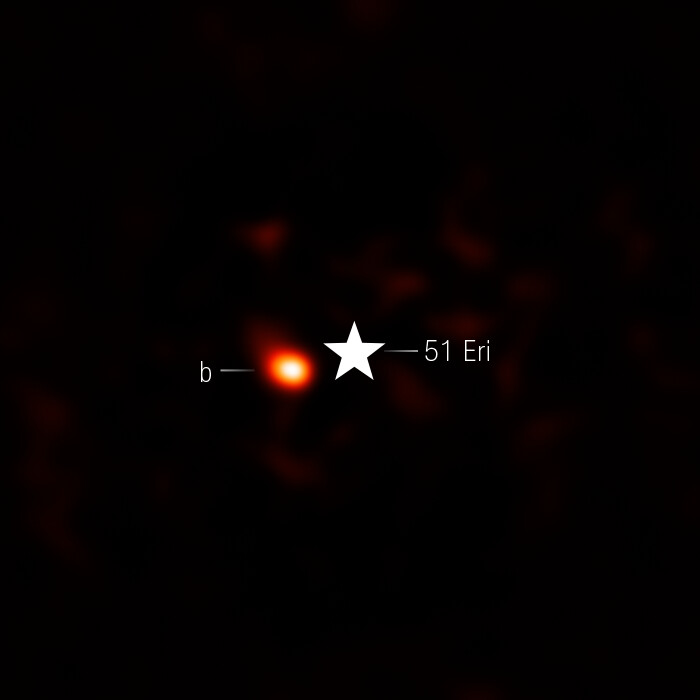
A planet beside its star is a faint ember next to a furnace. Young giant planets, the easiest kind to photograph, can be around 100,000 times fainter than their stars, and older, cooler worlds are dimmer still. Even the James Webb Space Telescope (JWST), with a coronagraph (a mask that blocks the central starlight), is left with a smear of residual glare that changes as the telescope shifts by tiny amounts. A new technique tackles that glare with software instead of hardware, and it has already pulled one of the hidden exoplanets in Webb’s data into view.
The method, called FLIP (Physics-based Learning for Imaging Planets), was published in Nature on 4 November 2026. Rodrigo Ferrer-Chavez, a graduate student at Northwestern University, led the work with Jason Wang of Northwestern and Katie Bouman of the California Institute of Technology (Caltech), who specialises in computational imaging. Co-authors from the Massachusetts Institute of Technology and the Space Telescope Science Institute, which runs Webb’s science operations, complete the team.
Conventional glare removal is pragmatic. Astronomers observe a second, similar star, then subtract its image from the target’s and hope the leftover light patterns match. They rarely match perfectly. Webb’s optics hold steady to around a nanometre (a billionth of a metre), which is extraordinary engineering and still not quite enough: small shifts between the two observations alter the pattern of scattered light, and the subtraction leaves residue that can bury a faint planet.
FLIP takes a different route. Rather than borrowing another star’s glare, it calculates the target’s own. The team built a digital twin of Webb’s Near Infrared Camera (NIRCam), a model that follows light through the telescope’s mirrors and coronagraph to the detector. They then let the model adjust millions of parameters describing small misalignments and optical distortions until its simulated starlight matched the real image, and subtracted the result. The fitting uses optimisation tools developed for training artificial intelligence, but no AI picks out the planets. What survives the subtraction is whatever the physics model of the star cannot explain.
The team tested FLIP on existing Webb observations of three stars: HIP 65426 and 51 Eridani, both with known planets, and TYC 5899, which has none. Across all the data it improved sensitivity to faint planets by two to 15 times compared with conventional methods. The most striking case is 51 Eridani b, a young gas giant about 97 light-years away that orbits roughly as far from its star as Saturn does from the Sun. In two-year-old Webb images taken at a wavelength of 4.3 microns, standard processing found nothing at the planet’s expected position. FLIP recovered it as a significant detection, in the place and with the shape a simulation predicted.
That wavelength was hard for a reason. Carbon dioxide in the planet’s atmosphere absorbs light at 4.3 microns, so the planet is dimmer there than at neighbouring wavelengths. Yet those dips are exactly what reveal a planet’s chemistry. Webb had already found carbon dioxide in 51 Eridani b in 2025, evidence that it built a solid core before gathering gas, much as Jupiter and Saturn are thought to have done. Seeing the planet inside its own absorption band means its light can be sampled across more of the wavelengths that carry that chemical story.
Archives matter here. Because FLIP works after the observation, coronagraphic images Webb has already taken become candidates for reprocessing, and the team says the approach is not limited to Webb. They plan to apply it to NASA’s Nancy Grace Roman Space Telescope and to telescopes on the ground. The larger prize is the proposed Habitable Worlds Observatory, designed to search for signs of life on planets around other stars. Ferrer-Chavez describes that task as imaging something “around 10 billion times fainter than something right next to it.” Its optics would need to be roughly 100 to 1,000 times more stable than Webb’s. A model that corrects for instability, rather than requiring it to be engineered away entirely, could ease one of the hardest demands on that design.
The catch is that FLIP has so far proved itself on planets astronomers already knew were there. Recovering a known world is a fair test of a method, but announcing a new one is a harder claim, because any optical quirk the model fails to capture could leave a speckle of light that mimics a planet. The approach also depends on how faithfully the digital twin reproduces the real instrument, and building comparable models for other telescopes will take work. Three stars is a small sample. The method’s real record will be written as it is run across many more.
Still, the idea has a pleasing economy. For decades the answer to starlight has been better hardware: sharper mirrors, steadier structures, cleverer masks. FLIP suggests that part of the next gain may come from understanding the telescope already in orbit. Some faint worlds may be sitting in Webb’s archive now, waiting only for a better description of the instrument that recorded them.
