

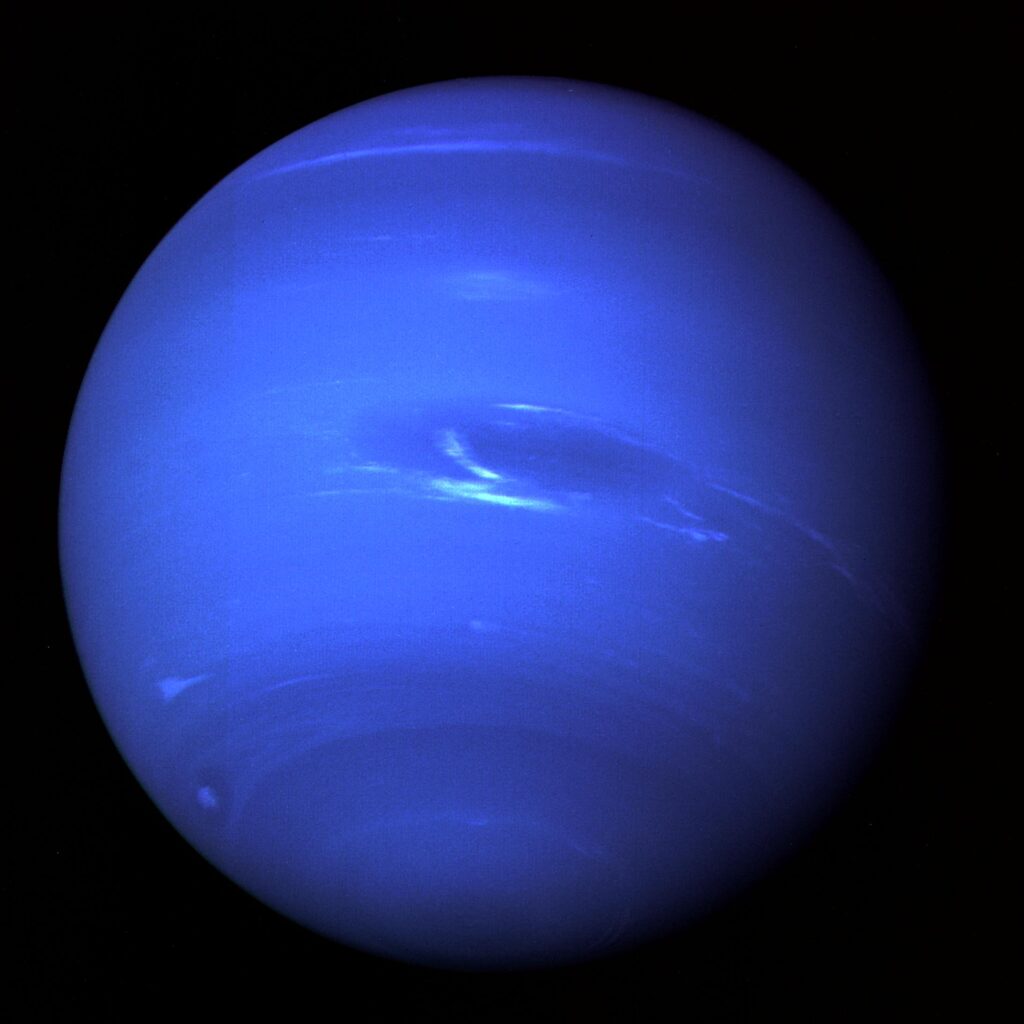
Every magnetic map of Uranus and Neptune in the textbooks comes from a single pass. Voyager 2 flew by each planet once, more than 30 years ago, sampled their magnetic fields on the way through and kept going. Those snapshots revealed the strangest fields in the Solar System. A new study argues that these ice giant magnetic fields may no longer look the way Voyager 2 found them, and could have swung by tens of degrees since anyone last checked.
The work, published on 3 November 2026 in Communications Physics by a six person team including Chi Yan, Krista Soderlund and Henrik Melin of Northumbria University, uses computer models of the planets’ interiors to reproduce the fields Voyager 2 measured. The researchers did not add an exotic new ingredient. They changed one assumption: how well the deep interior conducts electricity, and how that ability changes with depth.
Some context helps explain why the fields needed explaining at all. At most planets, including Earth, a simple two pole field like a bar magnet’s carries between 74 and 98 per cent of the magnetic energy at the surface. At the ice giants it carries about 12 per cent. The rest is spread across a lumpy patchwork of extra poles. Uranus adds a further twist: according to NASA, its magnetic axis is tilted nearly 60 degrees from its spin axis, and the field’s centre sits a third of a planetary radius away from the planet’s middle.
Planetary magnetic fields come from dynamos, in which churning, electrically conducting fluid generates and sustains a field. Inside Uranus and Neptune that fluid is thought to be a deep, water rich layer. At pressures of roughly 30 to 50 gigapascals, around 300,000 to 500,000 times the air pressure at sea level, water becomes ionic: its molecules break into charged fragments that can carry a current. The team compared models with uniform conductivity against models where conductivity falls away towards the top of the dynamo layer. Uniform conductivity produced tidy, Earth-like fields dominated by two poles. Letting conductivity vary broke the field into many poles that reversed at irregular intervals, and the best matches for both planets came from relatively thin dynamo shells.
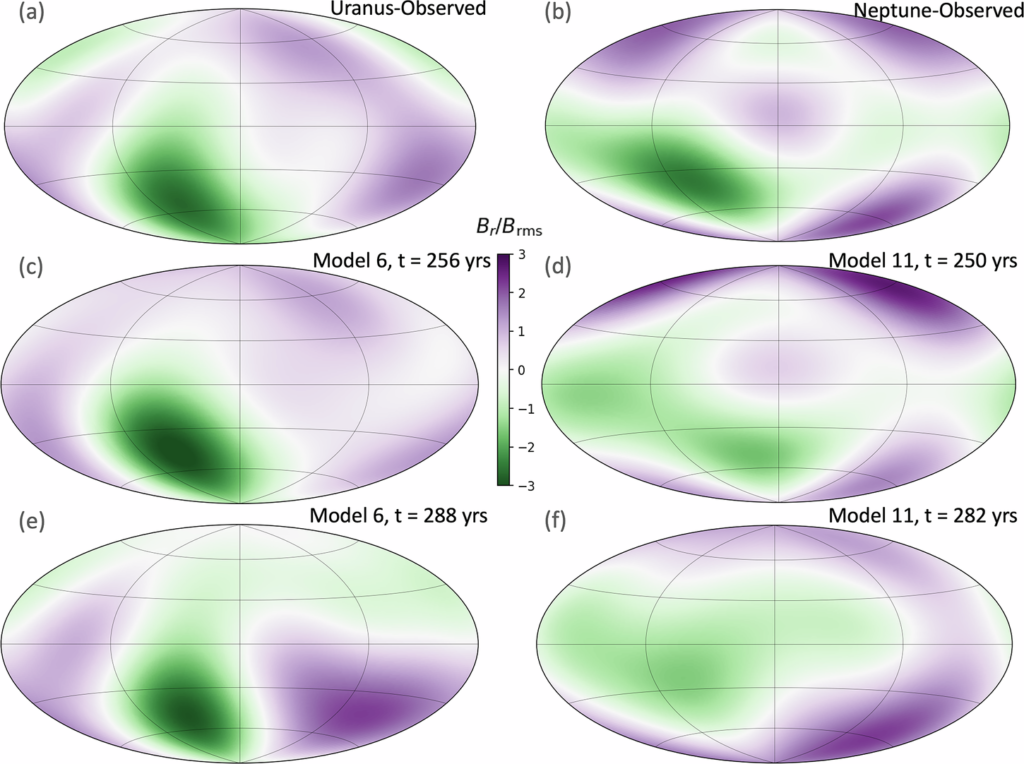
The more surprising result concerns time. Fields like these do not sit still. In one simulated Uranus the tilt of the main magnetic axis drifted by about 13 degrees over 40 years; in another it lurched by about 84 degrees. Neptune-like runs showed changes of about 11 degrees in one model and 26 to 56 degrees in several intervals of another. Forty years is roughly the gap between Voyager 2’s visits and today.
That matters because astronomers lean on the old maps. Auroras on both planets, traced through the infrared glow of a charged form of hydrogen, are interpreted using the Voyager era field, and so is one method of estimating how long a day lasts on Uranus. The authors point out that Neptune’s aurora appears to have moved by about 30 degrees between 1989 and 2023, which a changing field could partly explain. A shifting field would also alter how the planets’ magnetic bubbles meet the solar wind and how they interact with their moons, effects the authors say future missions to both planets should plan for.
The catch is that these are simulations, and simulations of planetary dynamos run far from real conditions. No computer can yet model the interior fluid as runny as it really is relative to the planet’s rapid spin, so the team relies on scaling arguments and a single test at more realistic settings. The quiet, slowly changing intervals in the models are temporary, and no single model is uniquely favoured; for Neptune, the ranking depends on which reconstruction of the Voyager 2 data is used. Even a steady field would be informative. In one test, raising the bulk conductivity tenfold kept the Uranus-like tilt within five degrees over about 500 years, which would point to a hotter or more conductive interior than assumed.
Either outcome needs a second measurement. Voyager 2 caught one frame of a long film, and the planets have kept rolling since.
Whichever spacecraft returns to Uranus or Neptune will not just be mapping a field. It will be measuring the difference between two frames, and that difference may say more about the hidden layer of charged water than either picture alone.
