

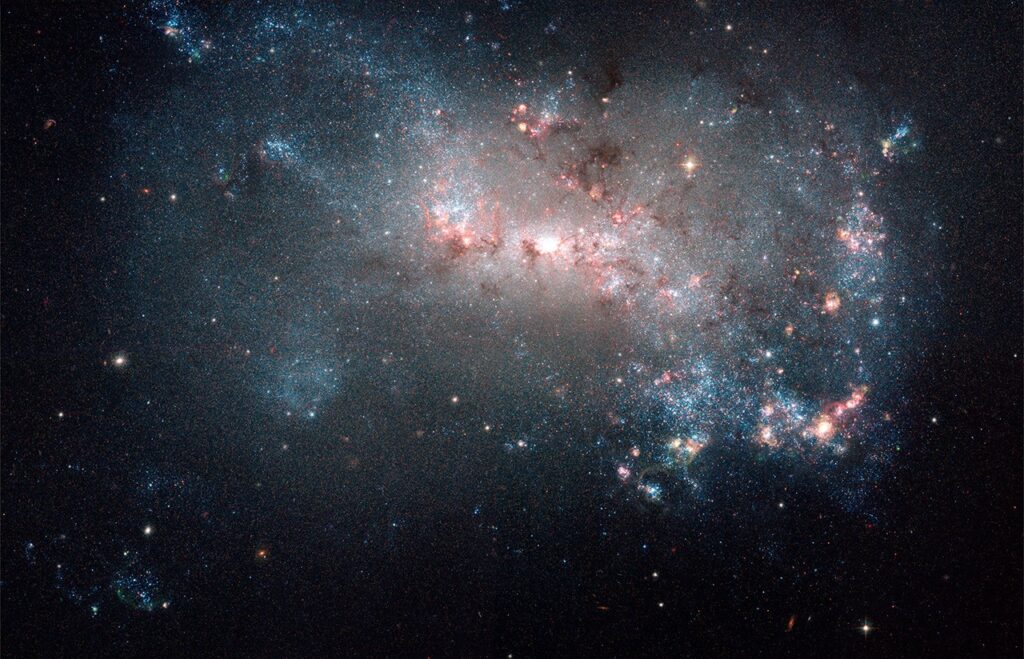
Every star that ends its life as a supernova leaves behind a small donation of oxygen, the most common element in the universe after hydrogen and helium. Over billions of years those donations should add up, enriching the gas from which new stars and planets form. In dwarf galaxies, most of the gift goes missing. A census of 37 nearby dwarf galaxies has found that they hold on to only about 11% of the oxygen their stars have ever made, far less than the leading computer models of galaxy formation predict.
The result comes from Galaxies Losing Oxygen via Winds, a project known as GLOW led by Kristen McQuinn of the Space Telescope Science Institute and Rutgers University, with Grace Telford of the University of Utah as a co-investigator. The team’s paper in The Astrophysical Journal was published on 2 November 2026, alongside a NASA release. All 37 galaxies lie within about 20 million light-years of the Milky Way. Their stars add up to between roughly three million and three billion times the mass of the Sun, which is the range where theory expects supernova winds to start beating gravity.
Measuring missing oxygen means first working out how much there should be. These galaxies are close enough for the Hubble Space Telescope to pick out individual stars, so the team could rebuild each one’s star formation history from archival images. Infrared light recorded by the retired Spitzer Space Telescope gave the total mass in stars, and known oxygen yields for stars of each type turned that into an expected oxygen total. Then came the inventory. Radio maps from the Very Large Array and the Australia Telescope Compact Array traced each galaxy’s hydrogen gas, while clouds of glowing, ionised gas around young stars revealed how much oxygen that gas carries. Stars and dust grains were counted too.
Across the sample, retention ranged from 4% to 25%, and 29 of the 37 galaxies kept 15% or less. Almost all of what remains sits in the gas; the stars themselves typically hold around 1% of the oxygen ever produced, and dust holds less still. The same accounting gives the Andromeda galaxy, with about 100 billion solar masses of stars, a retention of roughly 38%. Small galaxies leak. Big ones leak less.
The likely culprit is the energy released by massive stars and supernovae, which can drive winds of hot gas out of a galaxy whose gravity is too weak to hold it. As Telford puts it, “you need energy from massive stars and supernova explosions to drive material out.” The awkward part is that simulations already include such winds. They reproduce the observed link between a galaxy’s mass and its metal content, known as the mass to metallicity relation, yet they predict far more oxygen left behind than GLOW finds. Matching one measurement while missing the other suggests the balance of inflow and outflow in the models is off. The team’s simple models point to winds that carry away more mass, or more enriched gas, than assumed, and to dwarfs that draw in less fresh gas from intergalactic space.
That matters beyond the dwarfs themselves. Large galaxies such as the Milky Way grew partly by absorbing smaller ones, so any error in how dwarfs handle their heavy elements carries upwards into models of how bigger galaxies became enriched. Oxygen is a good tracer precisely because its production in stars is well understood, which leaves fewer places for the discrepancy to hide.
The bigger puzzle is where the oxygen went. Ultraviolet measurements of highly ionised oxygen around similar galaxies suggest their surrounding halo of thin gas, the circumgalactic medium, holds only 1% to 7% of what was produced, perhaps 5% to 35% once corrections for unseen forms are made. Most of it is still unaccounted for, either spread through a halo too faint to measure or lost to intergalactic space for good. The census has soft spots of its own. It leaves out molecular gas, ignores hydrogen far beyond the main disc and depends on assumed stellar yields; a higher yield would push retention down by about four percentage points on average. A hint that galaxies in crowded neighbourhoods keep more oxygen is, by the authors’ own account, tentative.
Fainter targets come next. McQuinn plans to use the Nancy Grace Roman Space Telescope, which has an approved programme, to find smaller and dimmer galaxies, then study their stars in detail with Hubble and the James Webb Space Telescope (JWST). Telford will use Hubble to examine the massive stars that make and expel oxygen in some of the nearby GLOW targets. A preprint of the study sets out the full oxygen budget for each galaxy.
Every breath taken on Earth contains oxygen forged inside stars. In the smallest galaxies, close to nine tenths of that oxygen has simply left the building, and astronomers have yet to find its forwarding address.
