

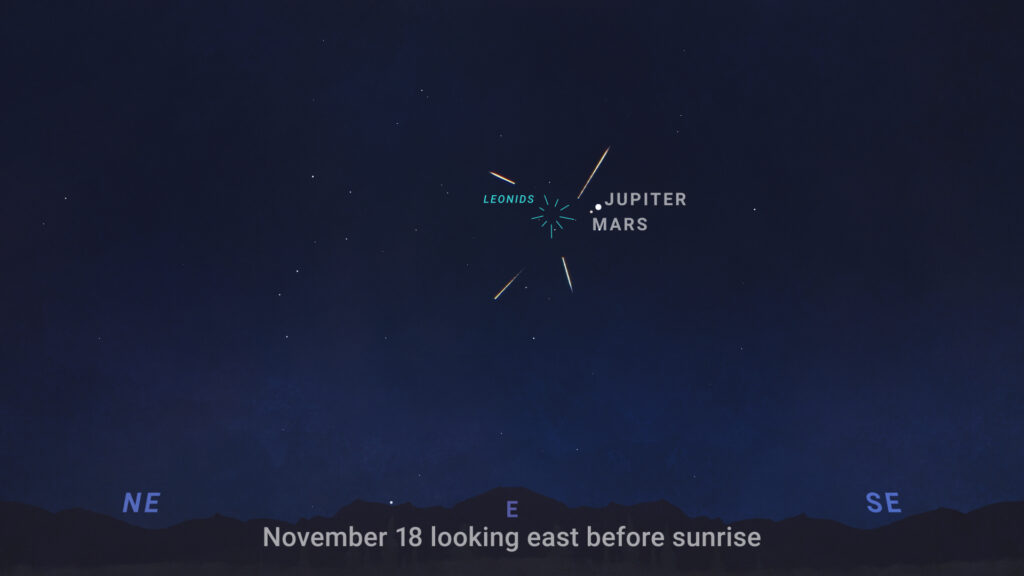
The best of the November night sky arrives before breakfast. Between now and the third week of the month, two slow Taurid showers, the much faster Leonids and a close pairing of Mars and Jupiter all play out in the dark hours before dawn. The Moon, for once, stays largely out of the way. NASA’s November skywatching guide sets out the dates, and the International Meteor Organization’s 2026 calendar supplies the finer detail.
First come the Taurids, debris shed by Comet 2P/Encke. The southern branch peaks around 5 November and the northern around 12 November, and NASA expects about five meteors an hour from each under ideal skies. That is not many. The appeal lies in the occasional fireball, and in the pace: Taurid grains strike the air at only 27 to 29 km per second, slow by meteor standards. The new Moon on 9 November leaves both peaks in properly dark skies.
The Leonids follow. Their parent, Comet 55P/Tempel-Tuttle, leaves grit that meets Earth head on at about 71 km per second, among the fastest of any annual shower. The organisation places this year’s peak at about 23:45 UT on 17 November, with a zenithal hourly rate (the count a single observer would log under a perfectly dark sky with the radiant overhead) of around 15. NASA suggests watching in the early hours of 17 and 18 November, once the first quarter Moon has set.
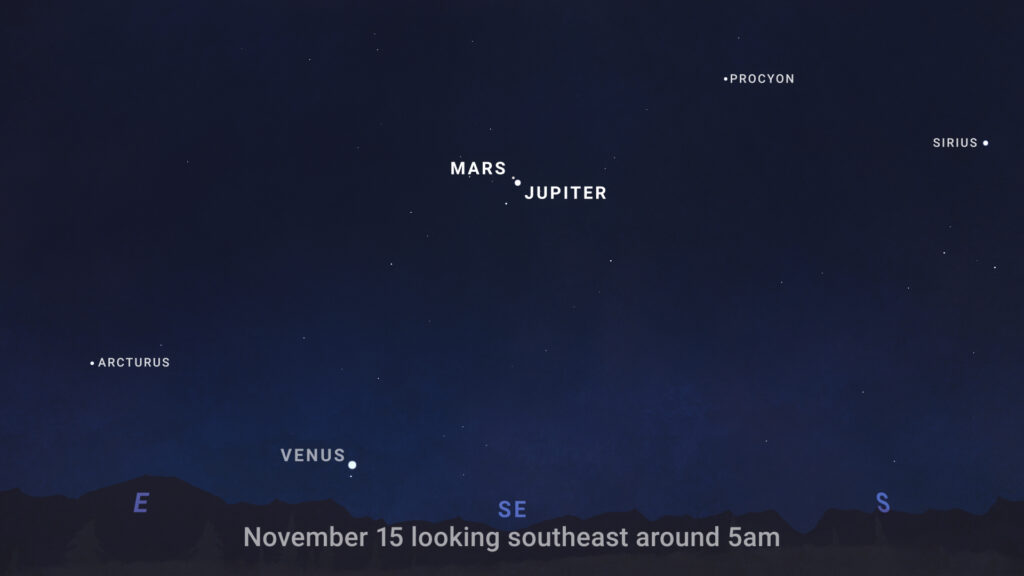
A few mornings earlier, the planets put on the month’s easiest show. On 15 and 16 November, Mars and Jupiter sit about 1.2 degrees apart in the south-eastern sky before sunrise, slightly more than the width of two full Moons side by side. Jupiter is the brighter of the pair; Mars is the reddish point beside it. Both lie in Leo, the constellation that gives the Leonids their name, so anyone out for the meteors gets the planets thrown in.
None of this will rival the great Leonid storms. Those come when Earth ploughs through fresh dust trails soon after the comet rounds the Sun, and Tempel-Tuttle’s next perihelion is not until 20 May 2031. The planetary pairing is also a trick of perspective. The two worlds are hundreds of millions of kilometres apart and simply line up from where we stand. British weather, as ever, keeps the casting vote.
Still, few mornings offer a red planet, a giant one and comet grit burning up at 71 km per second in the same patch of sky. Set an alarm, dress warmly and give your eyes half an hour to adjust.
