

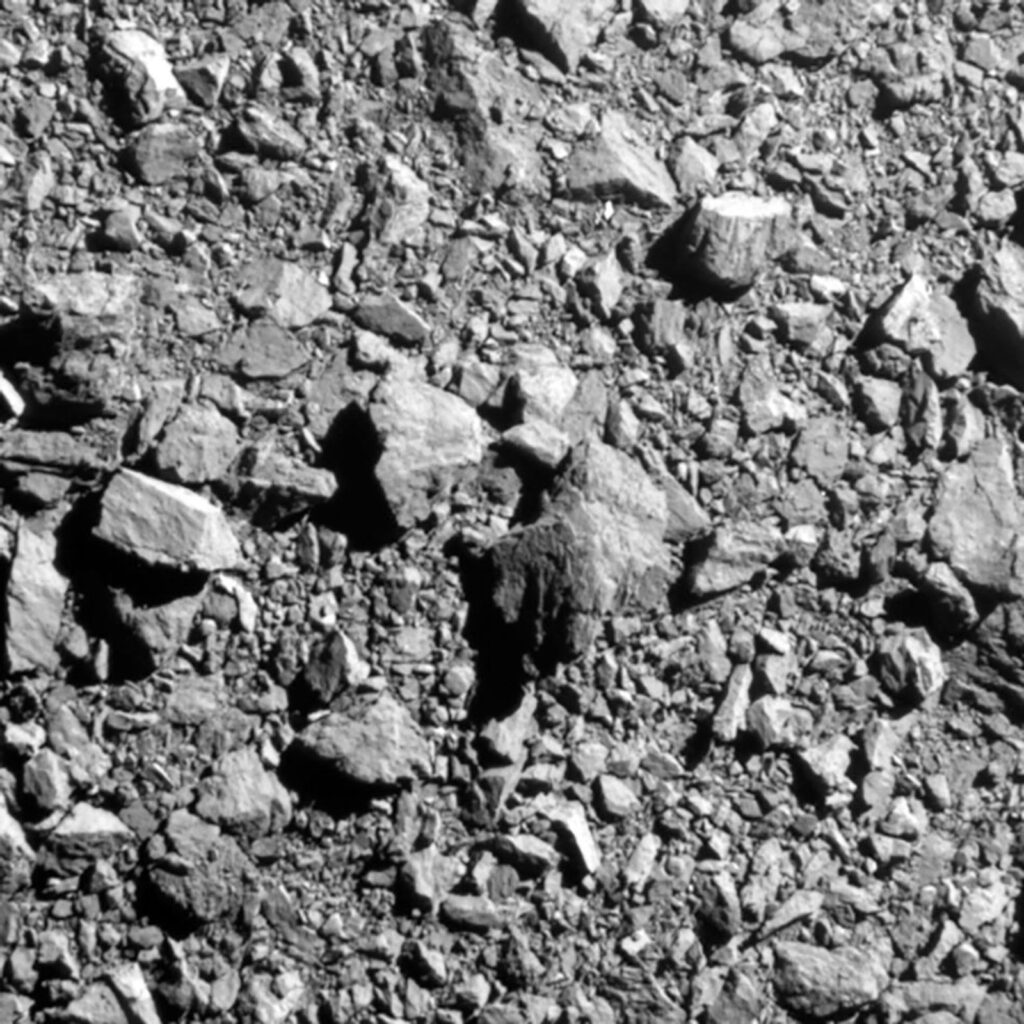
If a large asteroid were found heading for Earth with too little warning to nudge it gently, the last resort is a nuclear device detonated close to its surface. A new simulation study suggests that the success of that kind of asteroid deflection depends on something easy to overlook: which side of a lumpy rock the blast faces.
The work comes from physicists at Sandia National Laboratories in New Mexico, led by Nathan Moore. It was published in Icarus on 24 October 2026, with the laboratory announcing the results on 3 November. The study builds on a 2024 experiment at Sandia’s Z machine, a pulsed power facility, where an intense X-ray pulse pushed small silica targets standing in for asteroid rock to about 70 metres per second (reported in Nature Physics).
In principle, a detonation at a distance would flood one face of the asteroid with X-rays. The surface vaporises, and the expanding vapour acts like rocket exhaust, shoving the body the other way. Where earlier models mostly treated asteroids as spheres, the new one takes detailed 3D shapes from spacecraft flybys, maps which parts of the surface boil away, and works out the resulting push, spin and surface breakup. It pairs two Sandia codes, ALEGRA (made for fast, high-energy experiments) and SPARTA (made for gentle forces such as solar wind drag), and the team says the combination runs more than 1,600 times faster than older approaches.
Aim turned out to matter a great deal. For one simulated asteroid, irradiating one side produced a velocity change of 3.9 millimetres per second, while another side gave just 0.8 millimetres per second, a near fivefold difference. For a second asteroid, the extra spin imparted varied by a factor of 17. Moore said the team expected aim to matter. “What surprised us was how much,” he added. Millimetres per second sounds trivial, but applied years before a predicted impact, a small change in speed grows into a wide miss.
There are clear limits. The model predicts only the breakup of surface rock, not the shattering of the whole body, and it needs a complete shape model from all sides, which a hurried reconnaissance mission might not deliver in time. Placing a device at the right distance and angle would also be hard. None of this has been tried on a real asteroid; NASA’s DART mission in 2022 showed only that a kinetic impact can shift an asteroid’s orbit.
Planetary defence, it seems, starts with cartography. Any future nuclear option would need a detailed map of its target first, because on a rock shaped like a lumpy potato, the side chosen could decide between a comfortable miss and a very bad day.
