

Most accounts of a massive star’s death end with a bang. The core collapses, a shock wave rips through the outer layers, and for a few weeks the dying star can outshine its entire galaxy. Theorists have long suspected that some stars skip the show, falling inward to form a black hole with barely a flicker. A new analysis of colliding black holes suggests these failed supernovae may be common, and that they leave a recognisable fingerprint in the masses of the black holes they create.
The study, led by Isaac Legred with Jacob Golomb and Katerina Chatziioannou at Caltech, appears in Physical Review D and was announced by Caltech on 10 November 2026. Rather than hunting for vanishing stars, the team looked at the black holes themselves. They took 153 binary black hole mergers from GWTC-4.0, the latest catalogue from the LIGO, Virgo and KAGRA gravitational wave detectors, keeping only the events with the cleanest signals. Then they asked what shape the population’s mass distribution really has.
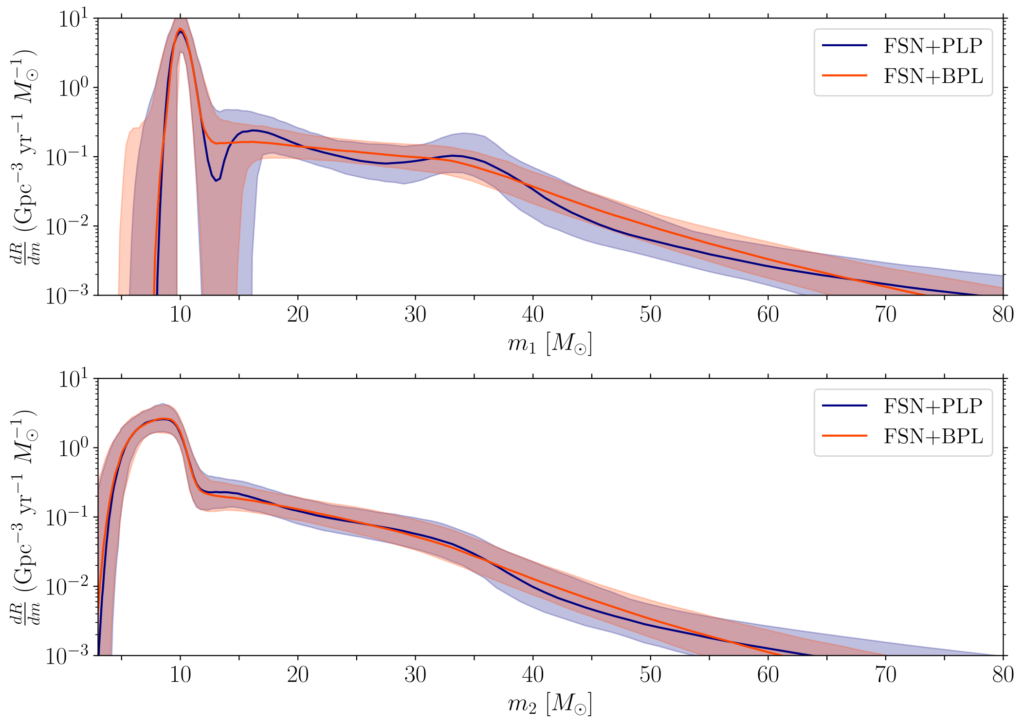
What emerged is lumpy. About three-quarters of the merging black holes sit in a tight peak just under 10 times the mass of the Sun. Move up to about 15 solar masses and the merger rate falls by roughly a factor of 100. Between about 12 and 16 solar masses the data are consistent with almost no black holes at all, before the numbers climb again for heavier objects. Legred framed the puzzle neatly: “why are, say, 14 solar-mass black holes so rare?”
Stars of one particular size may hold the explanation. Whether a collapsing core explodes depends on its internal structure, in particular how tightly packed it is when it gives way. Some supernova simulations find that stars born with roughly 11 to 14 times the Sun’s mass, at least with a Sun-like chemical makeup, fail to launch an explosion. With nothing to blow the outer layers away, much of the remaining star falls in. That would produce black holes of a narrow, characteristic mass, while stars just above the range explode and leave a shortage behind.
Spin offers a second clue. A black hole’s rotation carries a memory of how it formed, and the 10 solar mass group shows a noticeably narrower spread of spins than the heavier black holes. In the paper’s preferred model, the spread for the peak is roughly half that of the high mass population. Two groups with different masses and different spin habits look less like one continuous family and more like two populations with separate origins.
This matters for anyone trying to read the life stories of stars from gravitational waves. Standard population synthesis models, which simulate large numbers of binary stars from birth to collapse, predict only about a threefold excess of black holes near 9 to 10 solar masses. The observed peak is far sharper. If failed supernovae explain it, the merger catalogue becomes an indirect census of stars that died without a trace. It also becomes a test for supernova theory, where predicting which stars explode remains one of the hardest problems in astrophysics.
The catch is that nobody has watched one of these stars die. The study found no direct evidence of failed supernovae; it showed that the data match what such a population should look like. The gap itself is favoured rather than required, with the team putting the probability that it is real at about 88 per cent in their main model. A separate analysis that pairs black hole masses differently found no gap at all, and the authors trace the disagreement to that modelling choice. A couple of unusual low mass events also tug on the results, and the work circulated as a preprint from April before its peer reviewed publication.
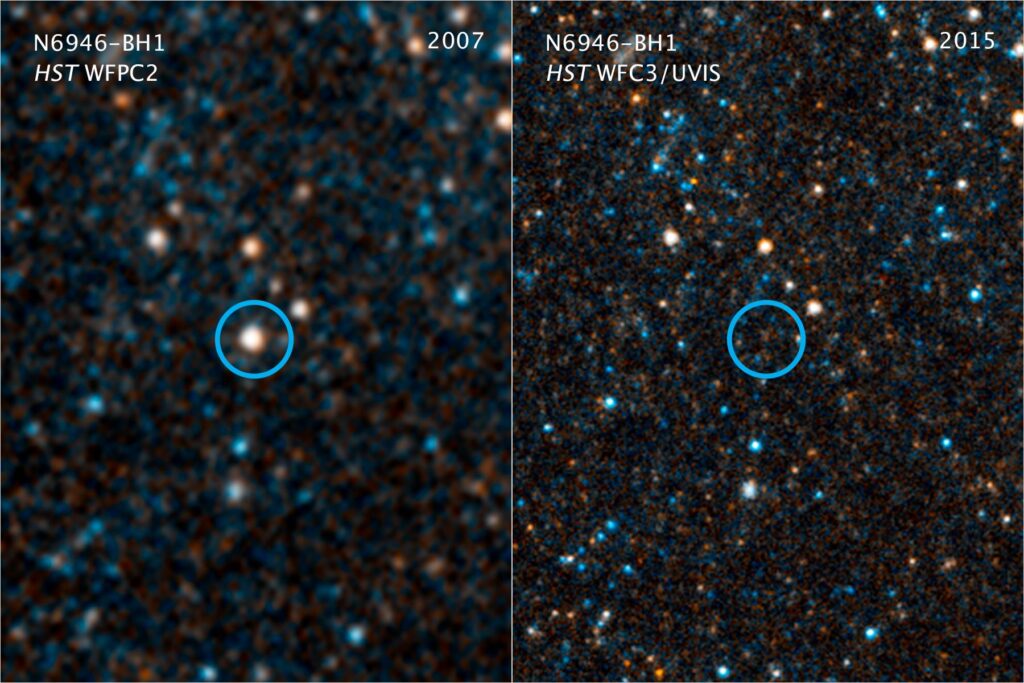
Finding the stars themselves is slow work. The best known candidate is N6946-BH1, a star of about 25 solar masses in the galaxy NGC 6946, some 22 million light-years away. It brightened briefly in 2009 and had faded from Hubble’s view by 2015, leaving only a faint infrared glow. That star is heavier than the range this study points to. Still, it shows what a failed supernova looks like from the outside: no explosion, just an absence.
There is something fitting in tracing these stars through the one signal they cannot hide. A supernova announces itself in light. A failed one only shows up much later, when its black hole meets another and the pair shake spacetime. Each new detection adds a point to the plot, and with enough of them the empty stretch between 12 and 16 solar masses will either fill in or harden into a rule.
