

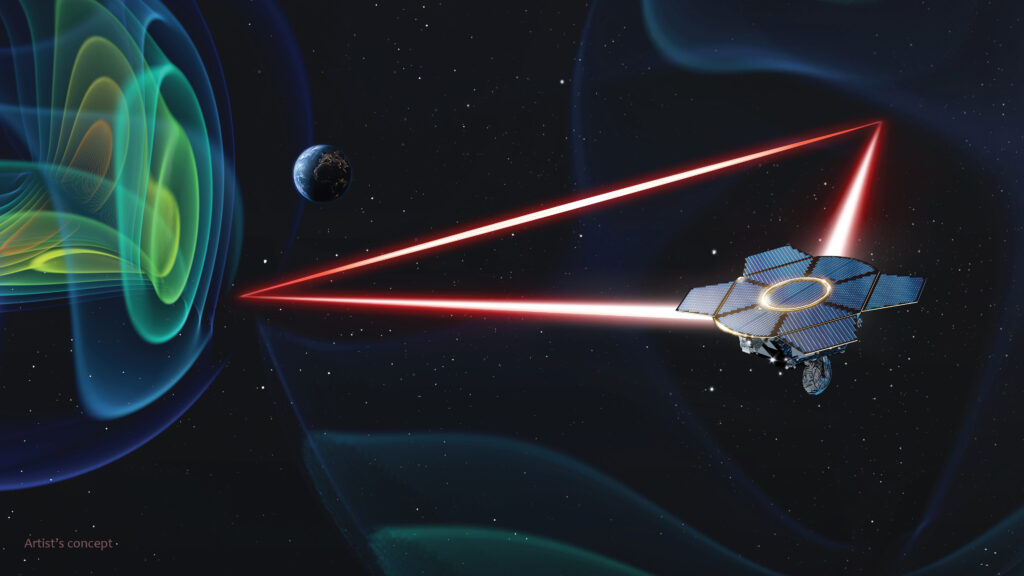
Somewhere in the Milky Way, two dead stars are whirling around each other every few minutes, and a giant planet may be circling the pair from a safe distance. No telescope today could find it. Two new papers argue that the gravitational waves streaming from the stellar pair would carry the planet’s signature, and that a space observatory due in the 2030s could read it. If they are right, searching for planets in gravitational waves would open up a population of worlds that nobody has yet seen.
Casey McGrath, a postdoctoral researcher at the University of Maryland, Baltimore County and NASA’s Goddard Space Flight Center, leads the work, published on 10 November 2026 in The Astrophysical Journal. A first paper sets out the detection method and maps where it works best. A second, written with Mary Anne Limbach of the University of Michigan, Scott Noble of Goddard and Vincent Kofman, asks how such a planet could be confirmed with ordinary light. Both are built around the Laser Interferometer Space Antenna (LISA), an ESA-led mission with NASA contributions that is scheduled to launch in the mid-2030s.
The idea borrows from one of the oldest tricks in planet hunting. A planet tugs its star back and forth, shifting its light towards blue and then red; this is the radial velocity method. McGrath applies the same logic to gravitational waves, the ripples in spacetime given off by massive objects in tight orbits. A pair of white dwarfs, the dense cores left behind by stars like the Sun, emits waves at an almost perfectly steady frequency. Add a heavy enough planet and the pair is pulled into a slow reflex motion of its own, which nudges that frequency up and down.
In the data, this shows up as sidebands: faint copies of the main signal sitting just above and below it in frequency. Sidebands are how a radio broadcast rides on a carrier wave, a comparison the first paper’s title leans into. Here the message is a planet. In McGrath’s words, quoted in NASA’s announcement, its presence “becomes imprinted on the gravitational wave signal”. The effect is strongest for massive planets on long orbits.
The numbers explain the appeal. The Milky Way is thought to hold around 10 million double white dwarfs that complete an orbit in under an hour, which places their waves in LISA’s range. LISA should pick out about 10,000 of them individually, along with roughly 100 mixed pairs in which a white dwarf orbits a neutron star or black hole. Its three spacecraft will fly in a triangle with sides 2.5 million km long, swapping laser beams to measure changes smaller than the width of a helium atom. Under ideal conditions, NASA says, LISA could sense a planet lighter than Jupiter around a nearby pair.
A detection made from ripples in spacetime will need checking, so the second paper turns to light. The team took a real system, ZTF J2243+5242, a pair of white dwarfs that circle each other every 8.8 minutes, and imagined it placed about 490 light-years away. A giant planet orbiting such a pair would glow faintly in the infrared, adding warmth the stars alone cannot explain. The James Webb Space Telescope (JWST) could pick up that infrared excess from a planet about five times the mass of Jupiter at that distance. Precise tracking of the pair’s position on the sky, by Gaia or the proposed Habitable Worlds Observatory, offers a second, independent check.
Why go to this trouble? No planet has yet been found orbiting two white dwarfs, and only a handful are known around single white dwarfs or circling pairs of ordinary stars. These binaries are what remains after stars have swollen, shed their outer layers and drawn close, a violent history any planet would have had to survive, or form after. Telescopes can only study a few nearby examples in detail. Gravitational waves do not depend on the stars being bright, and NASA estimates that a Jupiter-mass planet could be detectable around such a pair thousands of light-years away.
None of this is entirely new. Naoki Seto proposed the idea in 2008, estimating that LISA could search about 3,000 Galactic double white dwarfs for planets of around four Jupiter masses. A 2019 study suggested a four-year mission might find anywhere from three to 83 of them, a spread that says as much about our ignorance as about the instrument. The new papers map which planet masses and orbital periods suit the method, and how a detection could be confirmed.
The catch is that everything here is on paper. LISA is still being built, the planets it would find have never been observed, and the Webb calculation rests on a single real binary moved to a convenient distance. A missed planet could also skew estimates of the binary’s own properties, as the first paper notes. Limbach is clear that the first claims will need a second witness: joint detections with Webb, she says, are how researchers will establish that the signals are genuine planets.
If it works, the first planet found this way will be heard before it is seen. It will arrive as a pair of faint echoes on either side of a steady note from two dead stars, and Webb will then have the job of turning that whisper into a warm smudge of infrared light.
