

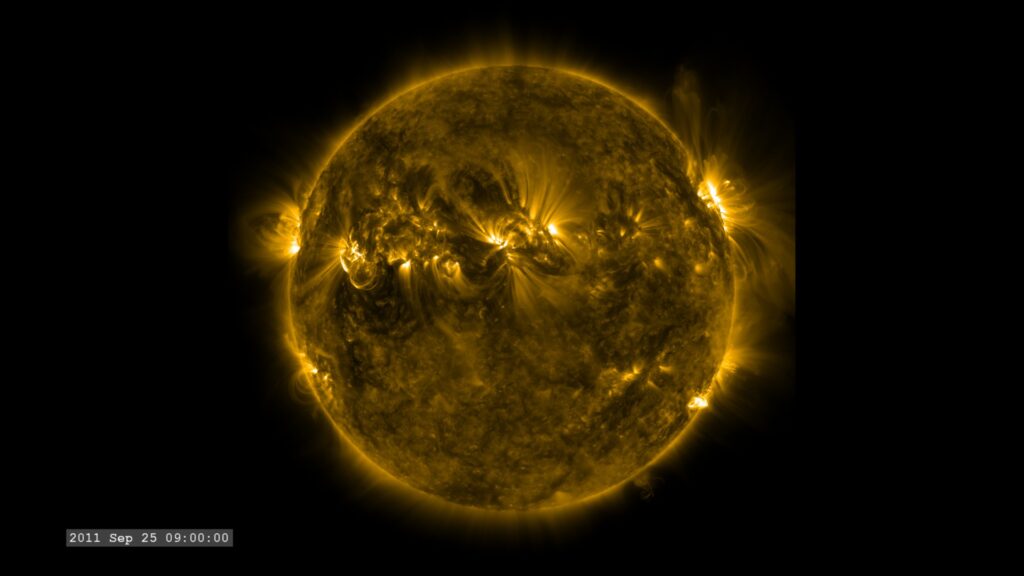
Step away from a fire and the air cools. The Sun breaks that rule. Its visible surface sits at about 5,800 kelvin, yet the thin outer atmosphere above it, the corona, runs at more than a million kelvin. Something carries energy upward and releases it as heat far above the surface, and the coronal heating problem has resisted a settled answer for decades. A new paper argues that part of the solution may be spinning at the Sun’s surface, in whirlpools only tens of kilometres wide.
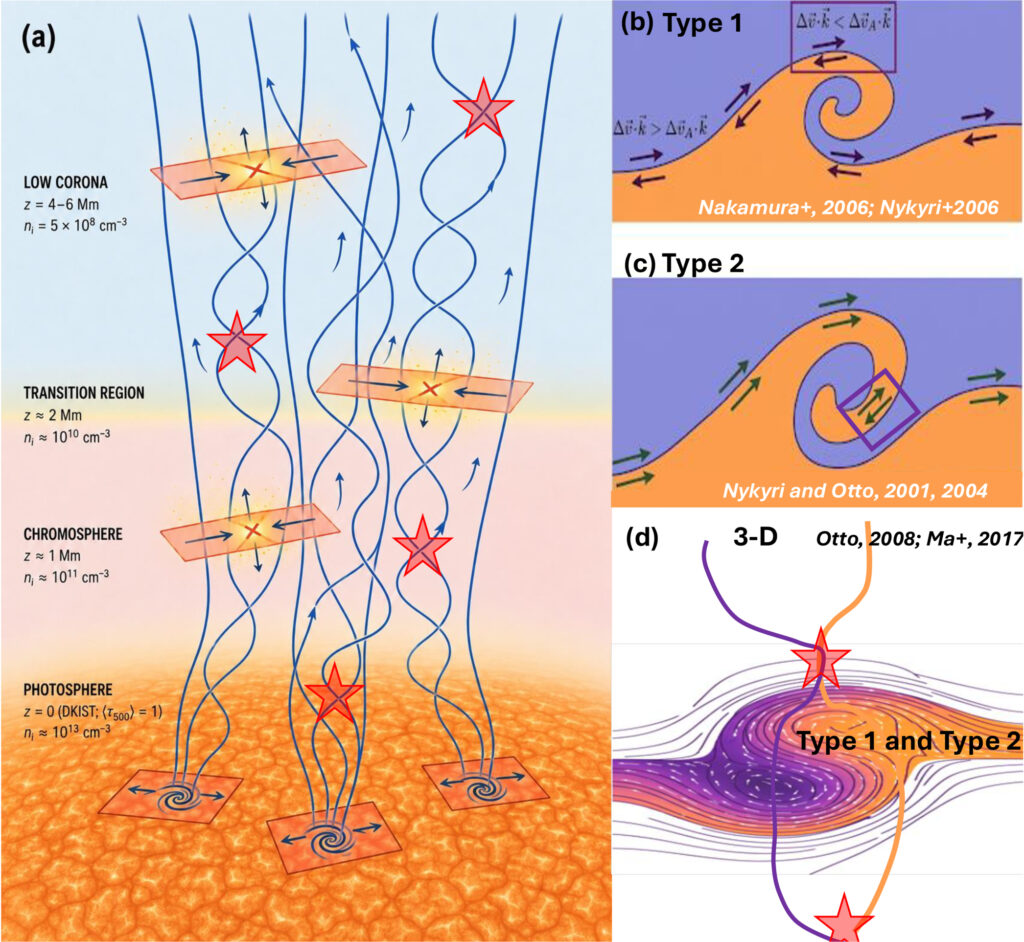
The study, by Katariina Nykyri of Embry-Riddle Aeronautical University, was published in The Astrophysical Journal Letters on 5 November 2026. It builds on observations that appeared in Nature in August, when a team led by David Kuridze used the Daniel K. Inouye Solar Telescope (DKIST), which has a four-metre mirror, to capture the highest resolution views yet of the solar surface. Those images showed rows of curling eddies along the edges of magnetic regions. They are the signature of a Kelvin-Helmholtz instability, the process that rolls wind over water into waves whenever two layers of fluid slide past each other at different speeds.
Nykyri comes to the Sun from space physics. The same instability ripples along the edge of Earth’s magnetosphere, the magnetic bubble around our planet, where spacecraft fly through the vortices and measure them directly. Those measurements yield scaling laws for how efficiently magnetic reconnection, the snapping and rejoining of tangled field lines, turns stored magnetic energy into heat. Her paper borrows those rules and applies them to 47 vortices in the DKIST images, which resolve detail down to 19 km.
The numbers are striking. The vortices repeat roughly every 65 km along a boundary, and a simulation of the solar surface from the earlier study suggests each typical vortex holds about 2.2 × 10¹⁷ joules of shear energy, the energy stored where flows rub past each other. As a vortex turns, it wraps magnetic field lines around itself and squeezes oppositely directed ones together. According to the Embry-Riddle release, the layers where reconnection begins are nearly a million times thinner than the vortices, and the paper argues that the swirling thins them fast enough to close that gap within a single vortex’s lifetime. Spacecraft-based scalings suggest that 28 to 44 per cent of the magnetic energy entering a reconnection site emerges as heat.
Then comes the energy budget. The quiet Sun, away from the sunspot groups called active regions, loses about 300 watts per square metre through its corona; coronal holes, where the fast solar wind escapes, lose about 800. Assuming vortices cover roughly 3 per cent of the surface, Nykyri calculates that the quiet Sun would need only 5 to 8 per cent of the vortices’ shear energy to reach upward as reconnecting magnetic energy. Coronal holes would need 14 to 21 per cent. Those are modest demands.
Modest demands matter because they move a mechanism seen directly in telescope images onto the list of serious contenders, alongside heating by waves. The approach also tests a broader idea: that physics measured by spacecraft near Earth can be scaled up to explain a star. If the scalings hold, observations of our own magnetic environment become a calibration tool for the Sun.
The weak link is the journey upward. DKIST’s images record brightness, not magnetic fields or velocities at the same spots, so the field angles and flow speeds in the calculation are inferred rather than measured. The simulated vortices sit mostly below the visible surface, rising only about 100 km above it, so the model cannot show whether the twisted fields survive the trip through the chromosphere, the layer between the surface and the corona. The 3 per cent coverage figure comes from a single simulation snapshot. And the mechanism falls short for active regions, which lose around 10,000 watts per square metre. Nykyri presents the vortices as a possible contributor to quiet Sun heating, not a solved problem.
Testing the idea will need DKIST to measure magnetic fields over the same boundaries while other instruments watch the layers above for opposing Doppler flows and brief, localised brightenings. The paper sets out exactly those signatures, and their absence would cap how much the vortices can contribute.
If they do appear, part of the answer to a very old solar puzzle will have been in plain view all along: eddies no wider than a large city, stirred by the boiling surface of a star.
