

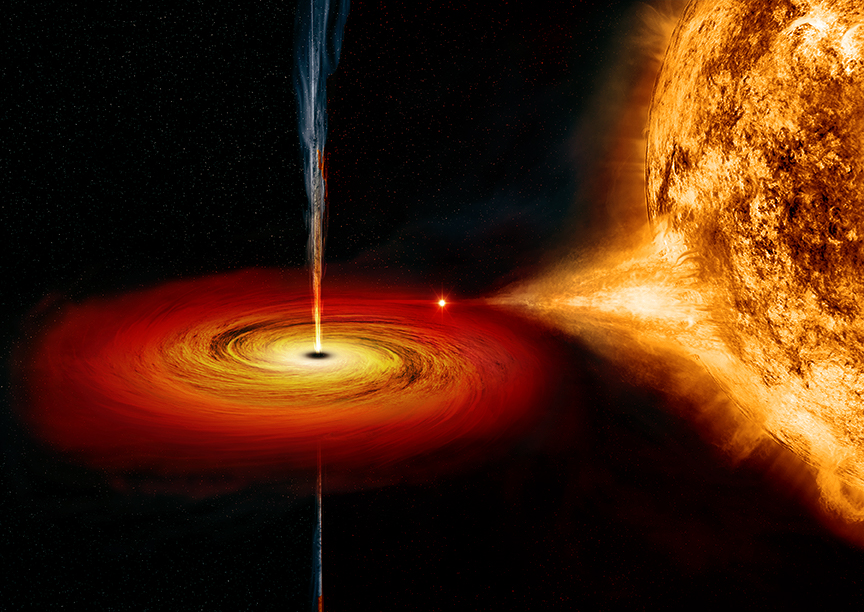
Astronomers who study black holes have a timing problem. Every so often, a black hole feeding on a companion star spits out a blob of plasma at a large fraction of the speed of light, and the first hours of that event hold the best clues to how it was launched. Nobody knows when the next one will come, so radio telescopes usually arrive late. A new study suggests black hole jets may give warning days in advance, for anyone watching the right X-ray signals.
The work comes from Toshihiro Kawaguchi of the University of Toyama and Kazutaka Yamaoka of Nagoya University’s Institute for Space-Earth Environmental Research, and was published in The Astrophysical Journal on 5 November 2026. It builds on the pair’s 2025 study of a single system, XTE J1859+226, which found that discrete jets were launched as the inner edge of the black hole’s accretion disc (the flattened whirlpool of gas spiralling inwards) moved rapidly towards the black hole. The new paper asks whether that pattern holds elsewhere. It tests three more systems, XTE J1550-564, GX 339-4 and MAXI J1820+070, using archived X-ray data from NASA’s Rossi X-ray Timing Explorer, Japan’s MAXI monitor and NICER on the International Space Station, alongside radio records of the jets themselves.
Everything hinges on the inner disc radius. Gas cannot orbit a black hole stably all the way down; below a limit called the innermost stable circular orbit, it plunges straight in. For a black hole of 10 solar masses that is not spinning, the limit sits about 89 km from the centre, a tiny target for something with the mass of 10 Suns. By fitting the X-ray spectrum, the authors estimate where the inner edge of the disc sits on each day of an outburst. In all four systems, that radius shrank and the flicker in X-ray brightness died down between one and 10 days before a jet appeared. The rate at which gas fed the black hole showed no large jumps over the same period.
That last point matters for theory. Some models of jet launching need the black hole to be swallowing gas near or above the Eddington limit, the rate at which the outward push of radiation balances gravity. In XTE J1859+226 and MAXI J1820+070, jets formed while the feeding rate was below that limit; for MAXI J1820+070 the authors put it at around a tenth or less. If those estimates hold, a sudden binge is not what triggers the jet. The geometry of the disc is.
From this the authors propose a forecasting rule. When both the disc radius and the X-ray flicker are falling, and the radius is closing in on its minimum, an alert would tell observatories that a jet is likely within hours to days. “Monitoring of Rin seems to be suitable for predicting the timing of jet ejections,” Kawaguchi said in the university’s announcement. For XTE J1859+226 the window would have been tight, with roughly half a day to decide; the other systems would have allowed more time to prepare.
The payoff would be in catching a jet at birth. MAXI J1820+070, about 10,000 light years away in Ophiuchus, launched a pair of jets on 7 July 2018 that NASA’s Chandra X-ray Observatory later tracked as they moved away at more than 80% of the speed of light. By the time most telescopes turn towards such an event, the launch itself is history. Stellar-mass black holes run through their outbursts in weeks to months, so they offer a fast view of processes that unfold over far longer spans around the supermassive black holes in galaxy centres. A reliable alert would turn lucky observations into planned ones.
Sample size is the catch. Four systems make a promising pattern, not a law, and only XTE J1859+226 has detailed data from the days leading up to its jets. The lead times also vary from about a day to 10 days, and the authors say better data are needed to explain why. The disc radius itself is a model-dependent estimate: it relies on uncertain black hole masses, distances and inclinations, assumes the black holes are not spinning, and leaves out a standard correction factor of 1.19. The authors argue their conclusions survive that correction, but the method also struggles when the disc is cool, as it was in MAXI J1820+070. And all of this is hindsight. No jet has yet been forecast before it happened.
That final test is the one that counts. Weather forecasters earned trust by being right about tomorrow, not by explaining yesterday. If an automated pipeline watching the X-ray sky can flag a shrinking disc and point the radio dishes before the plasma leaves, astronomers will see a black hole jet at the moment it is born rather than in the rear-view mirror.
