

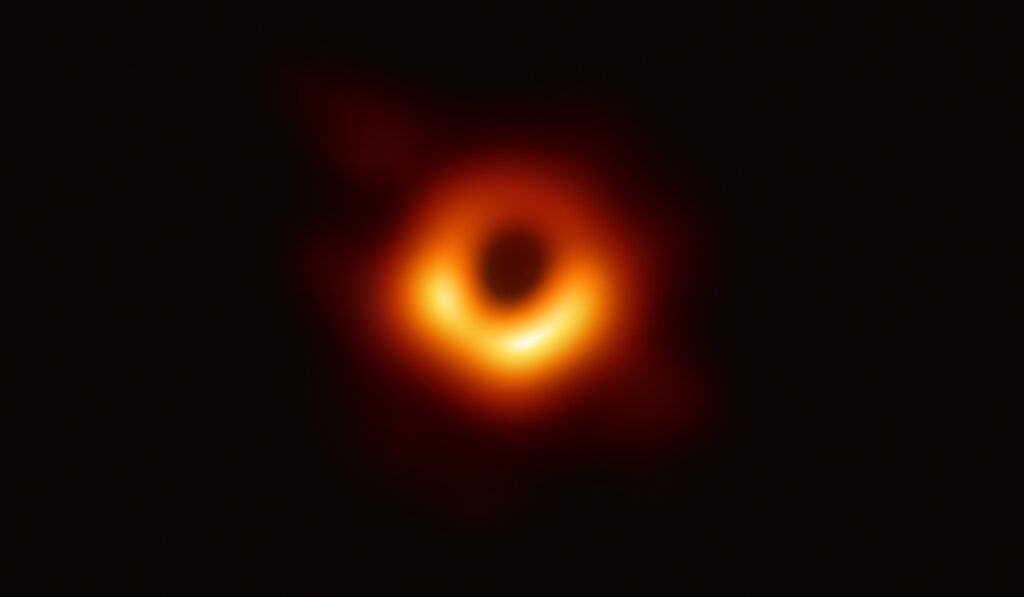
In April 2019 the world saw its first picture of a black hole: a blurred orange ring around a dark centre, 55 million light years away in the galaxy Messier 87. It became one of the most reproduced images in science. It also attracted a stubborn objection. Turning sparse radio measurements into a picture involves many choices, and critics argued that those choices had drawn a ring the data could not support. A new analysis, using a very different route through the same observations, finds that the M87 black hole ring is real.
The study, published in Nature on 11 November 2026, comes from Samuel Lai, Nithyanandan Thyagarajan, O. Ivy Wong and Foivos Diakogiannis at CSIRO, Australia’s national science agency. Working independently of the Event Horizon Telescope (EHT) collaboration, the network of radio dishes that made the original image, they reanalysed its public data from 2017, 2018 and 2021, all taken at a wavelength of 1.3 millimetres.
Doubts about the ring had a serious pedigree. In a 2022 paper in The Astrophysical Journal, a Japanese team including Junichiro Makino of Kobe University reprocessed the 2017 data with standard tools and found no ring at all. Their image showed a bright core, a jet and a string of knots. They argued that the ring, about 40 microarcseconds across, most likely reflected too few telescopes to resolve anything that small.
Every telescope in such an array adds its own errors. An amplifier drifts, or the air above one dish thickens with water vapour. Calibrating those effects away is where much of the human judgement in black hole imaging lives, and the CSIRO team chose to avoid it. By combining measurements around closed loops of telescopes, they built quantities called closure invariants, in which any error tied to a single station cancels out. The trade-off is that fewer usable numbers survive.
To turn those numbers into a picture, the team used a diffusion model called GenDIReCT, from the same family of machine learning that powers modern image generators. It learnt what images look like from a stock collection of small everyday photographs plus simple shapes such as discs and rings, not from simulations of black holes. For each dataset it produced about 300 reconstructions, each drawn from 4,096 samples, and the team took the median value of every pixel. The whole job ran for 96 hours on a single graphics processor.
The ring came back in every year of data and at every image size the team tried. Its diameter is 42.2 ± 1.5 microarcseconds, roughly how large an orange on the Moon would look from Earth. The EHT’s own 2019 analysis gave 42 ± 3 microarcseconds. Assuming a distance of 16.8 megaparsecs, the new size implies a black hole of 6.5 ± 0.5 billion solar masses, the same central value as the original. The ring is brightest to the south and south-west, and its orientation shifts between 2017 and the later years, which the authors put down to turbulence in the infalling gas.
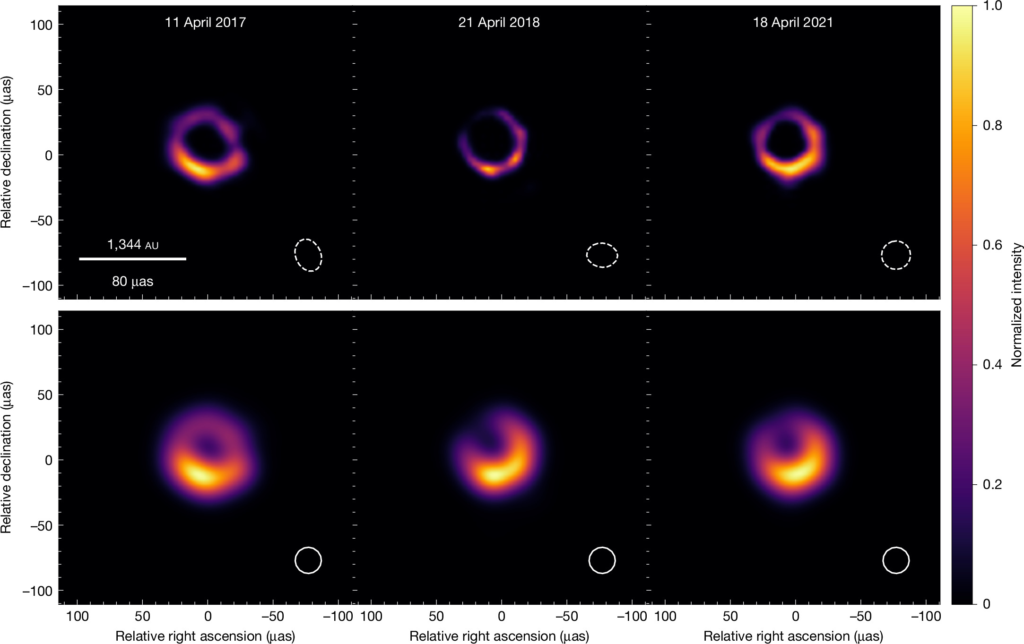
Comparing its images with simulated black holes seen from different angles, the team found that the best match puts our line of sight about 20 degrees from the jet. That sits close to the 17.2 ± 3.3 degrees measured from the jet itself at a lower radio frequency, an independent check that the geometry hangs together.
This reaches beyond one picture. The size of the ring is set by the black hole’s mass and by general relativity, so it is a test of Einstein’s theory in the strongest gravity astronomers can image. The 2019 result also anchored a programme that went on to image Sagittarius A*, the black hole at the centre of the Milky Way. If the first ring had rested on one set of imaging choices, everything built on it would be weaker. Two methods with very different assumptions now agree to within a few per cent.
There are limits. This is the same data, not new observations, so any flaw in the raw measurements themselves would pass straight through. The authors stress that their generative outputs are not formal statistical uncertainties, and that the chosen image size acts as a quiet assumption about how big the source can be. The ring’s width and the brightness of its centre changed with the method, so they probably say little about the black hole itself, and its spin remains unconstrained. A model trained partly on rings will also invite questions, even though the team found that removing those shapes from training made no notable difference.
Seven years on, the most famous picture in modern astronomy has passed a test its makers never set. A method designed to throw away every error a single telescope can make, run by people outside the original effort, has found the same ring at the same size.
More dishes have joined the array since 2017, and each one closes more loops. For now, the doughnut stands.
