

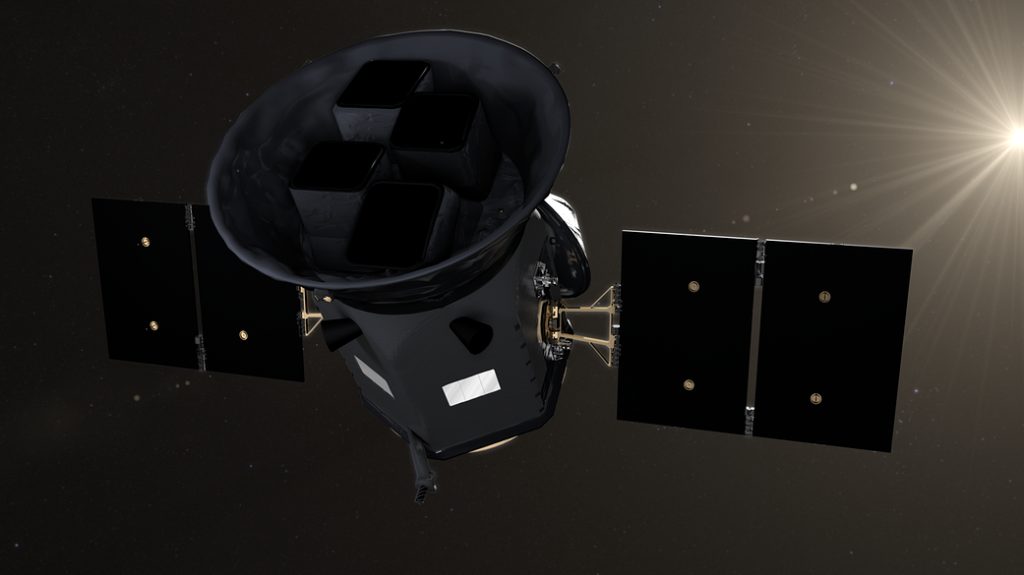
Most planets found by NASA’s Transiting Exoplanet Survey Satellite (TESS) are known only by their shadows: a small, regular dip in starlight each time the planet crosses the face of its star. That method assumes the geometry stays put. For one hot Jupiter about 1,100 light-years away, it did not. Over seven years the dips grew shallower and shorter, and in the latest data they stopped altogether. The planet has not gone anywhere. Its orbit has tilted, and the vanishing transits point to an unseen second giant doing the tilting.
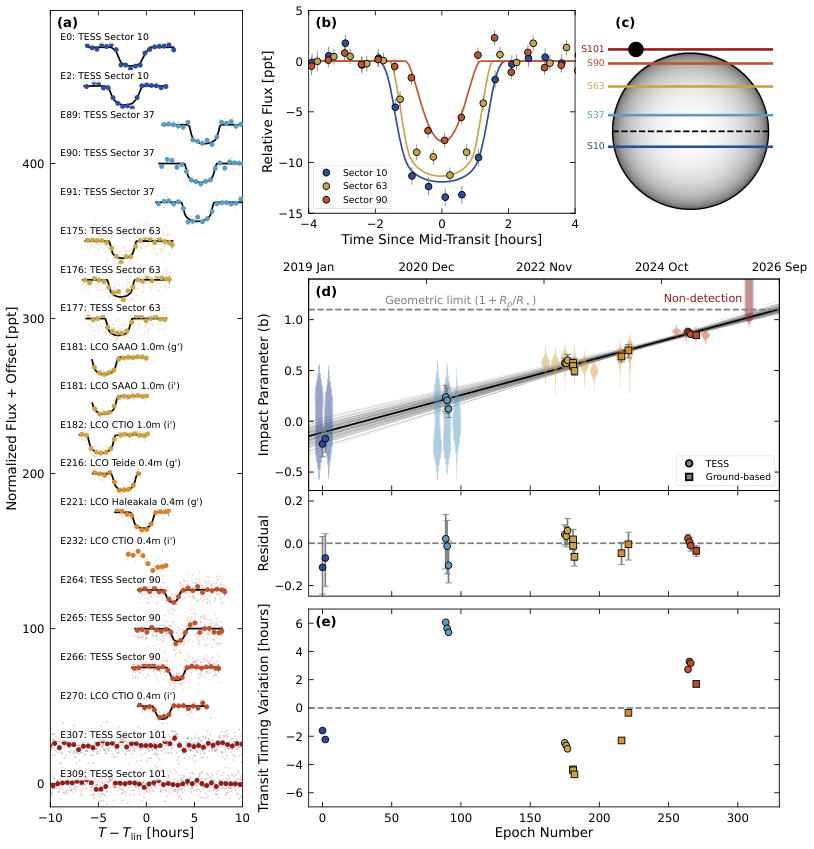
The planet, TOI-2535 b, circles an old orange dwarf of about 0.86 solar masses once every 8.24 days. A team of 28 astronomers led by Samuel Yee of the University of California, Los Angeles (UCLA), describes it in a paper published in The Astrophysical Journal Letters on 9 November 2026, with a version on arXiv. The authors call it the first confirmed planet around a single star whose transits have been directly observed to disappear. TESS watched the system in five separate stretches between April 2019 and March 2026, with ground-based telescopes filling some of the gaps.
Astronomers track the change with the impact parameter, a number that records how far from the centre of the star’s disc the planet’s path runs. Zero means a crossing straight through the middle; a value near one means the planet only grazes the edge. For TOI-2535 b it rose at a steady 0.16 per year. The path swept across more than half the disc, crossed the stellar equator, turned grazing, and then missed entirely. In the final TESS sector, no transit stood out from the noise. The timing wandered too, with transits arriving up to six hours early or late, about 3% of the orbital period.
Something has to swing the orbit round, and the team worked through the suspects. A stretched orbit turning slowly on itself would need an eccentricity above 0.69, which the transit durations and the star’s measured motion rule out. A bulge on the star cannot do it either, because an old, slowly spinning star is too round. A distant companion would have to exceed eight Jupiter masses even on a one year orbit, and would make the star lurch far more than observed. What remains is a nearby planet on an orbit tilted by at least 5° relative to TOI-2535 b, probably Saturn mass or larger, and probably locked in resonance with orbital periods in a 2:1 or 3:2 ratio.
Its pull makes the plane of TOI-2535 b’s orbit wheel round once every 30 to 50 years. Two other systems with drifting transits, TOI-216 and TOI-4504, turn on cycles of about 150 and 250 years. The authors describe the result as “the fastest rate of inclination change observed for an exoplanet orbiting a single star”.
Two giants packed this tightly are unusual. Hot Jupiters with a known close companion mostly have small planets for company, such as super-Earths or sub-Neptunes. The pairing also hints at how the hot Jupiter got so close to its star. One popular route has a giant flung onto a stretched orbit that later shrinks and settles near the star, a violent process that tends to clear out neighbours. A resonant pair fits a gentler story better, in which both planets drifted inward together through the disc of gas around the young star. The tilt would then need a later nudge, because gas discs tend to flatten orbits rather than tip them.
The neighbour itself has not been seen. Its existence rests on modelling the transit changes, and the team’s search turned up several families of possible arrangements rather than a single answer. Some steeply tilted setups, up to about 60°, match the data but do not last: of the 100 best solutions run forward for a million years, about two thirds ended in a close encounter between the planets. The timing scatter is also several times larger than the stated uncertainties. Now that the transits have gone, the timing method that exposed the problem can no longer help solve it.
That leaves the slow wobble the planets induce in their star. The models predict the hidden planet should tug it back and forth at 30 to 120 metres per second, well within reach of a dedicated campaign of radial velocity measurements. Then comes the long wait. If the orbital plane keeps turning on a cycle of decades, TOI-2535 b should eventually swing back into line with Earth. Whoever records its return may still be at school today.
