

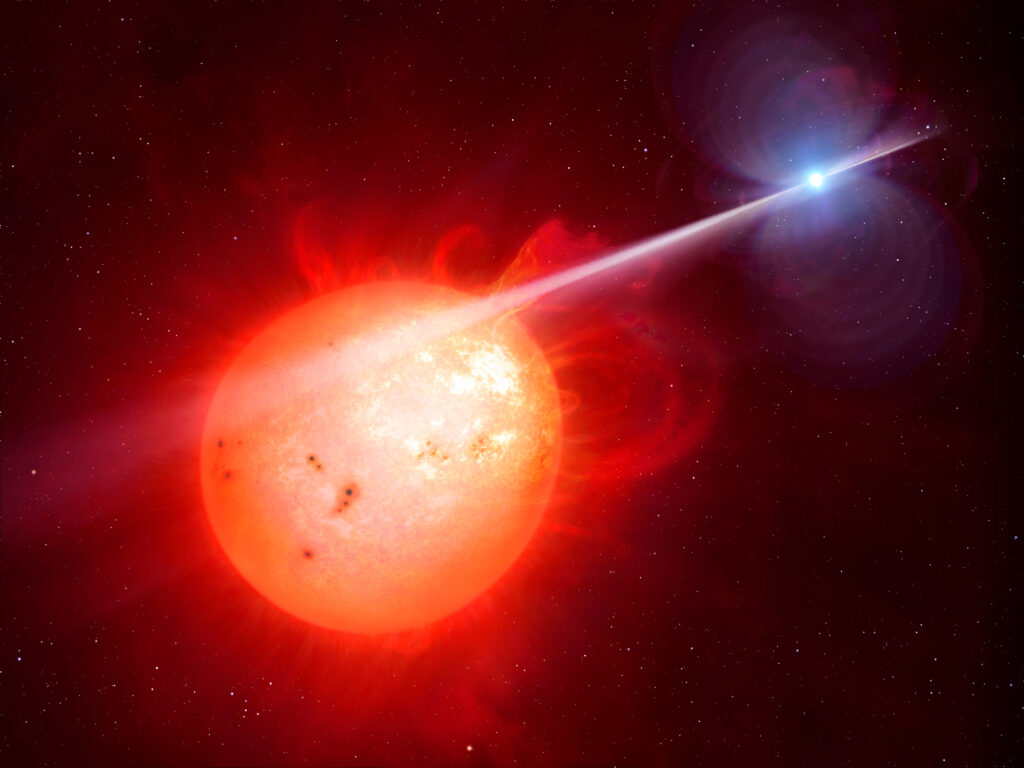
Pulsars keep time like metronomes. These spinning remnants of exploded stars sweep their radio beams past Earth every few seconds or faster, and astronomers have catalogued thousands of them. Since 2022 a much stranger class of object has turned up: radio sources that flash once every few minutes or hours, then fall silent. A newly found long-period transient now adds a twist nobody expected, because its dead star is locked in orbit with a star very much like the Sun.
The source, catalogued as GPM J071507-114153, pulses once every 7.9 minutes. A team led by Sam McSweeney, who made the discovery at the Curtin University node of the International Centre for Radio Astronomy Research (ICRAR) and now works for the SKA Observatory, described it in Nature Astronomy on 12 November 2026. The Murchison Widefield Array (MWA), a low-frequency radio telescope in Western Australia, spotted the pulses during a survey of the Milky Way. South Africa’s MeerKAT telescope then pinned the signal to a single faint star, and spectra from the Keck Observatory in Hawai’i revealed what kind of star it was.
Keck’s answer was a G-type star, the same class as the Sun. Its spectrum best matches a model star with a surface temperature of 5,500 K, close to our own star’s. The pulses themselves rise and fade on a cycle of about 1.3 days, which the team reads as the orbital period of the pair. Better still, their arrival times drift early and late in step with that orbit. According to Curtin’s announcement, McSweeney called them “clear enough to see the white dwarf moving in its orbit”. Confirming this meant processing more than 100 hours of radio data at the Pawsey Supercomputing Research Centre.
That timing goes a long way towards settling an argument that has dogged the field. In earlier systems, astronomers could not be sure which star produced the flashes; here the pulses follow the white dwarf, the dense, Earth-sized core left behind when a star like the Sun dies, so they come from it or its immediate surroundings. The radio light doubles as a probe of the neighbour. When the white dwarf passes behind the G-type star, its signal crosses the companion’s corona, the hot, magnetised outer atmosphere. Magnetised plasma twists the orientation of polarised radio waves, an effect called Faraday rotation, and the team saw that twist change rapidly near this point in the orbit. The team also picked up flares on the companion and a strongly magnetic region that may be a prominence, a huge loop of plasma, all from more than 5,000 light-years away.
Context makes the result more interesting. Roughly a dozen long-period transients are known, and the paper notes that at least four have already been tied to a white dwarf paired with an M dwarf, a small, cool red star. The first one reported, in 2022, repeated every 18 minutes and was proposed as a possible magnetar, a neutron star with an extreme magnetic field, while a later example paired with a red dwarf repeats only every 2.9 hours. The closest relative may be AR Scorpii, a white dwarf pulsar 380 light-years away that pulses every 1.97 minutes as it circles a red dwarf every 3.6 hours. A Sun-like partner widens the family considerably.
It also narrows the possible explanations. The timing shows that the G-type star does not fill its Roche lobe, the region within which its own gravity holds on to its gas, so it is not spilling material onto the white dwarf. Whatever powers the pulses, it is probably not a stream of stolen gas. The authors argue instead that the radio emission depends strongly on the white dwarf interacting with its companion, presumably through their magnetic fields, and that a Sun-like star in an orbit lasting about a day can play that role.
The catch is that nobody yet knows exactly how that interaction works. The pulses are coherent, meaning vast numbers of particles radiate in step, like a laser rather than a light bulb, and turning a magnetic tangle between two stars into such orderly emission remains an open problem. The orbital reading of the 1.3-day cycle is an interpretation, consistent with the data rather than measured directly. One system is also a small sample. Some long-period transients have no companion visible at all, and they may not share a single cause.
More examples should come quickly. The MWA and MeerKAT are precursors to the two telescopes of the Square Kilometre Array, SKA-Low in Australia and SKA-Mid in South Africa, which will search the sky with far greater sensitivity. If they find more systems like this one, astronomers will gain something unusual. A dead star, ticking every eight minutes, could become a weather station for the living star beside it.
