

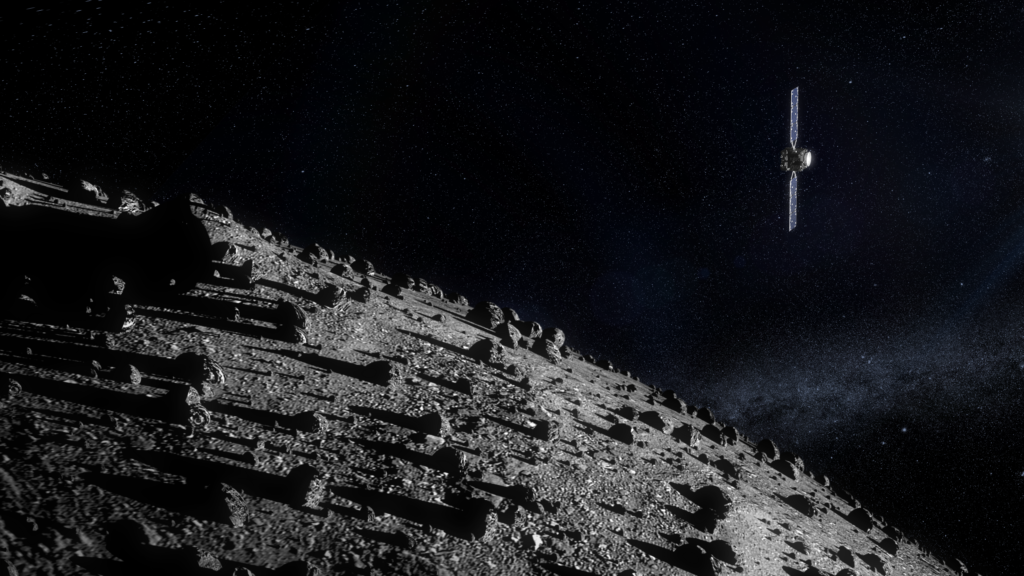
Orbiting a planet is mostly a matter of falling with style. Orbiting a pair of small asteroids is harder, because there is almost nothing to fall towards. The European Space Agency’s (ESA) Hera spacecraft has now reached the Didymos asteroids, the binary system whose smaller member NASA deliberately struck in 2022, and it is solving the problem by flying boxes instead of circles.
ESA announced on 11 November 2026 that Hera has started its early characterisation phase, holding station 25 to 30 km from the pair. Days earlier it released Hera’s first close-up of Didymos, taken from 600 km on the approach. Now comes a broad survey, the first global look at a small asteroid that has survived a hypervelocity impact. Mission scientist Michael Kueppers says the immediate aim is to gather “the big-picture findings” that matter for planetary defence.
Gravity here is feeble. Didymos, about 780 m across, pulls roughly 40,000 times more weakly than Earth, and its 151 m moonlet Dimorphos manages about 200,000 times less. A conventional circular orbit is impractical, so Hera drifts around the pair’s shared centre of gravity at a typical 12 cm per second, roughly the pace of a hurrying insect. It travels in nearly straight lines and, after legs of three days and then four, fires its thrusters to turn through 90 degrees. ESA calls the result a rectangular orbit.
Lessons from the Rosetta comet mission shaped the pattern, and its appeal is safety. If any single burn fails, Hera drifts away from the asteroids rather than into them. That is the point. Because the speeds are so low, each manoeuvre also costs very little propellant. Controllers at ESOC in Darmstadt, Germany, steer it across 196.5 million km, with about eight hours of contact a day through four 35 m antennas in Argentina, Spain and Australia.
Navigation is only the means. NASA’s 580 kg DART spacecraft hit Dimorphos at 6.1 km/s on 26 September 2022 and shortened its orbit around Didymos by about 33 minutes, a larger nudge than impact simulations had predicted. Nobody yet knows whether DART left a crater or reshaped the whole moonlet, or what Dimorphos is made of and how much it weighs. Until then, the kinetic impact method is a successful experiment, not a proven tool.
Next month Hera moves in to about 20 km and switches to bowtie-shaped hyperbolic arcs for its detailed characterisation phase. Close passes over the impact site and two shoebox-sized CubeSats follow. For now, the spacecraft is doing what any careful investigator does first. It is walking slowly around the scene, taking pictures before anyone touches anything.
