

Stars form from cold gas, and a galaxy that runs out of it stops making them. Astronomers have known for decades that galaxies in crowded neighbourhoods go quiet sooner than loners in emptier space. The hard part has been catching the fuel as it disappears. A new study of a galaxy group whose light set out more than six billion years ago finds its members holding far less molecular gas than comparable galaxies elsewhere: a shutdown caught partway through.
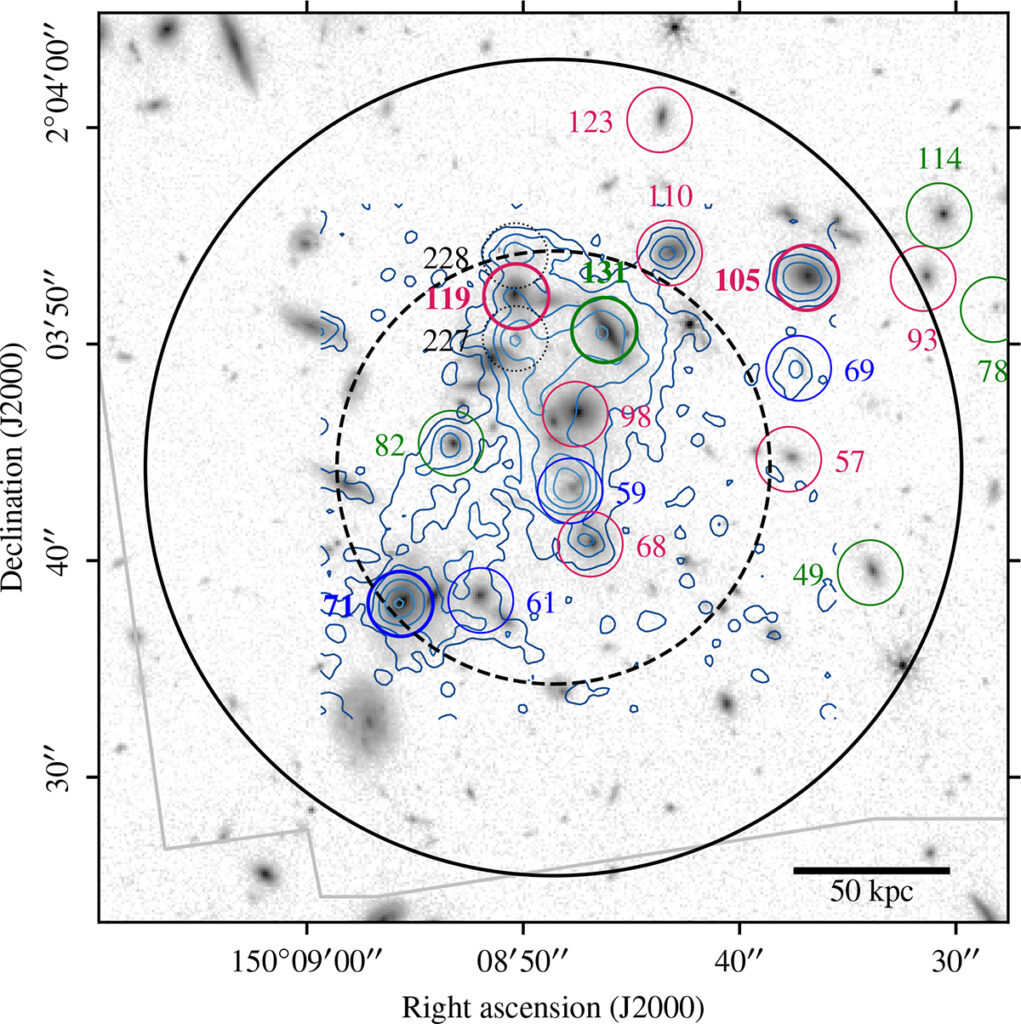
The group, known as COSMOS-Gr30 or CGr30, lies in the well studied COSMOS field, at a point where several filaments of the cosmic web cross. It has 44 confirmed members, moving with a spread of speeds of about 400 km/s. Its galaxies were first mapped by MAGIC, a survey of galaxy groups made with the MUSE spectrograph. The new results, from a team led by J. Freundlich, were published in Astronomy & Astrophysics on 10 November 2026, with an accompanying journal press release.
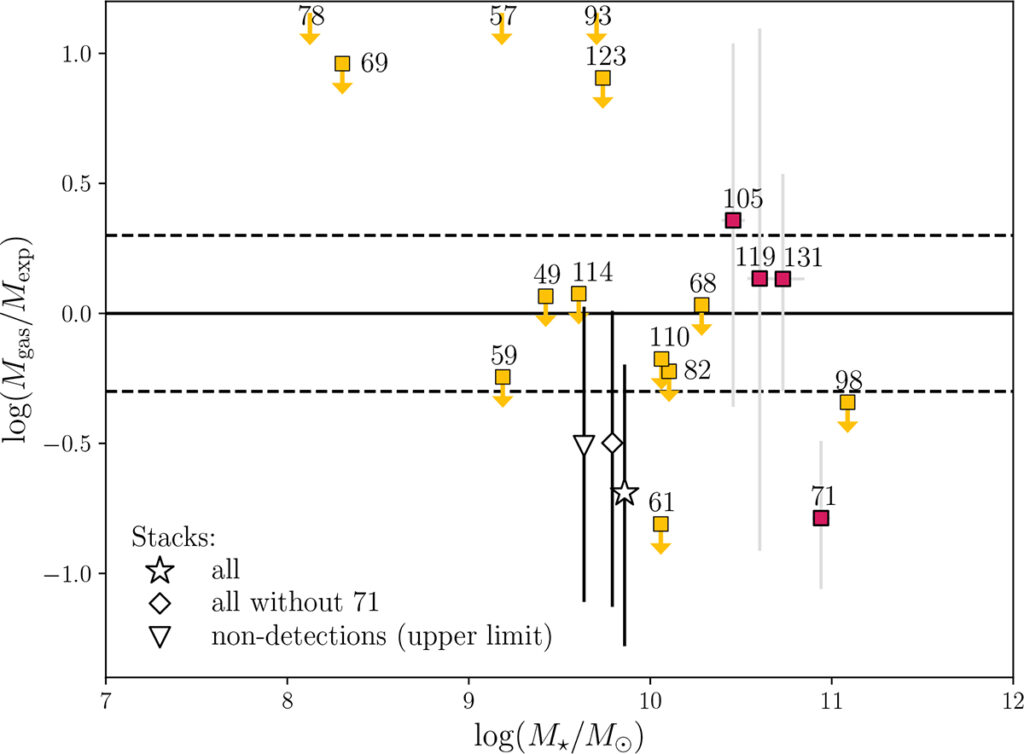
Molecular hydrogen, the raw material of stars, is almost invisible on its own. Carbon monoxide is not. It glows at millimetre wavelengths wherever cold hydrogen gathers, so it serves as a tracer. The team observed the group for 12.2 hours with the NOEMA interferometer, run by the IRAM institute, and for 9.5 hours with IRAM’s 30 metre telescope. Four galaxies gave clear signals. For the rest, too faint to see one by one, the team stacked the data, adding the spectra together so that a weak shared signal rises above the noise.
The shortfall is large. Stacked across the 17 galaxies inside NOEMA’s field of view, the group holds about a fifth of the molecular gas that standard scaling relations predict for galaxies of the same mass and star formation rate. Leave out one galaxy with an actively feeding black hole, which may skew its numbers, and the figure rises to roughly a third. Either way the members sit about 0.5 dex, or a factor of three, below their counterparts in the field.
Something stranger sits among the galaxies: a sprawling cloud of ionised gas, covering about 10,000 square kiloparsecs, that wraps around eight members and weighs an estimated 50 billion solar masses. The authors argue it is not pristine material from the cosmic web. They suggest it was pulled out of the galaxies by tidal forces, by outflows driven by stars and black holes, and perhaps by ram pressure, the headwind a galaxy feels as it ploughs through hot gas between its neighbours. The 30 metre telescope found little cold gas in this cloud: under 20 billion solar masses, so less than a third of it is in a state that could form stars.
This matters because quenching, the switching off of star formation, shapes what galaxies look like today. Most galaxies in dense groups and clusters now are red and quiet, but the order of events that made them so is hard to reconstruct after the fact. CGr30 helps. The shortfall seems to lie in the fuel itself rather than in how efficiently the galaxies burn it, although the error bars are wide. Several members also show bursts of star formation one to two billion years ago, possibly before they fell into the group core, which hints that the starving may begin in smaller subgroups. In the authors’ words, “environmental processes efficiently deplete molecular gas reservoirs” here.
The catch is that this is one group, and a modest data set. Only four galaxies were detected directly, and the stacked signals are significant at just a few sigma. The galaxies share a single environment, so they are not independent samples. Converting carbon monoxide brightness into hydrogen mass carries its own uncertainty of about 0.2 dex, and star formation rates estimated from the galaxies’ colours are rough. The study cannot say which mechanism does most of the damage, and the team calls for deeper observations with NOEMA, the 30 metre telescope and ALMA.
Still, it is a rare look at the moment the tank runs low. Eight billion years of group histories wait in surveys like MAGIC. The next step is to read enough of them to tell whether CGr30 is typical, or simply caught on a bad day.
