

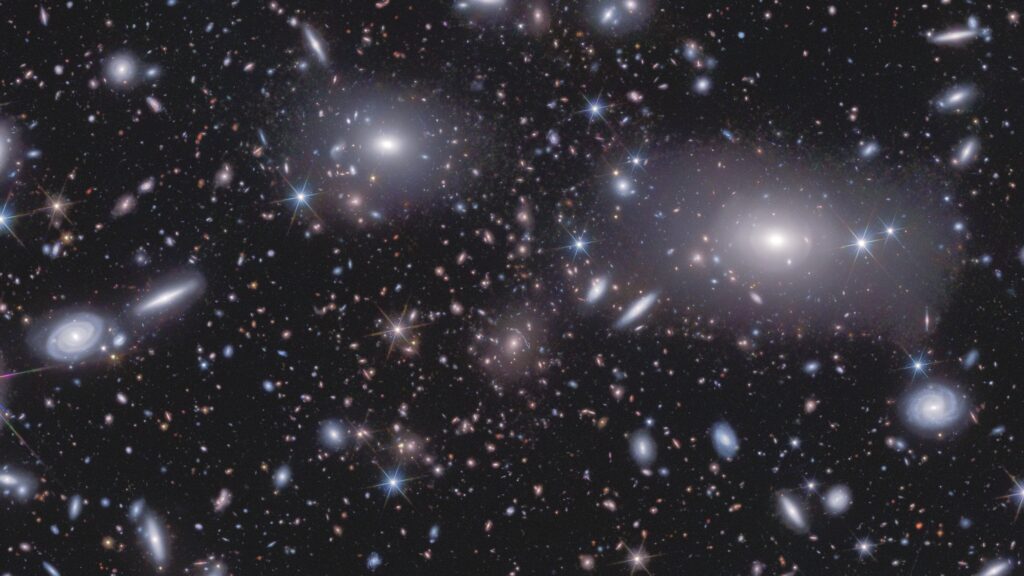
For nearly three decades, astronomers have known that the expansion of the Universe is speeding up, and for nearly three decades they have been unable to say why. Whatever is responsible, usually called dark energy, should leave its mark on how galaxies are spread through space and on how their light bends on the way to us. Reading that mark needs a map of billions of galaxies. On 12 November 2026 the European Space Agency (ESA) published the first large piece of it: a Euclid data release called DR1-Foundation, which catalogues more than a billion objects.
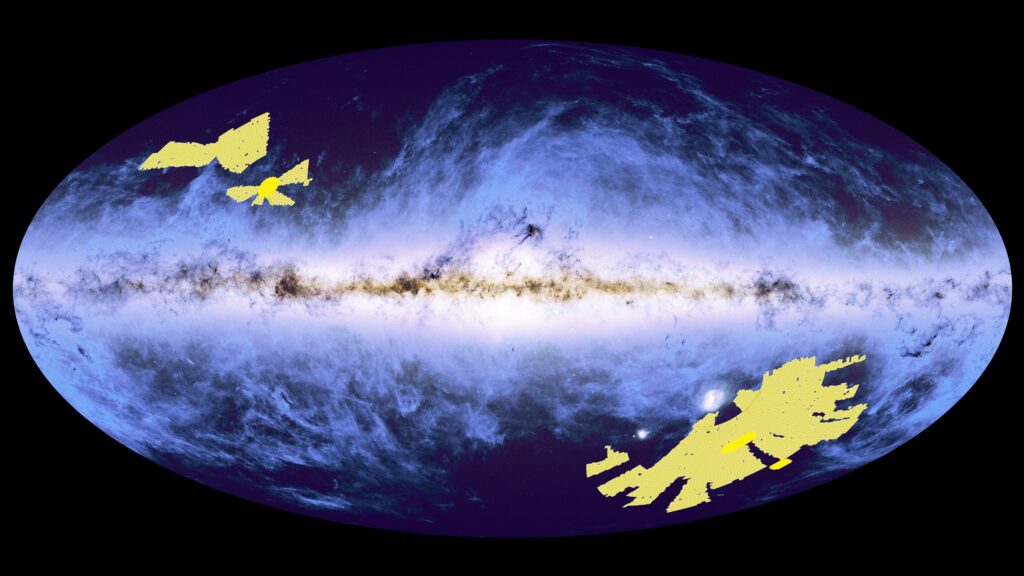
The release draws on about 13 months of observations, from spring 2024 to spring 2025, by a telescope that launched in July 2023. Its share of the Euclid Wide Survey spans about 1,900 square degrees, an area equal to 9,500 full Moons and roughly 14% of the sky Euclid will cover over its six-year mission. Previous releases held a few days of observing across about 60 square degrees. This one runs to about 1.7 million gigabytes, which rules out casual browsing.
Euclid gathers all of this with two instruments. VIS, a 600-megapixel visible light camera, records sharp images that capture the shapes of faint galaxies. NISP, the Near-Infrared Spectrometer and Photometer, measures brightness in the infrared and splits light into spectra. Those spectra matter because the expansion of space stretches light to longer, redder wavelengths, so the shift of a known feature gives a galaxy’s distance. Euclid hunts in particular for hydrogen-alpha, the red glow of hydrogen in star-forming clouds. The release holds spectra from more than 160 million sources, alongside more than 900 million galaxies and over 60 million quasar candidates, the bright cores of distant galaxies powered by matter falling into black holes.
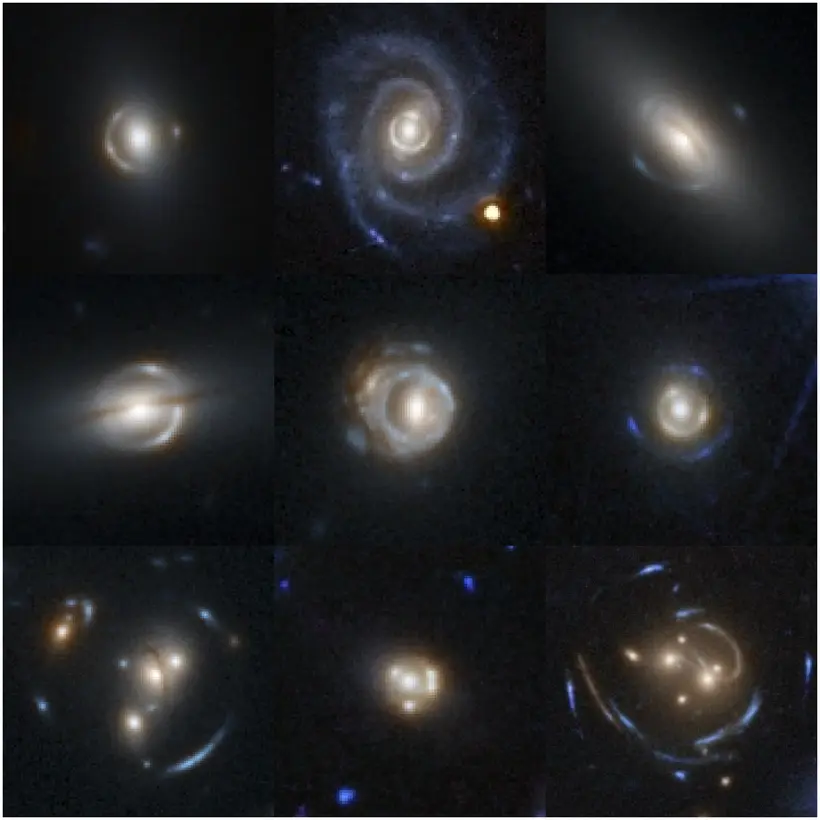
The standout product is a catalogue of about 15,000 strong gravitational lens candidates, larger than all previous catalogues combined. A strong lens forms when a massive foreground galaxy bends the light of a more distant one into arcs, rings or multiple images. Only around one galaxy in several thousand does this, so they have mostly been studied one at a time. Here they were found by machine learning and by thousands of volunteers on the Space Warps project, all with the same telescope and the same method. That consistency lets researchers treat lenses as a population, using them to weigh galaxies, dark matter included, and to magnify galaxies too faint to study otherwise.
Lenses are a bonus, not the main event. Euclid exists to build a three dimensional map of the cosmic web, the network of filaments and clusters in which galaxies sit, and to test dark energy and dark matter through how that structure grew over time. The release already includes cluster masses, member galaxies and distances, collapsing protoclusters with directly measured redshifts, and the faint haze of stray starlight inside hundreds of clusters. ESA’s Director of Science, Carole Mundell, described the release as “far more than beautiful pictures”. On the numbers, that is fair.
The catch is that the cosmology itself is not here. The measurements that bear most directly on dark energy, weak lensing (tiny, statistical distortions in the shapes of millions of galaxies) and galaxy clustering, are held back for the full DR1 in mid-2027. The overview paper is candid about why. The model of the VIS point spread function, the blur pattern a single star makes in the camera, underestimated its size, an error that would bias the shape measurements weak lensing depends on. About three months of early survey data, from a stretch the team calls the “ice age”, were left out because of calibration uncertainties. Some spectra show no measurable features yet still carry catalogue entries, and users are warned not to trust those redshifts blindly. The lens and quasar totals are candidates, not confirmations.
None of that diminishes the scale of what is now public through ESA’s Euclid archive. The survey is scheduled to keep observing until January 2030, and most of its eventual map is still blank. The page drawn so far already holds a billion objects, and anyone with the patience can start reading it.
