

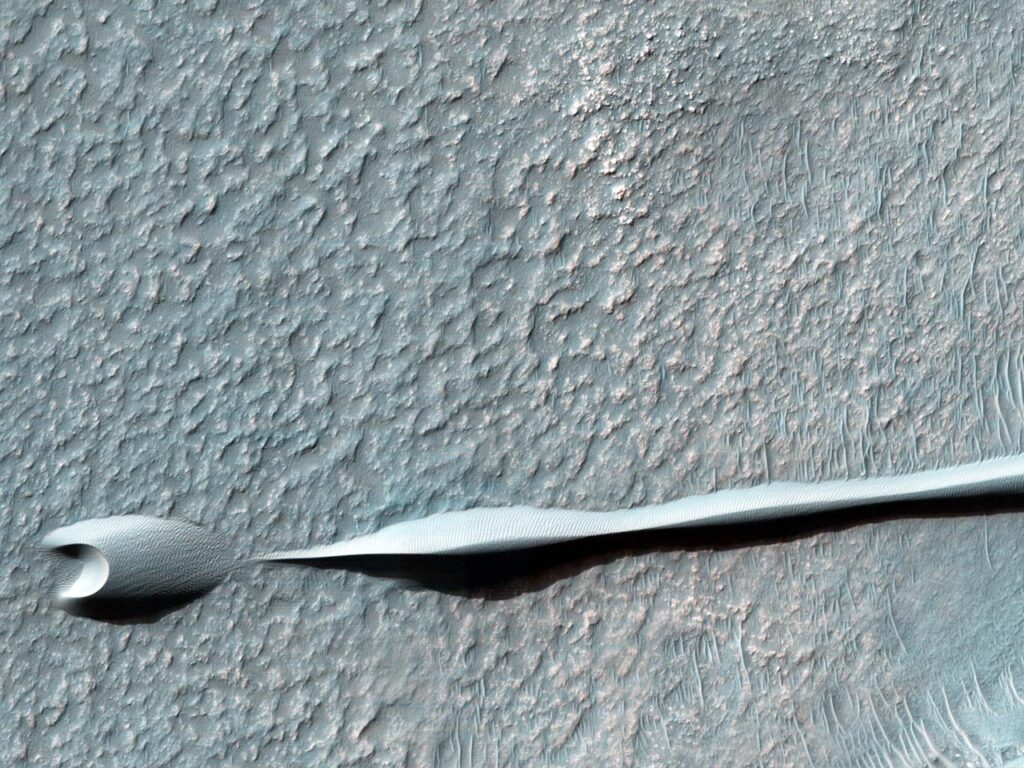
Orbiters have photographed sand dunes across Mars, and their shapes record which way the wind blew and how steadily. What they have never revealed is how hard it blew. A study published on 16 November in the Proceedings of the National Academy of Sciences suggests the answer was in the sand all along: the size of the grains sets the speed of the winds that build the dunes.
Colin Marvin and Mathieu Lapôtre at Stanford University tested an idea first proposed in 2010: that dunes are shaped by winds only slightly stronger than the threshold needed to set sand moving. They combined 30 years of wind records with grain size measurements from 24 dune fields, from Coral Pink Sand Dunes State Park in Utah to the Namib, Earth’s oldest desert. At each field they worked out which wind speed had moved the most sand over time. Every time, it sat only modestly above the threshold.
The logic is simple once stated. Gales shift plenty of sand, but they are rare; gentler winds that barely lift grains blow far more often and do most of the building. Because the threshold depends on grain size, a dune’s median grain size points to its formative wind. The team repeated the analysis for a dune field on Mars, where gravity is weaker, the air far thinner and the sand a different density. The same relationship held. “It works for modern dunes and for sandstones dating back three billion years,” says Lapôtre.
There are limits. The Martian result rests on a single dune field, a thin sample beside two dozen on Earth. The method recovers the typical dune-building wind rather than the extremes. Dunes have also been seen on Venus, Titan and a comet, and in principle each could become a wind gauge, but none was part of this study.
Still, the finding turns sand into an instrument. Deserts are built less by their fiercest days than by their ordinary ones, and the grains keep count.
