

Most of the data a Mars rover sends home takes a detour. Rather than shout across the gap to Earth, rovers pass bulk data up to orbiting spacecraft, which forward it on. That arrangement, NASA’s Mars relay network, has had a difficult month. On 19 November 2026 the agency reported that Perseverance has paused its science and the 2001 Mars Odyssey orbiter has its instruments offline, each because of a separate hardware fault.
The rover’s trouble began on 30 October. When it powered up for the day, its primary UHF radio, the set used to send large volumes of data to orbiters, stopped sending the regular electronic “heartbeat” its main computer listens for. After 25 missed pings, roughly 100 seconds of silence, fault protection switched the radio off, swapped to the backup and put the rover into safe mode. Engineers then found the backup transmitting at about half its expected power. Both radios are now out of use, and Perseverance talks directly to the Deep Space Network over its high-gain antenna. That link works, but slowly, so camera and instrument work has stopped to leave bandwidth for diagnostics.
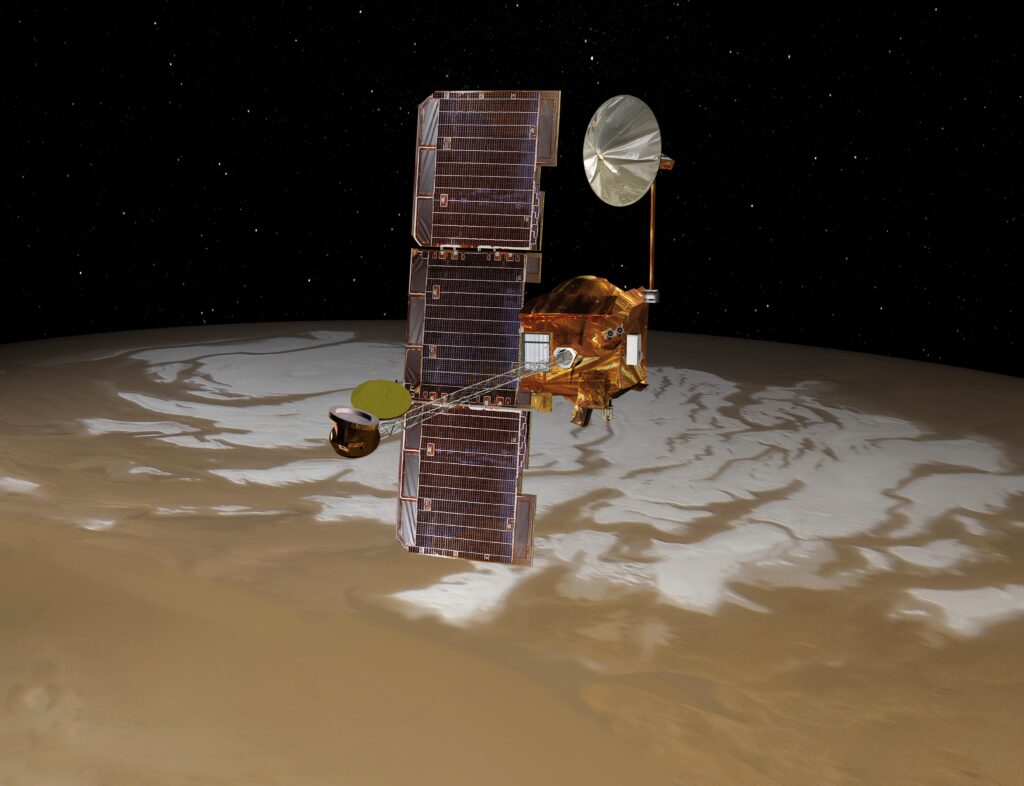
Odyssey’s problem is mechanical. The orbiter steers with reaction wheels, flywheels that turn the spacecraft by speeding up or slowing down. It carries four, lost one in 2013 and needs three. Between 4 and 6 November it sat in safe mode after a second wheel stopped spinning. Thrusters can hold its orientation instead, but after 25 years at Mars the team estimates it has only one to two months of hydrazine for the job.
The timing is awkward. NASA declared MAVEN lost in June, six months after contact ended on 6 December 2025, and that orbiter had also carried rover data home. Odyssey itself was designed for a mission of just over two and a half years. It went on to relay the first post-landing images from Spirit, Opportunity and Curiosity, and it is still part of the relay fleet today.
Neither fault is settled. In one test Odyssey’s stalled wheel moved when commanded, and engineers are checking whether it can be recovered. NASA hopes both spacecraft will be back at work by the end of November. It has not said what caused either radio to falter.
For now the rover waits, healthy but quiet, sending engineering data down a narrow pipe. Exploring Mars, it turns out, depends as much on the switchboard as on the explorers.
