

Most stars that share a tight orbit with a dying giant do not get a happy ending. When a Sun-like star swells into a giant late in life, a nearby companion is engulfed by its bloated outer layers and spirals inwards, ending up on an orbit lasting hours or days. Just 28 light-years away, astronomers have found a triple star system where that script seems to have been torn up: a small red dwarf circling a dead star at a distance it has no obvious right to occupy.
The system, named Welopōʻai, is described in a paper published on 19 November 2026 in Astronomy & Astrophysics by a team led by Étienne Artigau of the Trottier Institute for Research on Exoplanets at the Université de Montréal. It turned up by accident. The team was using SPIRou, an infrared spectrograph on the Canada-France-Hawaii Telescope, to look for planets around the red dwarf by measuring the slight wobble a planet induces in its star. Planets produce shifts of a few metres per second. This star’s velocity swung by about 16 kilometres per second.
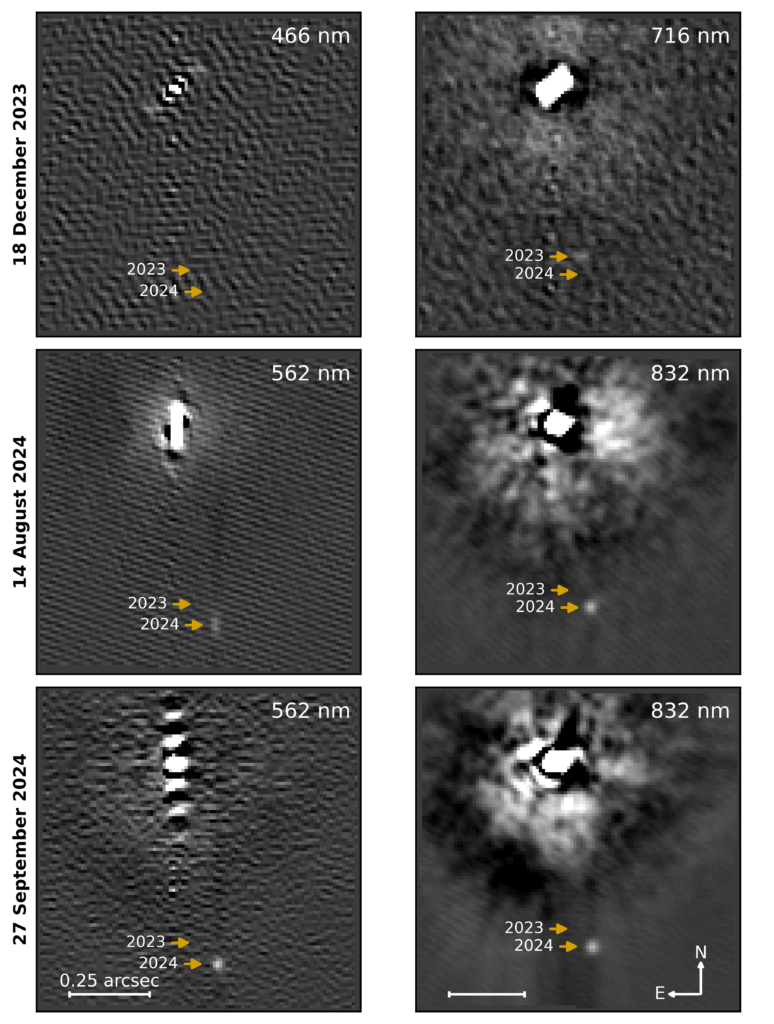
Over 4.8 years and 411 measurements, that signal resolved into an orbit of roughly 9.8 years and a companion heavier than the red dwarf, yet too faint to be an ordinary star. In December 2023 the ʻAlopeke speckle camera on the 8.1 metre Gemini North telescope, which takes rapid exposures to freeze atmospheric blurring, picked out a faint point of light beside the red dwarf; by September 2024 it had visibly moved. It is a white dwarf, the dense core left when a Sun-like star exhausts its fuel. A second, previously known white dwarf orbits the pair at a projected distance of about 124 astronomical units (au, the distance from Earth to the Sun).
Pairing the velocities with the image positions let the team weigh both inner stars directly. The red dwarf comes out at 0.419 solar masses and the white dwarf at 0.618, the latter with an uncertainty of just 0.7 per cent: the most precise dynamical mass for any white dwarf within 20 parsecs, better than the classic measurements of Sirius B and Procyon B. The two orbit 4.64 au apart, a little closer than Jupiter is to the Sun. The white dwarf has a surface temperature near 5,200 kelvin and has been cooling for about 5.3 billion years.
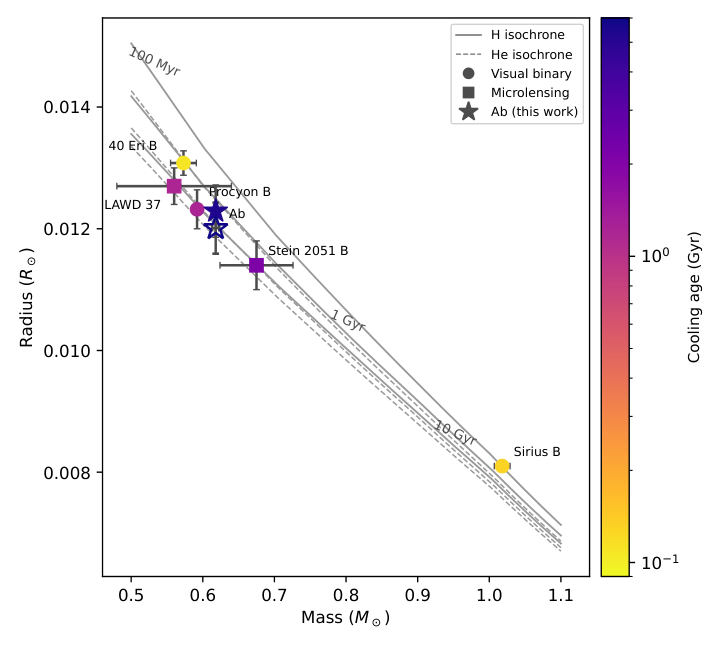
The trouble is the history. The white dwarf began life as a star about 1.4 times the Sun’s mass. As it aged it lost roughly 0.8 solar masses of gas, and shedding mass loosens an orbit. Run that process in reverse and the two stars started only about 2.6 au apart, while the giant at its largest would have reached a radius of around 1.2 au. Strong tides and at least a partial brush with the giant’s envelope look almost unavoidable. Companions that go through this common envelope phase, in which one star ends up orbiting inside the other’s swollen atmosphere, usually emerge in orbits of hours to days. The nearest comparable survivor, G 203-47 at 7.6 parsecs, circles its white dwarf every 14.7 days. Welopōʻai’s inner pair takes nearly a decade.
Those steps matter well beyond one nearby star. Common envelope evolution shapes many of the close binaries behind stellar explosions and gravitational waves, yet it remains one of the least understood stages of a star’s life. Only this week, astronomers reported the first direct view of a star spiralling inside a giant’s envelope in the Andromeda galaxy; Welopōʻai looks like an outcome standard models struggle to produce. “This system should not exist,” said Patrick Dufour, a white dwarf specialist on the team, in the university’s announcement. The third star adds a twist: its gravity should periodically stretch the inner orbit through Kozai-Lidov cycles, and only detailed simulations can say whether that helped or hindered the escape.
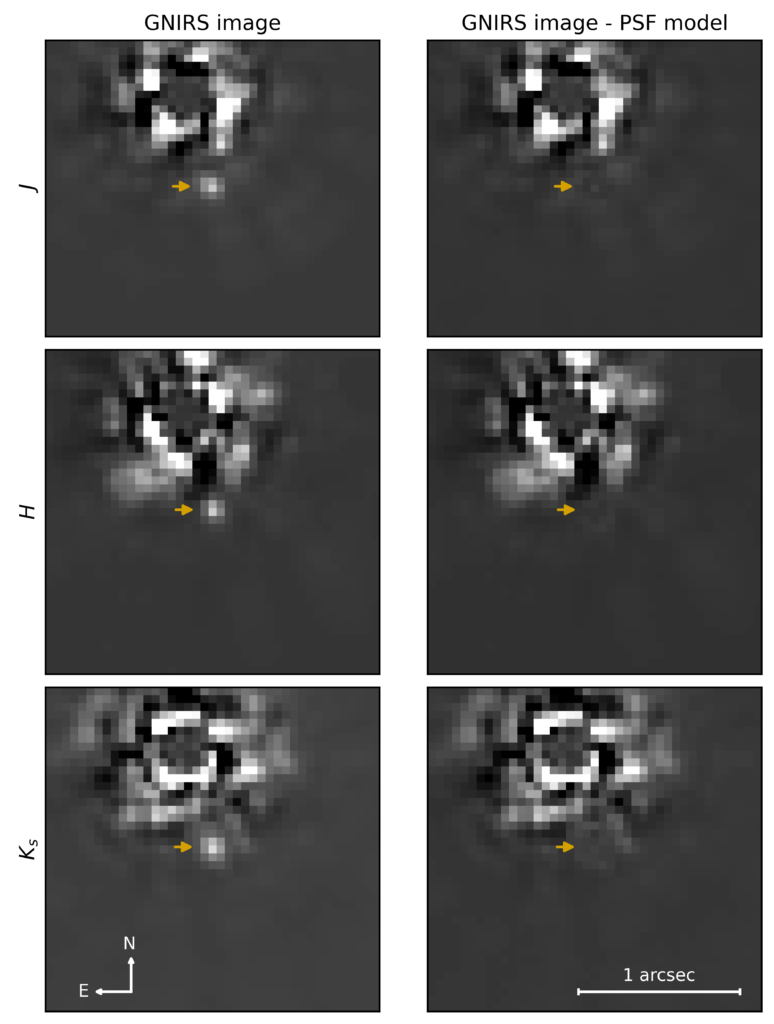
Other loose ends remain. Both white dwarfs point to a system nine to 11 billion years old, among the oldest in the Galaxy, yet the red dwarf is richer in heavy elements than the Sun, a trait more typical of younger stars. Blaming pollution from its dying neighbour would require the red dwarf to have swept up about two thirds of the metals the giant ejected and almost none of its hydrogen or helium; no known process works like that. The authors suggest the system may simply be a rare outlier. A hint of extra near-infrared light from the inner white dwarf could point to a dusty debris disc or a cold brown dwarf companion, but the signal is only about three sigma and the team describes it as tentative.
Part of what makes Welopōʻai striking is how long it hid in plain sight. An old infrared catalogue entry and no reliable distance led the team behind the CARMENES planet survey to mistake the red dwarf for a distant giant, so it went unmonitored. Follow-up looks straightforward: Gaia’s next data release should pin down the red dwarf’s own distance, currently borrowed from the outer white dwarf, and the James Webb Space Telescope (JWST) could settle the infrared excess.
The name, proposed through the ʻImiloa Astronomy Center of Hawaiʻi, joins the Hawaiian words for an inherited trait and an orbit, evoking a path of family traits. For a family this old and this odd, the inheritance is still being sorted out.
