

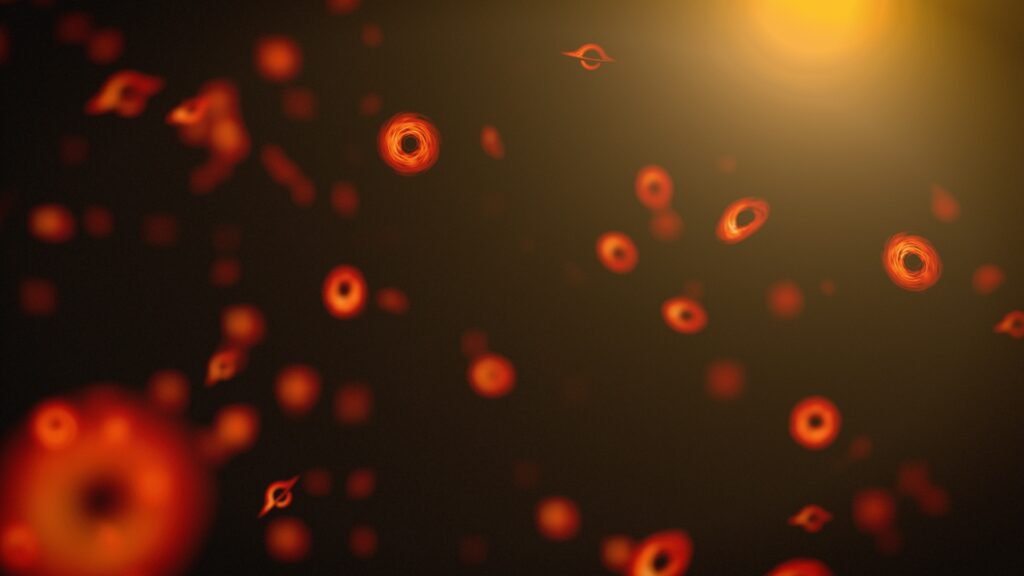
Most of the matter in the universe gives off no light, and nobody yet knows what it is. One long-standing idea is that some of it could be primordial black holes: objects squeezed out of the hot, dense first moments after the Big Bang rather than left behind by dying stars. The difficulty is finding something with the mass of an asteroid and the width of an atom. A new study suggests looking for stars that explode when they have no business doing so.
The work, led by Ore Gottlieb at the Massachusetts Institute of Technology (MIT) with colleagues at the Flatiron Institute, New York University and Stanford University, is published in The Astrophysical Journal. It follows a primordial black hole from the moment a star captures it to the moment the star dies. The team combined stellar evolution models, three-dimensional simulations built on general relativity and magnetohydrodynamics (the physics of flowing, magnetised gas), and statistical models of whole populations of stars. A preprint first appeared in June; MIT announced the peer reviewed version on 19 November 2026.
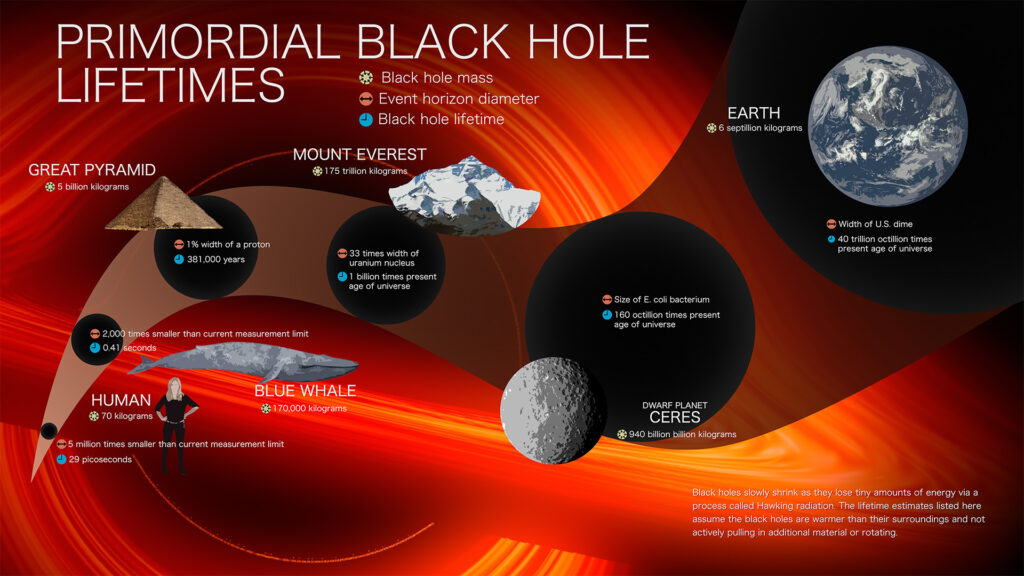
Its focus is the so-called asteroid-mass window, black holes of roughly 1017 to 1023 grams. Lighter ones would have evaporated long ago through Hawking radiation, the slow leak of energy that Stephen Hawking predicted for all black holes. In this window, existing searches still allow primordial black holes to make up a large share of dark matter, or even all of it. The heaviest are around a millionth of the mass of Earth.
A star on its own makes a poor trap. A black hole falling in from the wider galaxy simply swings through and leaves again. Capture needs a third body. A planet or companion star can steal some of the black hole’s orbital energy, much as Jupiter redirects passing comets, leaving it on a bound orbit that plunges through the star again and again until drag from the gas pulls it down into the core.
Once inside, the black hole eats slowly. Gas falls in from all sides, and growth takes millions to billions of years depending on the starting mass. Its fate then turns on rotation. If the infalling gas carries enough spin, it settles into a disc around the black hole while the star is still largely intact; magnetic fields threaded through that disc launch jets and winds that tear the star apart within minutes. If no disc forms in time, the black hole consumes its host quietly from the inside. In the team’s population models, the explosive route accounts for between 23 and 52 per cent of outcomes, depending on the black hole’s starting mass.
The explosion would not look like an ordinary supernova. The paper predicts a bright ultraviolet and blue flash lasting about a day, possibly accompanied by X-rays or a weak gamma-ray burst, followed by a radio afterglow. Under optimistic assumptions, with primordial black holes making up most of dark matter, such events could be roughly as common as low-luminosity gamma-ray bursts, a faint class that satellites already detect. The leftovers would be telling too. The explosive cases leave fast-spinning black holes with typical masses of six to 10 per cent of the Sun’s. Collapsing stars cannot make black holes that small, so gravitational wave detectors catching two of them merging would be hard to explain any other way.
All of this is theory. Nobody has seen such an event, and nobody has shown that primordial black holes exist at all. The scenario needs a particular setup: a companion to make the capture, and a host star spinning fast enough for a disc to form. The authors describe their capture rates as order of magnitude estimates, and their pessimistic and optimistic cases differ by a factor of 10,000. Other kinds of explosion could also produce a similar flash, so any candidate would need supporting evidence, such as a host star too small to explode by any normal route.
That last point is the attraction. Sun-like stars do not explode; they swell, shed their outer layers and fade. One that went off like a bomb would be a clue in its own right, and survey telescopes such as the Vera C. Rubin Observatory now sweep the sky every few nights for flashes that come and go within days.
If dark matter is partly made of tiny black holes, the first one anyone finds may not be seen directly at all. It may announce itself by destroying the star it was quietly eating from the inside.
