

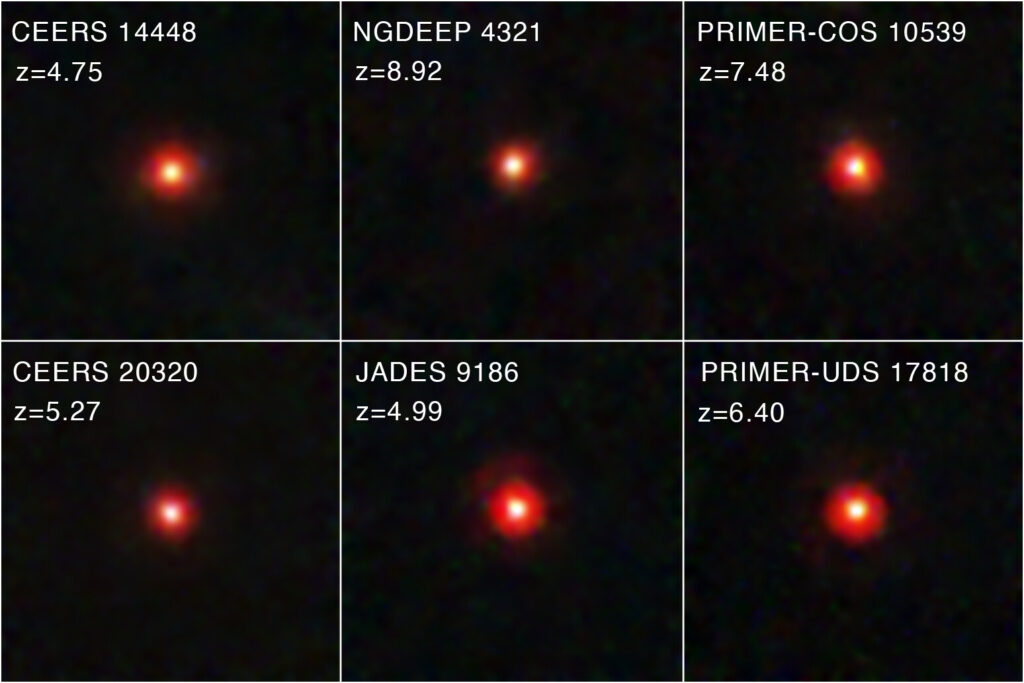
Supermassive black holes turn up far too early. Astronomers have found them only 700 million to 800 million years after the Big Bang, and nobody can yet say how they grew so large so fast. One way to find out is to catch them younger. A team led by Takumi Tanaka at the Kavli Institute for the Physics and Mathematics of the Universe in Tokyo has now confirmed a little red dot whose light left it when the universe was about 400 million to 500 million years old.
Little red dots are compact, strikingly red objects that the James Webb Space Telescope (JWST) began finding in 2022. Many appear to be growing black holes, though their nature is still debated, and known examples date from roughly 600 million to 1.5 billion years after the Big Bang. The new object, CW-LRD-z10, has a redshift of 10.36, a measure of how far cosmic expansion has stretched its light. The result appeared in The Astrophysical Journal Letters on 24 November 2026 (Tanaka et al.).
Finding it took a workaround. At that distance, much of the light that marks out a little red dot is stretched beyond 5 micrometres, the limit of Webb’s near-infrared camera. The team paired that camera with Webb’s Mid-Infrared Instrument in COSMOS-Web survey data, which first flagged the object in a study published in December 2025. Spectra taken for the EMBER programme then pinned down the distance, showing a sharp cut-off where neutral hydrogen absorbs ultraviolet light.
The timing matters. According to the Kavli IPMU announcement, promising theories place the birth of the seeds of supermassive black holes around 500 million years after the Big Bang. CW-LRD-z10 pushes observations into that window.
There is a catch, and it sits in the word candidate. The carbon and oxygen emission lines that back up the redshift are tentative, each detected at under four times the noise level, and an iron feature is only possible. The hydrogen lines that would reveal black hole activity are still to be studied, and planned mid-infrared spectroscopy should show whether a black hole really drives the red glow.
One faint dot cannot settle how giant black holes began. It does show where to look: in light that has drifted beyond the near infrared.
