

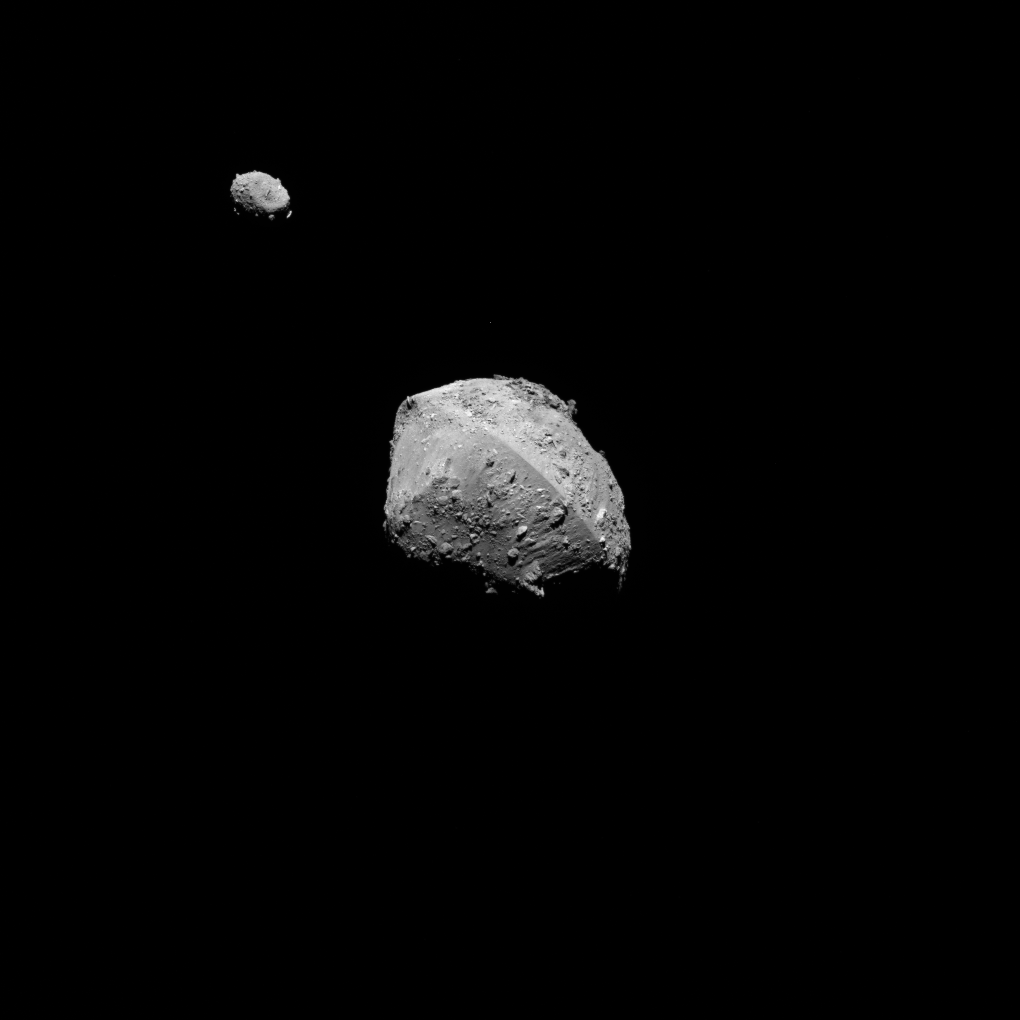
For four years the most famous dent in the Solar System was one nobody had actually seen. NASA’s DART spacecraft flew into the small asteroid moonlet Dimorphos in September 2022 and shortened its orbit; telescopes on Earth measured the change, but not the damage. Now the European Space Agency’s (ESA) Hera spacecraft has taken the first close look at the Dimorphos crater. The answer is untidy in the most useful way: the impact flattened an entire face of the asteroid and left it tumbling.
ESA unveiled the images on 25 November 2026 in the dinosaur hall of the Museum für Naturkunde in Berlin, a venue that made the case for planetary defence without saying a word. Dimorphos is 151 m across and circles Didymos, a 730 m asteroid, at an average distance of about 1 km. Before Hera arrived, scientists argued over three outcomes: a crater, a reshaped body, or almost no change. Patrick Michel of CNRS and the Observatoire de la Côte d’Azur, the mission’s principal investigator, gave the verdict: “Much to our surprise the answer turns out to be all three at once.”
The key frame came from Hera’s Asteroid Framing Camera, its main visible light imager, which took the picture on 7 November from 29 km away at a resolution of 2.7 m per pixel. One side of Dimorphos is now flat. The crater appears to be as wide as the face DART struck, roughly the footprint of a sports stadium, and inside it sit some odd structures, including what ESA describes as a cigar-shaped feature at its centre. Elsewhere, little has changed. The boulder fields covering the rest of the moonlet look just as they did in DART’s final images.
Before the collision, Dimorphos kept the same face turned towards Didymos, much as the Moon does with Earth. That arrangement is gone. According to Hera mission scientist Michael Kueppers, the impact has set the moonlet tumbling chaotically along its orbit, so the crater no longer stays politely in one place. A body turning around a wandering axis is harder to map, harder to approach and much harder to land on.
The second surprise is the company the asteroids keep. A long exposure from Hyperscout H, a camera that records 25 colours at once, shows hundreds of previously unknown boulders, each a few metres across, orbiting the pair. Some debris was expected. In December 2022 the Hubble Space Telescope picked out a few dozen boulders between 1 m and 6.7 m wide, drifting away from Dimorphos at about 1 km per hour. ESA has not yet said how many of Hera’s boulders came from DART, but the flight team now has to plan around them as the spacecraft moves closer.
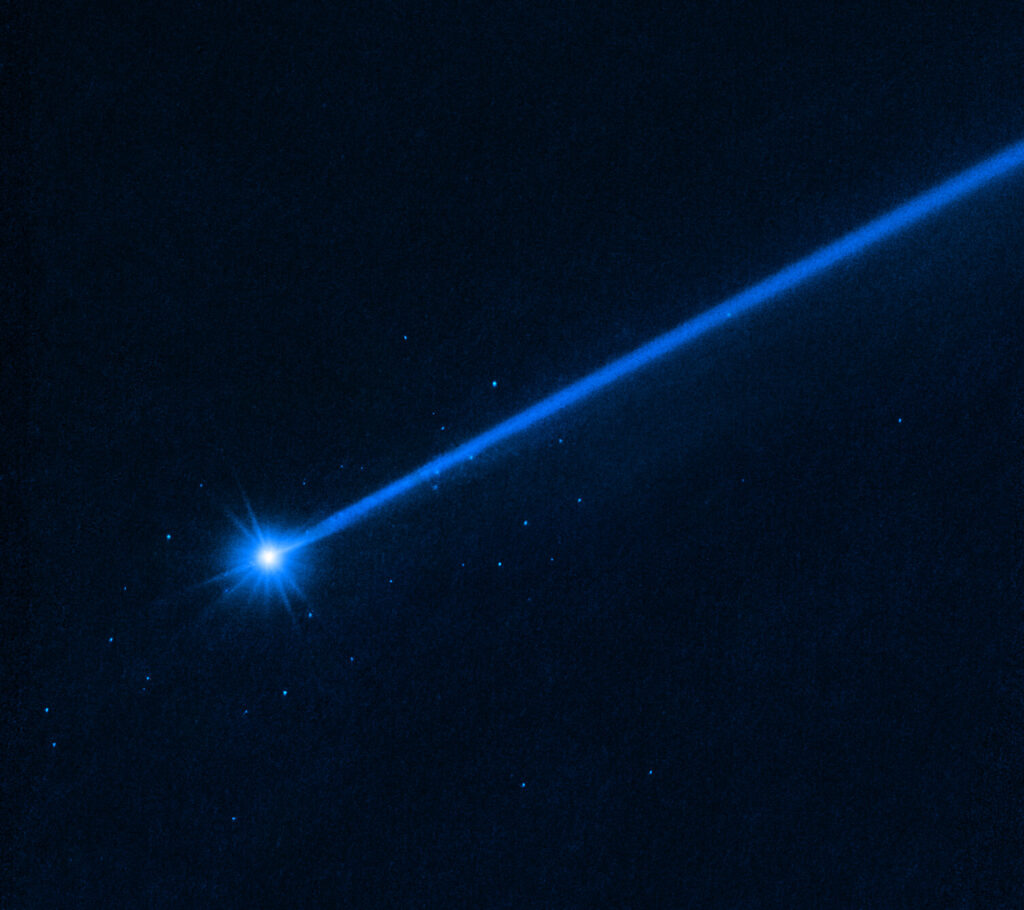
All of this feeds a practical question. A kinetic impactor works partly by brute force and partly by recoil: rock blasted off the surface acts like air rushing out of a balloon, adding to the spacecraft’s own push. NASA says that recoil substantially boosted DART’s shove, which helps explain why an orbit of 11 hours 55 minutes shrank by about half an hour, a much bigger change than forecasts had suggested. A crater spanning a whole face fits the picture of a great deal of material leaving in a hurry. If a real threat ever needs nudging, engineers will want to know how much extra push a given impact buys.
Answering that needs numbers ESA has not yet released. The announcement gives no diameter or depth for the crater, and the mass of Dimorphos, which decides how efficient the impact really was, is still to be measured. These are first looks from 25 to 30 km. In December Hera will close to about 13 km, and in January 2027 it plans to release two shoebox-sized CubeSats: Juventas, whose low-frequency radar will probe an asteroid’s interior for the first time, and Milani, which will study surface material and dust. NASA also cautions that a solid asteroid would throw off less debris than a loose rubble pile like Dimorphos, so one test cannot settle every case.
Sixty-six million years ago, an asteroid rewrote life on Earth without anyone taking notes. This time the notes are the point. Dimorphos was already the first Solar System object whose orbit humans had measurably changed. It now carries a scar to show its shape changed too, turning it towards Hera one moment and away the next.
