

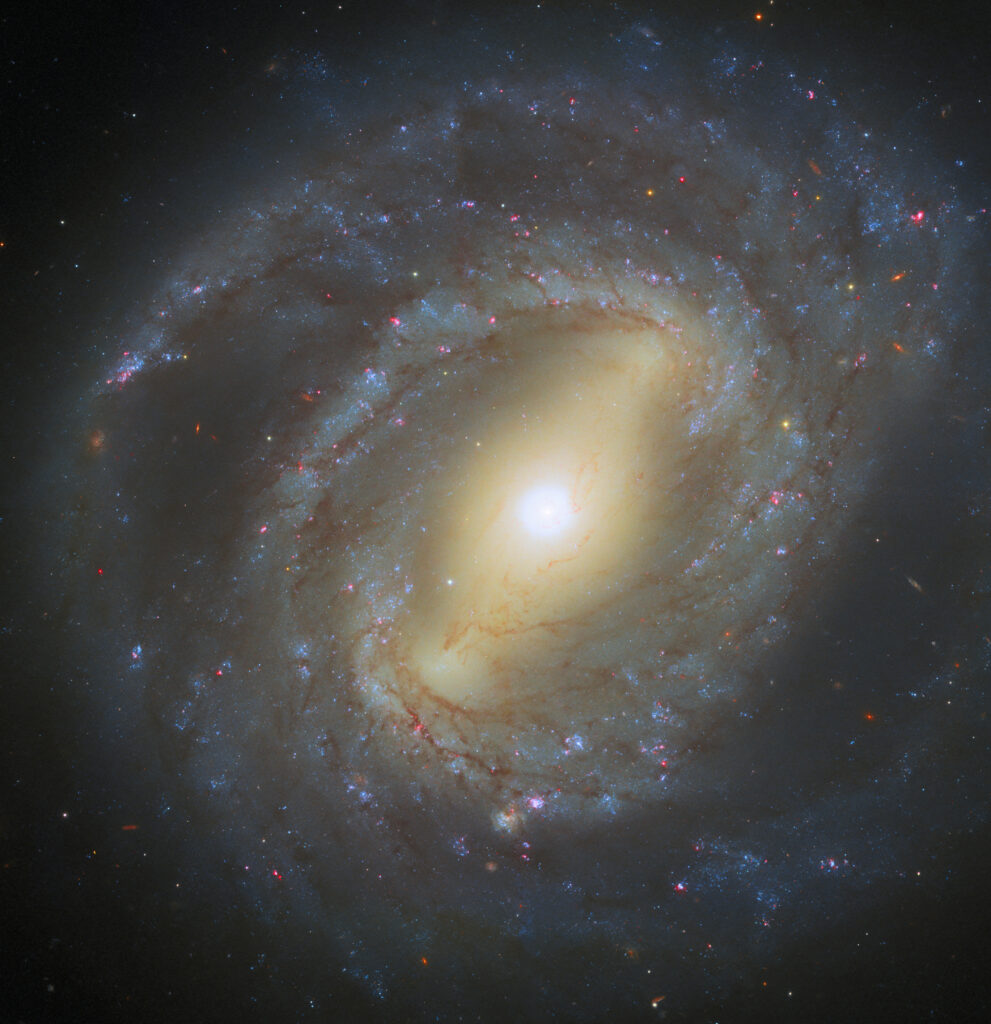
Every computer model of the Universe built on cold dark matter makes the same prediction about the heart of a galaxy: the invisible mass should pile up there, its density climbing steeply towards the centre like a crowd pressing towards a stage. A new survey of 136 nearby galaxies finds the crowd is thinner than expected. Across most of the sample, the central dark matter falls well below what leading simulations forecast, and in the heaviest galaxies the shortfall stretches tens of thousands of light-years from the core.
The study, led by Yu Lei and Ling Zhu of the Shanghai Astronomical Observatory with an international team, was published in Nature Astronomy on 26 November 2026. The team combined two records of motion. Spectroscopic maps from the MaNGA and CALIFA surveys show how stars move in the inner parts of each galaxy, while radio observations of neutral hydrogen gas, including new data from China’s FAST radio telescope, follow the rotation of the outer disc. Together they reach 20 to 50 kiloparsecs from the centre, roughly 65,000 to 165,000 light-years.
Weighing something invisible means watching what it does to things you can see. Stars and gas orbit faster when more mass lies inside their paths, so their speeds record the total mass at each radius. The researchers built orbit superposition models, which assemble a galaxy from thousands of individual stellar orbits until the mix reproduces the observed motions. Subtract the mass in stars, estimated from their light and colours, and what remains is dark matter. The galaxies span stellar masses from about one billion to 300 billion times that of the Sun.
The comparison with simulations is stark. At five kiloparsecs from the centre, the team set each galaxy against the spread of outcomes in the IllustrisTNG simulation. If real galaxies matched the model, about 16% should sit below the lower edge of its typical range by chance alone. In the three heavier mass groups, 77% to 88% did; in the lightest group, 31%. Among galaxies above roughly 30 billion solar masses, 90% have a smaller share of dark matter within 20 kiloparsecs than the simulated median. The low density region also grows with mass, from about 10 kiloparsecs across in middling galaxies to 20 to 30 kiloparsecs in heavier ones, and across the full 50 kiloparsecs the data can reach in the most massive.
One pattern stands out. As the galaxies get heavier, the density of stars at their centres rises about 25-fold, yet the dark matter density at the same spot changes by less than a factor of two. Whatever sets the amount of dark matter in a galaxy’s core, it does not appear to track the stars piling up there.
This is an old argument in a new venue. For decades, small dwarf galaxies have appeared to have flatter, cored centres than the steep cusps that simulations predict, a tension known as the cusp core problem. The usual remedy is that bursts of star formation and supernovae churn the gas, and the shifting gravity of that gas drags dark matter outward. That remedy works best in small galaxies with shallow gravity, which makes a deficit in galaxies as massive as the Milky Way much harder to explain.
Nor is one simulation to blame. EAGLE, SIMBA and the AIDA-TNG suite all predicted more central dark matter than was measured in galaxies between roughly 10 billion and 300 billion solar masses. AIDA-TNG includes versions with self-interacting dark matter, in which particles can bounce off one another and spread out, flattening the centre. That nudged the predictions the right way for the biggest galaxies but produced a deficit neither as deep nor as wide as the one observed.
The catch is real. Separating stars from dark matter in the inner few kiloparsecs is hard, because heavier stars with lighter dark matter can produce nearly the same motions as the reverse. Within five kiloparsecs the dark matter fraction carries uncertainties above 50%, and some individual galaxies would allow several times more dark matter than the best fit. The models also assume a spherical halo, an orderly gas disc and a particular recipe for turning starlight into stellar mass, and galaxies with disturbed hydrogen were left out. Tests on 58 simulated mock galaxies recovered the total mass to within 10% between two and 20 kiloparsecs, but a statistical pattern across a sample is not the same as a clean measurement in every galaxy.
What could empty the middle? The paper lists candidates without choosing one. Supermassive black holes can blast gas out of a galaxy’s centre, and the sudden loss of mass would let dark matter drift outward. Dark matter halos might simply be lighter than standard relations between stars and halos assume. Or the particles themselves may behave differently from the cold, collisionless material in the models. The physical origin “remains unclear”, the authors write, and they offer their measurements, also available as a preprint on arXiv, as a benchmark for future simulations.
Cold dark matter has earned its standing on the largest scales. The insides of ordinary galaxies are where it has to meet stars, gas and black holes at close quarters, and on this evidence the meeting is not going smoothly. The next generation of cosmological simulations now has 136 galaxies to answer to.
