

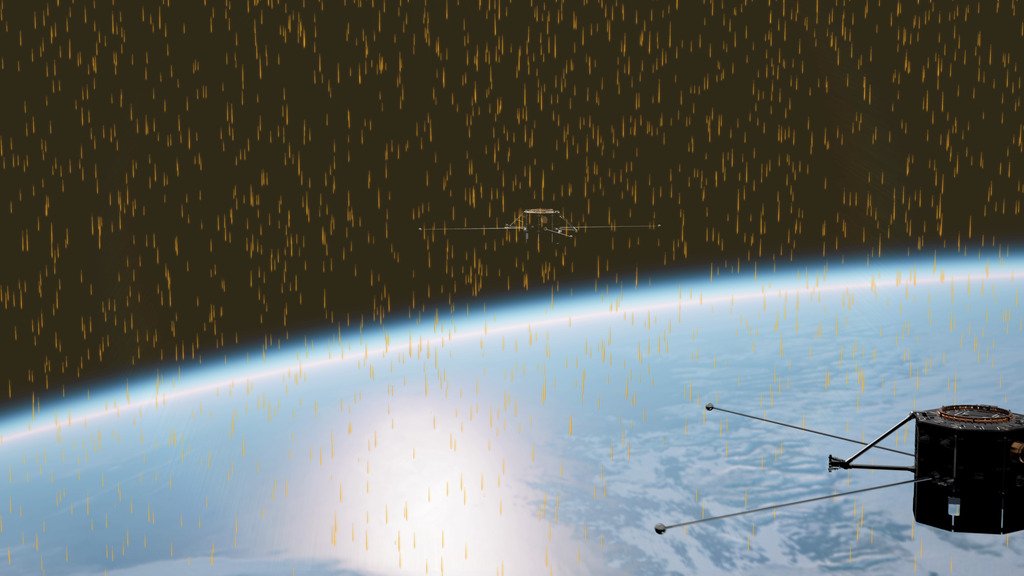
On the sunward edge of Earth’s magnetic field, the solar wind carries its own magnetic field into ours. Where the two meet at the right angle, field lines break and rejoin, and energy pours into near-Earth space. This process, called magnetic reconnection, powers auroras and geomagnetic storms. A single spacecraft crossing the region cannot tell whether reconnection is flickering on and off in one place or running steadily while its location shifts. The first peer reviewed results from NASA’s twin TRACERS satellites favour the second picture.
The study, led by Stephen Fuselier of Southwest Research Institute, appeared on 29 October 2026 in the Journal of Geophysical Research: Space Physics (Fuselier et al.). It uses the Analyzers for Cusp Ions aboard both spacecraft, which launched on 23 July 2025, during paired passes through the polar cusp between November 2025 and February 2026. The cusp is a funnel shaped gap in the magnetic field where solar particles stream down towards the atmosphere.
Everything rests on the tandem. The satellites fly one behind the other about 580 kilometres (360 miles) up, sometimes as little as 10 seconds apart, according to NASA’s mission overview. Ions reaching the cusp arrive sorted by energy, in patterns set by where and when reconnection opened the field lines that guided them. If both spacecraft see the same pattern, the structure is fixed and they simply crossed it. If it changes between passes, reconnection itself has changed. Across every orientation of the solar wind’s magnetic field and every solar wind pressure examined, spatial differences outweighed changes over time by at least a factor of two.
That distinction matters for forecasting. A reconnection site that pulses in place feeds energy into the magnetosphere differently from one that wanders, and space weather models need to know which they are dealing with. A companion preprint, not yet peer reviewed, uses the same kind of cusp data to estimate reconnection rates during a storm on 30 September 2025, with results that track ground radar measurements reasonably well.
The authors call their findings preliminary. Most encounters classed as spatial still showed some change over time, and confirming the pattern needs more tandem passes. One satellite also suffered a setback after launch before the team regained contact, as NASA’s mission update notes. Fuselier calls the work “an important first step in understanding how magnetic reconnection works.” NASA has extended the prime mission into spring 2027, which should supply those extra passes.
For decades, researchers have tried to judge a moving scene from a single photograph. TRACERS takes two, seconds apart. The early verdict is that the scene rarely changes; the camera is simply pointed at a different part of it.
