
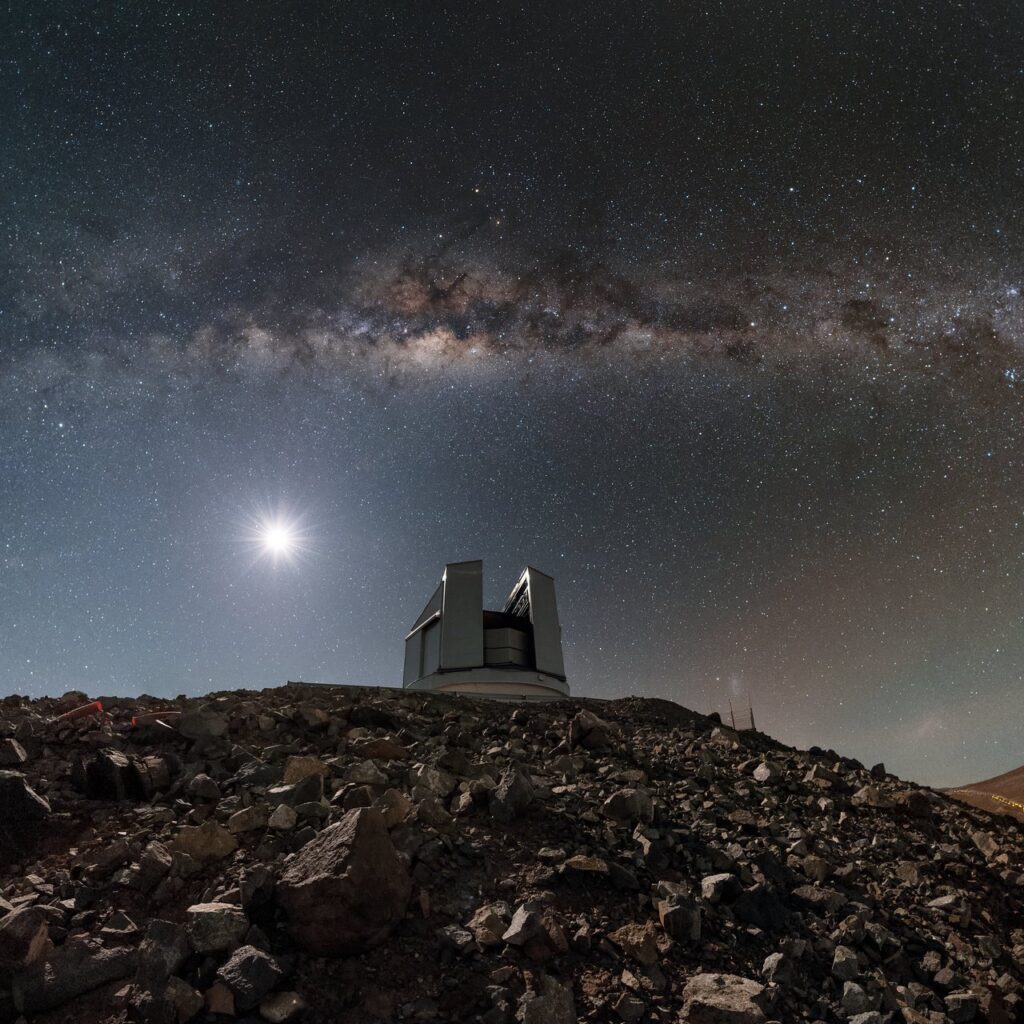
A photograph of the sky shows astronomers where things are. It cannot tell them how far away those things lie, what they are made of or how fast they are moving. For that, starlight has to be spread into a spectrum, and the southern sky holds far more targets than any telescope could ever examine one by one. The 4MOST survey, run by the 4-metre Multi-Object Spectroscopic Telescope, has just begun at a European Southern Observatory (ESO) telescope in Chile, and it attacks that queue by taking spectra of more than 2,400 objects at once.
After 15 years of development, 4MOST has started its main science programme, the Max Planck Institute for Extraterrestrial Physics (MPE) announced on 26 November 2026. The instrument sits on ESO’s Visible and Infrared Survey Telescope for Astronomy (VISTA) at Paranal, where it replaced the infrared camera that had surveyed for VISTA since 2008. The Leibniz Institute for Astrophysics Potsdam (AIP) leads the 4MOST consortium: 30 institutes and around 800 scientists from Europe, Chile and Australia. Over the next five years the plan is to record more than 50 million spectra.
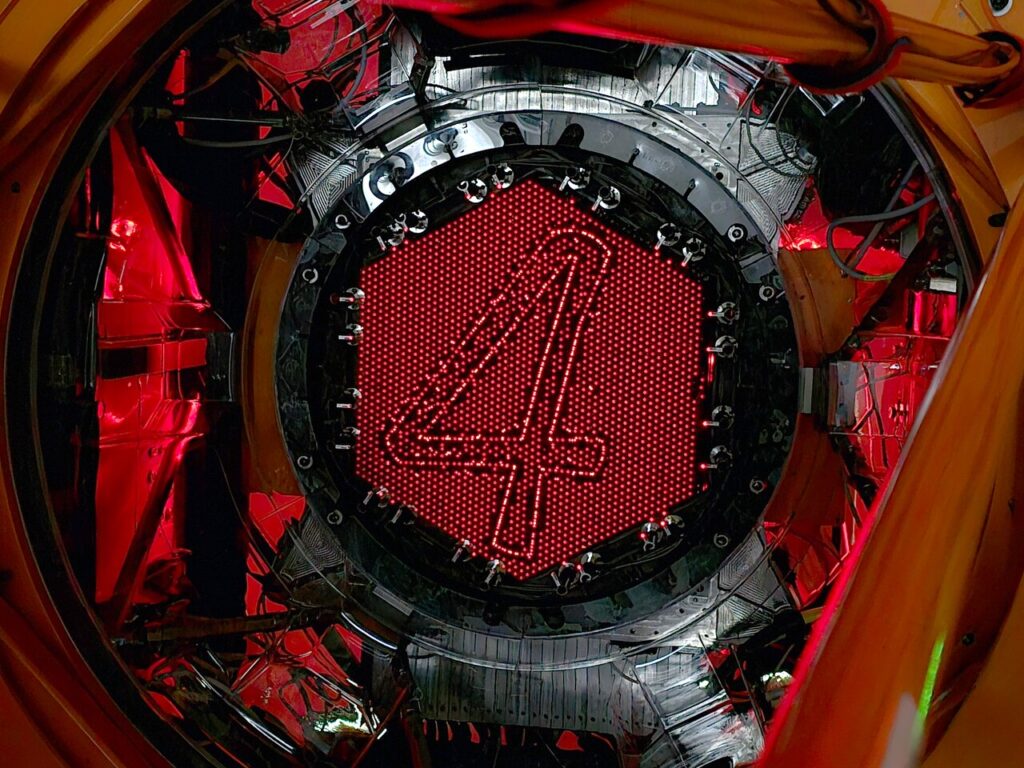
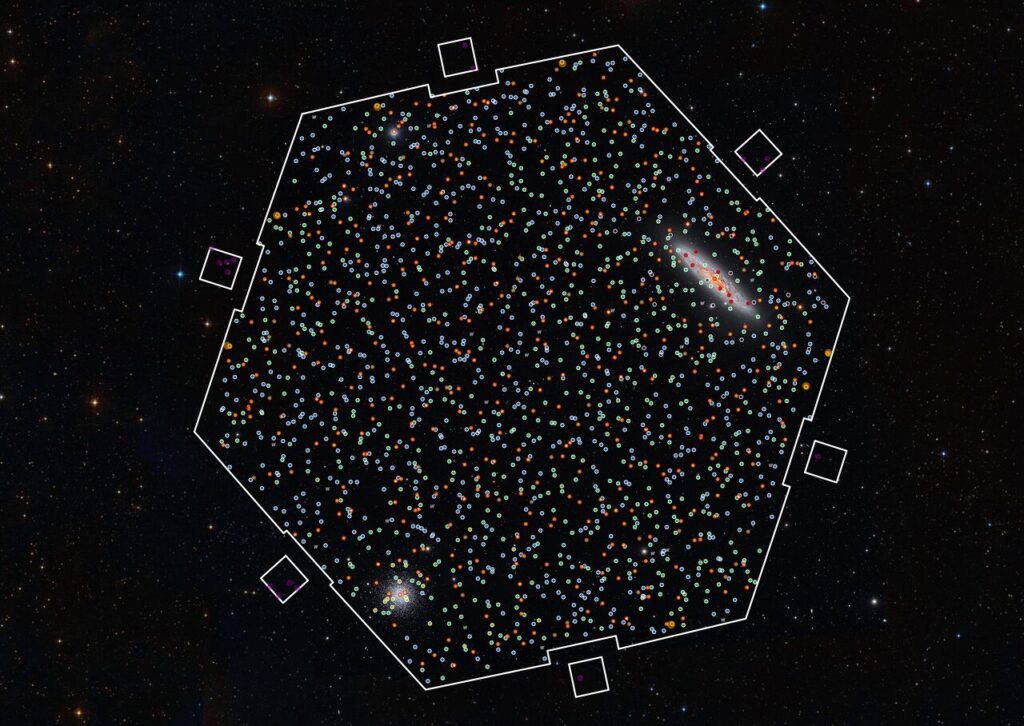
The trick is parallelism. A robotic positioner places each of its optical fibres, every one about as thick as a human hair, on a chosen star, galaxy or quasar inside a hexagonal patch of sky roughly the size of 16 full Moons. The fibres carry that light to three spectrographs, which split it into as many as 18,000 colour components, according to ESO. Each spectrum reveals an object’s chemical make-up and its speed along the line of sight. For distant galaxies it also gives the redshift, the stretching of light by cosmic expansion that astronomers use as a distance gauge.
Because each pointing captures so many targets, 25 separate surveys share the same fibres and the same nights. ESO expects 4MOST to study more than 25 million different objects in its first five years. Some programmes will read the chemistry of Milky Way stars to reconstruct how our galaxy was assembled. Others chase distant galaxies, growing black holes and the expansion history of the universe. No single team could justify that much telescope time alone; pooled, the surveys keep every fibre busy.
Just as unusual is who decides where the telescope points. ESO staff run VISTA at Paranal, but each night’s plan comes from software written at MPE in Garching, an arrangement ESO calls designated visitor mode. Andrea Merloni, who has led the operations system since 2012, calls it “a new paradigm” for the observatory. The scheduler runs unsupervised all night. It watches cloud, wind and seeing (the blurring of starlight by atmospheric turbulence), plans about an hour ahead and steers clear of the laser guide stars fired by the neighbouring Very Large Telescope. When conditions worsen, it switches to brighter targets and shorter exposures.
For MPE, the prize is distance. The eROSITA X-ray telescope has already shown where galaxy clusters and actively feeding black holes sit on the sky, but an X-ray map is flat. Spectra add the third dimension. One MPE-led programme aims to measure distances to around one million galaxies in clusters, looking back about six billion years, and to map the thin filaments of the cosmic web where some of the universe’s missing ordinary matter is suspected to hide. Counting clusters and tracing how their distribution has grown lets astronomers test whether dark energy behaves like the cosmological constant in Einstein’s equations.
None of this arrives quickly. The survey runs for five years, and the more than 800,000 usable spectra gathered during the test phase alone will not be made public until June 2027. A fully automatic scheduler is efficient, but it also means the instrument’s output rests on software making sound choices every night with no human at the controls, at a site where wind or rain can force the dome shut. Spectra are also raw material rather than conclusions. Turning distances to a million galaxies into a verdict on dark energy will take years of careful modelling.
During installation, engineers once arranged the fibres to spell out a giant number four, a small joke played with thousands of moving parts. From now on the pattern changes with every pointing, set by the sky rather than by the team. A few thousand points of starlight at a time, the southern sky is about to be read, not just photographed.
