
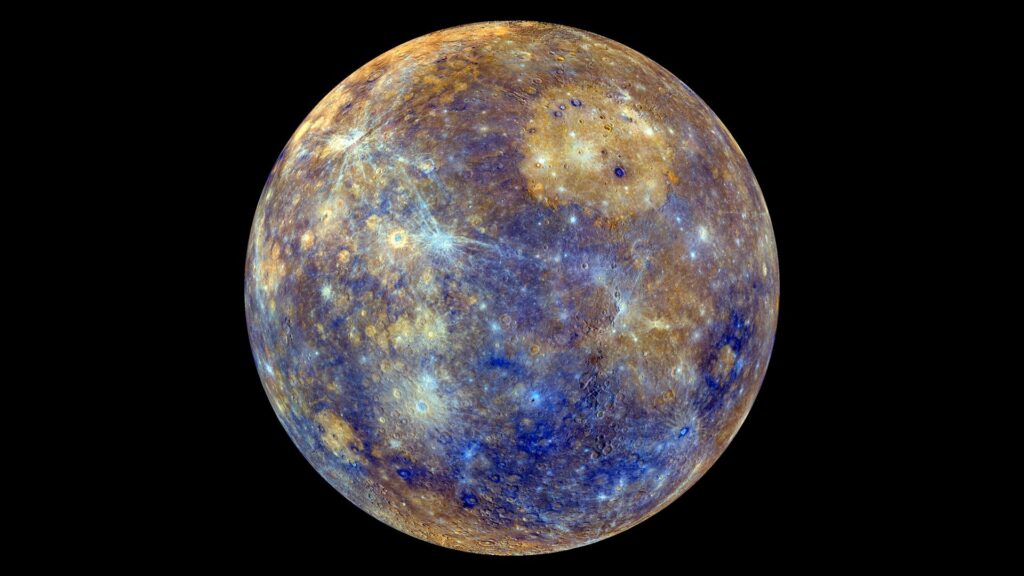
Reaching Mercury is easy compared with stopping there. A spacecraft heading towards the Sun picks up speed all the way in, and shedding it took BepiColombo eight years, solar electric propulsion and nine planetary flybys. On 21 November the joint ESA and JAXA mission finally entered Mercury orbit, becoming only the second mission ever to do so, though not quite in the way its controllers had planned.
According to ESA’s account, published on 23 November, the spacecraft turned into position and ran its commands alone during a planned loss of contact. At 18:24 UTC, 635 kilometres above the surface, its four axial thrusters began a burn meant to last 37 minutes. When the New Norcia ground station in Australia picked up the signal again, telemetry showed that the burn had stopped early. The spacecraft had dropped into safe mode, a protective state that pauses all but its most basic functions.
Most of the job was done. The burn delivered about 77% of the planned change in velocity, which was enough for Mercury to capture it. The price is a looser orbit than intended, taking 75 hours per lap instead of 58. Flight dynamics teams have reworked the remaining sequence so that no extra burns are needed, and engineers at ESA’s operations centre in Darmstadt and at Airbus are investigating a glitch in the software that guides the spacecraft’s attitude and controls its thrusters.
The arrival was a first in its own right. BepiColombo is the first spacecraft to enter orbit around another planet by weak stability capture, a technique that arrives at a lower speed than is usual for planetary missions, so a smaller push from the engines is enough for the planet to take hold. Until now only some Moon missions had used it. The insertion was also split into several burns. Long ones waste propellant on what engineers call gravity loss: thrust spent fighting gravity rather than reshaping the orbit.
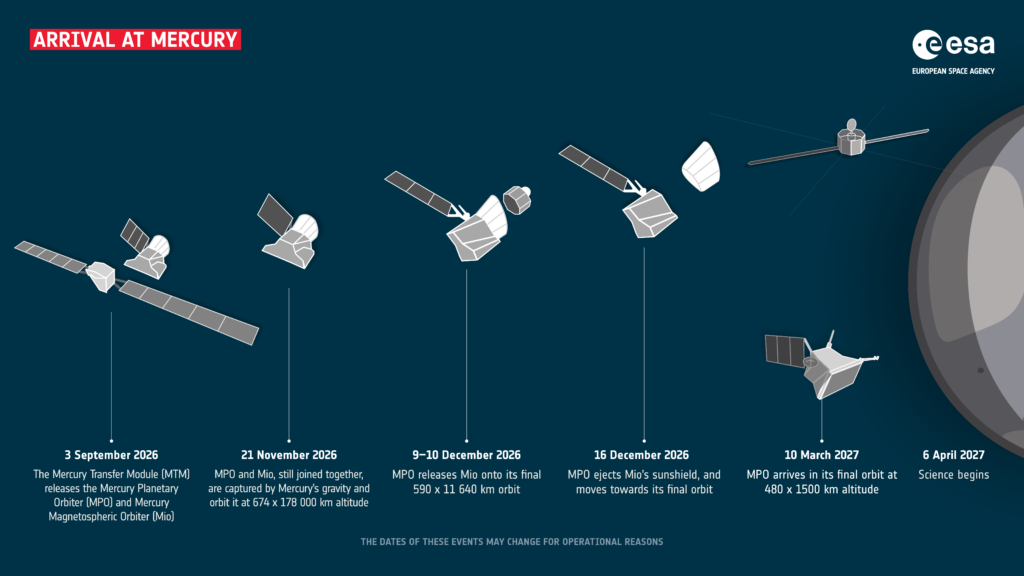
Science is still months away. The two orbiters, ESA’s Mercury Planetary Orbiter and JAXA’s Mio, are due to separate on 9 and 10 December, and the sunshield that protected Mio during the cruise should be released on 16 December. The planetary orbiter is then due in its final orbit in March 2027, with science operations starting in April. ESA’s arrival timeline warns that exact dates may still shift, and the investigation into the fault is continuing.
For a spacecraft that spent eight years learning to slow down, arriving slightly too fast has cost it 17 hours a lap. For now, that is a bargain.
