

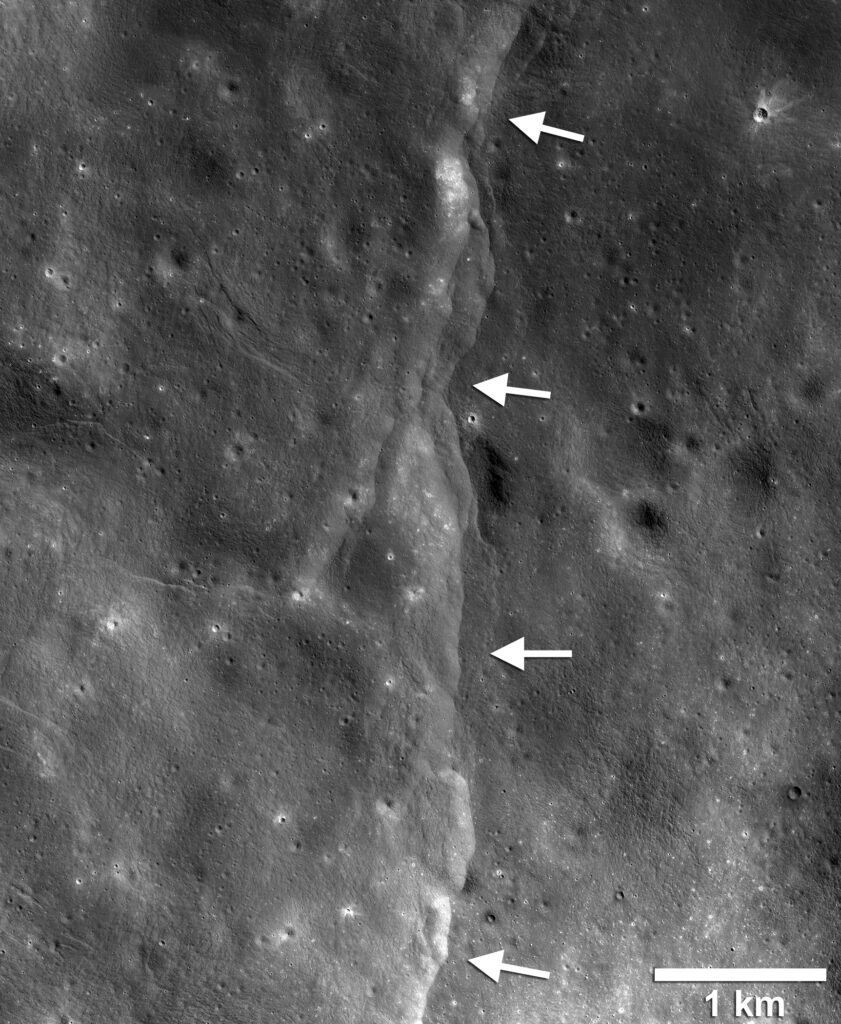
The Moon looks like the very picture of a finished world. It has no weather, no oceans and no drifting continents, and its grey surface seems frozen in place. Yet it is still getting smaller. A new map of more than 10,000 young faults shows that the shrinking Moon has lost about 45 metres (148 ft) of radius over the past 400 to 800 million years, and the cracks it has left behind are scattered across almost the entire surface. For anyone planning to build there, that is more than a curiosity.
Thomas Watters, a scientist emeritus at the Smithsonian’s National Air and Space Museum, led the study, which was published on 14 October 2026 in The Planetary Science Journal. Watters and his co-authors Maria Banks, Cole Nypaver and Mark Robinson worked through images from the Lunar Reconnaissance Orbiter Camera (LROC), which has circled the Moon aboard NASA’s Lunar Reconnaissance Orbiter since its launch on 18 June 2009. Seventeen years in orbit add up to millions of frames. In them the team mapped more than 8,900 lobate scarps and more than 2,000 small mare ridges. Watters said in the museum’s release that the count was “much greater than I ever imagined.”
Cooling does the work. A rocky body that cools also contracts, and a rigid crust resting on a shrinking interior has to give somewhere. On the Moon it gives by thrust faulting, in which the crust breaks and one side is pushed up and over the other. The result is a lobate scarp: a cliff-like step in the ground, typically under 10 kilometres long and tens of metres high, according to an earlier NASA summary of the team’s work. Small mare ridges record the same squeeze in the dark volcanic plains. The tallest scarp highlighted in the new study, on the floor of Mouchez L crater near the north pole, rises more than 100 metres above the terrain around it.
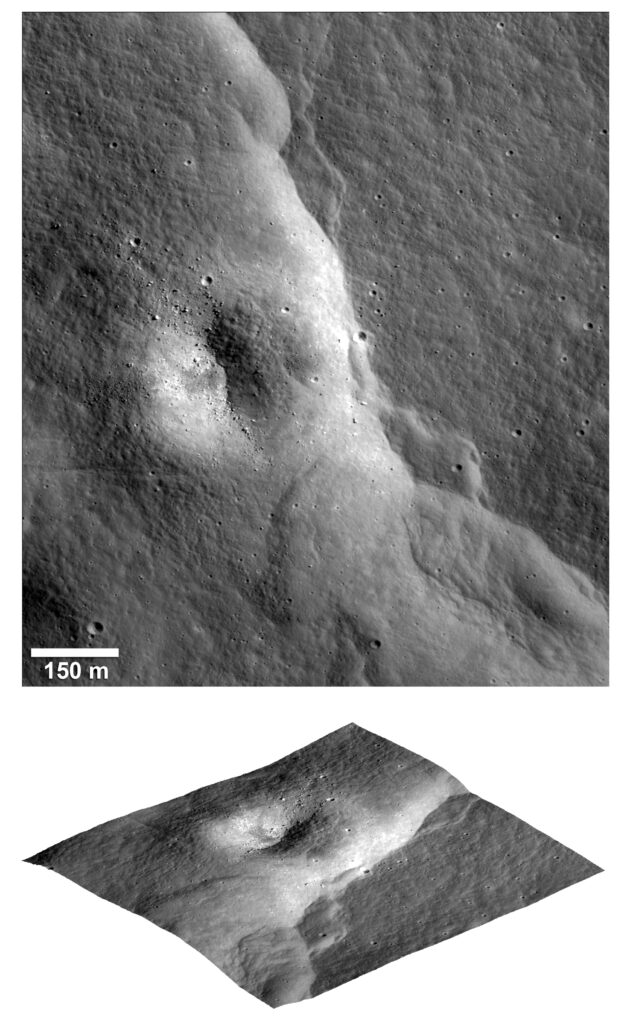
Spread evenly over the period, the contraction works out at 6 to 11 centimetres per million years, or about 0.1 micrometres a year. That is slow even by geological standards. Earth’s tectonic plates move about 1.5 centimetres a year, roughly the rate at which fingernails grow. The Moon shrinks around 150,000 times more slowly.
Speed is not the interesting part, though. Location is. Earth has more than 15 lithospheric plates, and their boundaries host about 90 per cent of the planet’s tectonic and seismic activity, which is why earthquake hazard maps have such sharp edges. The Moon is a single plate. With no boundaries to concentrate the strain, faults can form or slip almost anywhere, and so can moonquakes. The new map bears this out: young faults turn up across the globe, although some regions carry far more than others.
That has direct consequences for Artemis. Watters’s earlier work, published in January 2024, linked one of the strongest shallow moonquakes recorded by Apollo seismometers, about magnitude 5, to a young thrust fault in the south polar region. The same study found faults near or within areas NASA has proposed for crewed landings, including the de Gerlache Rim 2 site, and modelled how even light shaking could send regolith (the loose, dusty surface layer) sliding down steep slopes. A global fault map gives mission planners something firmer than a hunch about where the ground is steady. The thickest crust appears to hold the fewest faults, which may make those regions the most stable places to build.
There is a puzzle, too. If the Moon has been cooling since it formed, why does so much of its faulting look recent? The authors suggest the crust itself is the answer. A thick, heavily fractured and porous crust may behave like a layer of insulation, trapping heat from the core and holding off widespread contraction until relatively late in lunar history. It is an attractive idea, but it remains a proposal rather than a measurement.
The headline rate carries caveats of its own. The figure of 6 to 11 centimetres per million years assumes the Moon has contracted steadily, and the fault ages span a window of several hundred million years. A map also shows where the crust has moved, not how often each fault slips today. Answering that will take long-term seismic monitoring on the surface, ideally close to the places where people intend to live.
Watters expects existing faults to keep growing and new ones to form as the interior goes on cooling. On any human timescale the Moon will never look smaller; a tenth of a micrometre a year is invisible. But the ground beneath a future base is not quite as settled as it appears. The cliffs in those orbital images are the evidence: a world still cooling, and still quietly cracking as it does.
