

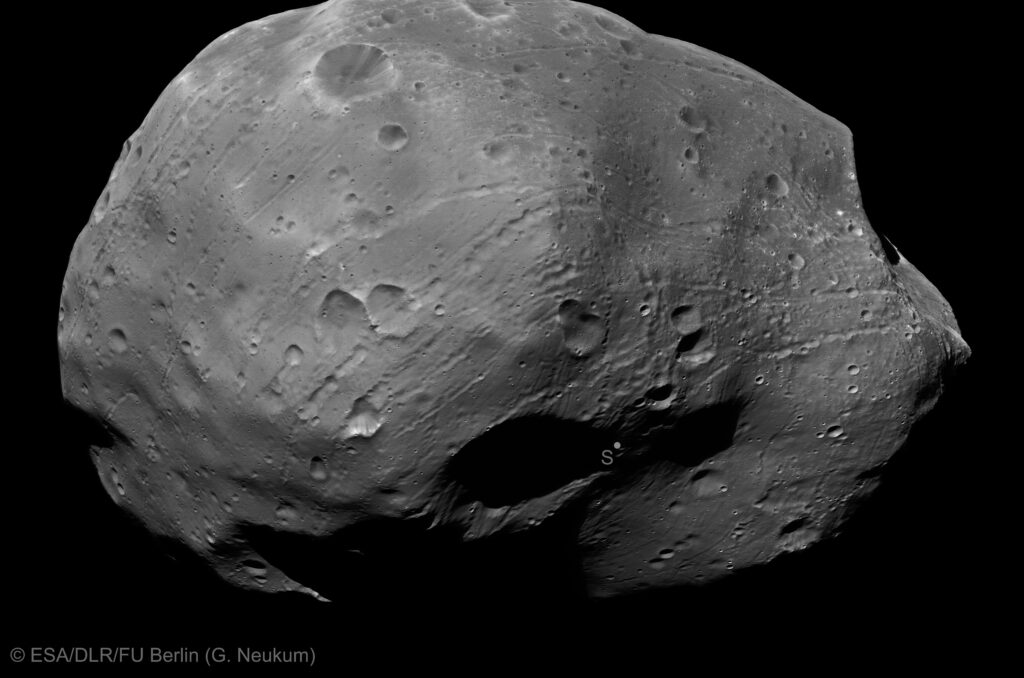
Mars has two small, dark moons, and after decades of study nobody can say with confidence how it got them. Were they asteroids captured from passing traffic, or rubble flung into orbit when something enormous struck the planet? The MMX mission, which left Earth on Monday evening UK time, intends to settle the argument in the most direct way available: land on Phobos, collect some of its surface and bring it home.
Martian Moons eXploration (MMX) is led by the Japan Aerospace Exploration Agency (JAXA), working with NASA, ESA and the French and German space agencies. An H3 rocket lifted off from Tanegashima Space Center at 04:41 Japan time on 20 October, or 20:41 on 19 October in the UK. JAXA confirmed that the spacecraft separated about 71 minutes later and reached its planned orbit. It is built in three parts: a propulsion module to get it there, an exploration module to do the work and a return module to make the trip home.
Getting close to Phobos is harder than it sounds. The moon measures roughly 27 by 22 by 18 km, according to NASA, and its gravity is far too feeble to hold a spacecraft in an ordinary orbit. MMX will instead fly what engineers call a quasi-satellite orbit. The spacecraft circles Mars on a path matched to Phobos, so that from the moon’s point of view it appears to loop around it. No spacecraft has flown one around Phobos before.
The schedule is long and carefully staged. ESA’s mission timeline has MMX reaching Mars in August 2027 and settling near Phobos a month later. Early in 2029 it is due to release Idefix, a 25 kg rover that would weigh about as much as a 15 g object does on Earth. Idefix will test the ground and report on its texture before the main spacecraft commits to touching down. The landings and sampling follow in 2030, with a target of at least 10 grams of material, and a capsule should come down in Australia in 2031.
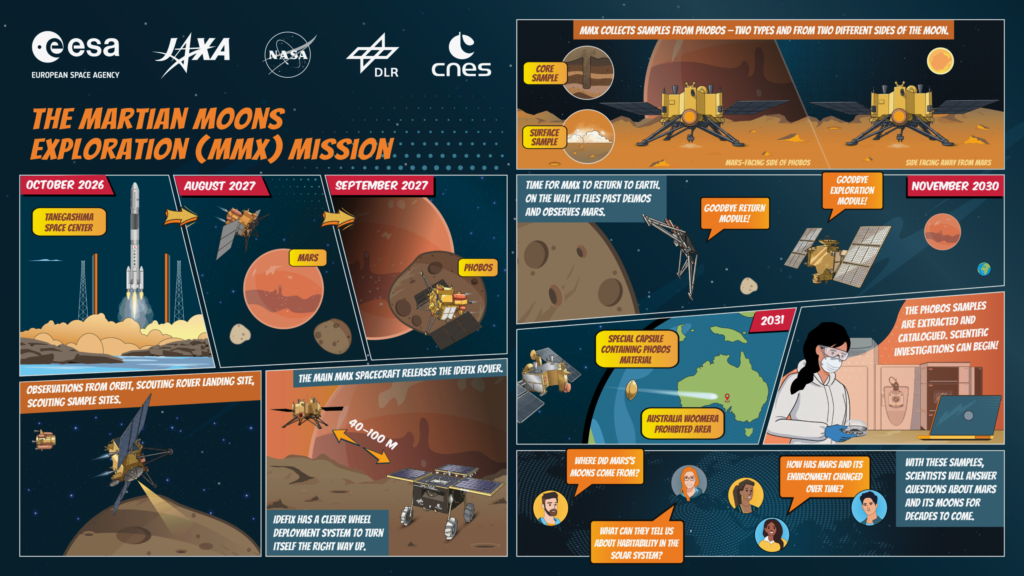
Before anything is scooped up, the spacecraft will read the moon’s chemistry from a distance. NASA’s contribution, an instrument called MEGANE, measures the gamma rays and neutrons that Phobos gives off when cosmic rays and solar particles strike its surface. Those energies reveal which elements are present, and the map they produce will help choose where to land. It also gives a first answer that the returned grains can later confirm or overturn.
Composition is the heart of the question. A captured asteroid should carry the chemistry of wherever it formed, and JAXA has said the moons look a lot like carbon rich asteroids. A moon assembled from impact debris should look much more like Mars itself. The two ideas predict different rocks, which is exactly why a sample in a laboratory is worth more than any number of remote observations.
This matters well beyond Phobos. If the moons are captured carbon rich asteroids, bodies like them may have delivered water and the ingredients of an atmosphere to the young Mars, and perhaps to Earth too. If they are impact debris, Phobos may be built from material blasted off Mars long ago, a free sample of the planet without the trouble of landing on it. Either way, MMX would return the first surface sample from any moon other than our own.
Almost every step is new, and that is the catch. Touching down where gravity is this weak is closer to docking than landing; push too hard and the spacecraft simply drifts away. Ten grams from two sites is a small window on a whole moon, and it may not end the debate if the surface turns out to be a mix of both origins. And no grains reach a laboratory before 2031, after a round trip of roughly five years.
Phobos is also on borrowed time. NASA notes that it creeps about 1.8 metres closer to Mars every century, and in roughly 50 million years it will either crash into the planet or break apart into a ring.
MMX is going to fetch a piece of it while there is still a moon to fetch from.
