

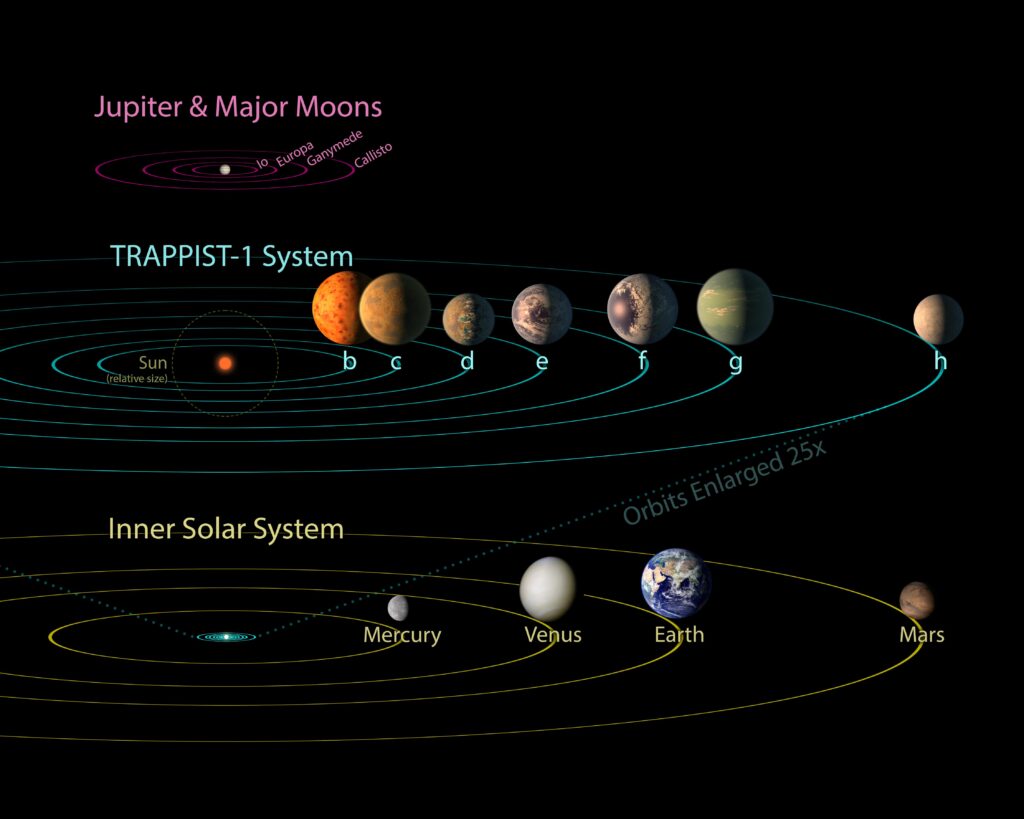
The Solar System was once treated as the template for how planets ought to arrange themselves. Then exoplanet surveys turned up giant worlds skimming their stars and tight rows of small planets packed inside Mercury’s distance. A study published in Nature Astronomy on 13 October 2026 suggests this variety follows a pattern. Comparing about 300 well characterised multi-planet systems, a team led by Italy’s National Institute for Astrophysics (INAF) finds they fall into two distinct families, and the dividing line runs through the host star.
Diego Turrini of INAF and Camilla Danielski of the University of Valencia led the work, which grew out of a team at the International Space Science Institute in Bern. The researchers chose the best understood systems from the more than 1,000 multi-planet systems known in the Milky Way. They compared them using what they call dynamical temperature: a measure of how far a system has strayed from a calm arrangement in which every orbit is circular and every planet shares one plane.
One family is wide and heavy, with total planetary masses between two and 10 times the Solar System’s. These systems orbit stars more massive and richer in metals (astronomers’ word for every element heavier than hydrogen and helium) than the Sun. They run hot, pointing to histories of instability, giant collisions and planets thrown out entirely. The other family is compact and modest. Its planets resemble one another in size and mass, a pattern nicknamed peas in a pod, and mostly circle far closer in than Mercury, around stars no heavier and no more metal rich than the Sun.
Simulations offered a cause. The runs that best reproduced the first family started out unstable: a richer supply of building material lets planets grow too large to settle, so they jostle until something gives. As Turrini puts it in the INAF announcement, “there is a genetic link between planetary systems and their stars.” If that holds, a star’s mass and composition could tell astronomers what sort of neighbourhood to expect before a single planet is found.
The catch is the sample. Most known exoplanets were found by methods that favour large planets on short orbits, and the authors say their hardest task was showing the two families were real rather than a product of those biases. They concluded the biases were only the visible tip of deeper differences. Still, 300 systems is a small census, and simulations show what is plausible, not what happened.
By the team’s account, the Solar System’s history looks more like the calm family’s than the violent one’s. That quiet past may owe less to luck than to the ordinary star at its centre.
