

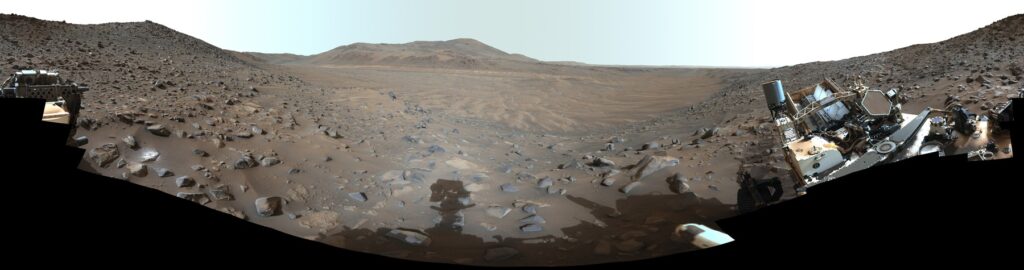
The Apollo astronauts learned that one of the Moon’s most stubborn hazards was the dirt. Lunar dust scratched helmet visors, wore down the outer layers of suits and damaged the seals that kept air in, and some crew members reported symptoms resembling hay fever. Anyone planning to send people to Mars has to ask how much of that story will repeat. A new study using NASA’s Perseverance rover gives the first direct measurements of the smallest grains of Mars dust, and they turn out to be very good at hanging on.
Led by Scott VanBommel of Washington University in St. Louis with 34 co-authors, the work was published on 26 October 2026 in the Proceedings of the National Academy of Sciences. It draws on 1,645 Martian days of rover operations. Over that time, the team found particles as small as 100 to 200 nanometres (billionths of a metre) clinging to samples of spacesuit material that Perseverance has carried across Jezero Crater, according to the paper and NASA’s announcement.
Perseverance was never meant to be a dust laboratory. Its robotic arm carries SHERLOC, an instrument that searches rocks for organic molecules, and SHERLOC’s calibration target (a plate of reference materials used to check the instrument’s settings) includes five spacesuit swatches, each 20 millimetres square. They are a polycarbonate visor, Vectran from glove palms, Ortho-Fabric and two kinds of Teflon. NASA sent them to see how suit materials weather on the Martian surface. For years they have also been quietly collecting dust.
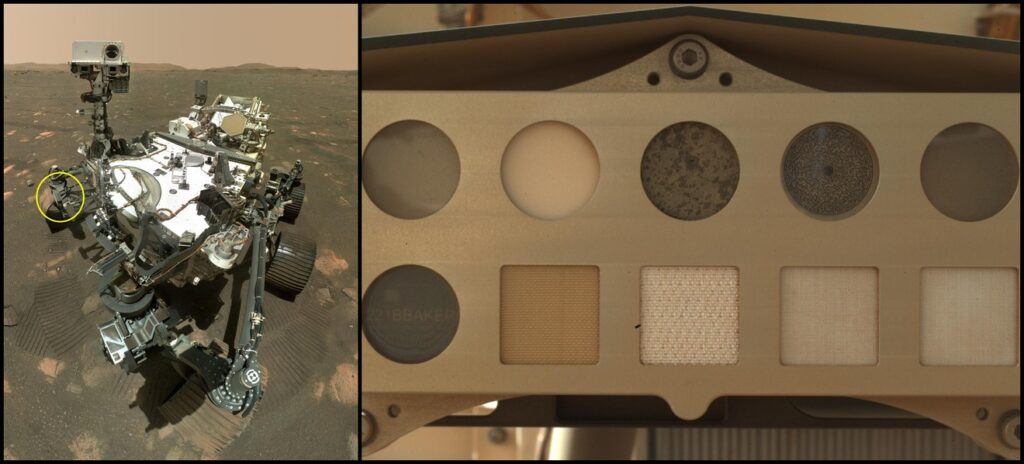
The measurements themselves came from a second instrument, PIXL (the Planetary Instrument for X-ray Lithochemistry). It fires a narrow X-ray beam at a target and identifies elements from the X-rays that come back, a technique called X-ray fluorescence. PIXL’s own calibration target holds a piece of Teflon and a piece of basaltic glass. The Teflon is the clever part. It contains no elements PIXL can detect, so any signal from it must come from the dust lying on top, and by analysing and modelling those signals the team could estimate grain sizes as well as chemistry.
Earlier Mars missions could resolve dust down to about 3 micrometres (millionths of a metre). PIXL reached two smaller classes: fine particles below 2.5 micrometres and ultrafine particles of around 100 nanometres, roughly 700 times thinner than a human hair. Grains on PIXL’s Teflon and on SHERLOC’s Vectran swatch averaged about 2 micrometres, while those on the basaltic glass and SHERLOC’s Teflon went down to 100 to 300 nanometres. Chemically, the dust is a mafic silicate, a rock powder rich in iron and magnesium, enriched in phosphorus, iron and sulfur, with signs of calcium sulfate.
Why should different surfaces hold different sizes? Static electricity appears to decide it. Grains pick up electric charge as they collide in the wind, and each material attracts particles of a different size. Years of driving and drilling shook loose the bigger clumps but left the finest particles in place. “The larger clumps, the Martian dust bunnies, get shaken off over time,” VanBommel said. Organic polymers such as Teflon, common in the outer layers of suits, gathered fine dust readily.
Size matters because of where dust goes once it is breathed in. On Earth, particles under 2.5 micrometres can travel deep into the lungs and pass into the bloodstream. Martian dust adds its own chemistry: perchlorates, salts that can disrupt thyroid function, and reactive iron, which can damage cells. Collisions in the wind have rounded the grains, so they are less abrasive than lunar dust. Less abrasive is not the same as harmless.
Some materials held less dust than others, which gives suit and habitat designers something concrete to work with when choosing fabrics and coatings. Layouts such as suitports, where an astronaut climbs into a suit docked on the outside of a habitat, and airlocks with two chambers could keep more of the dust outdoors. None of this needs exotic technology. It needs good numbers, and those are what the rover has started to supply.
There are limits. Grain sizes were inferred by modelling X-ray signals, not seen under a microscope, and swatches fixed to a rover are not a suit being worn, knelt in and brushed down. The study measured what is there, not what it does to a body; NASA notes that the health risk will depend on how much dust a crew meets and for how long. The authors call for thorough characterisation of Martian dust in laboratories on Earth, and no spacecraft has yet brought any home.
Apollo crews could brush down their suits and leave within days. Mars crews will live with this dust for months, inside habitats it will keep trying to enter. Perseverance, built to look for signs of ancient life, has handed engineers an early sample of the problem: a few small squares of fabric, still wearing the planet’s finest dust after more than four years on the surface.
