

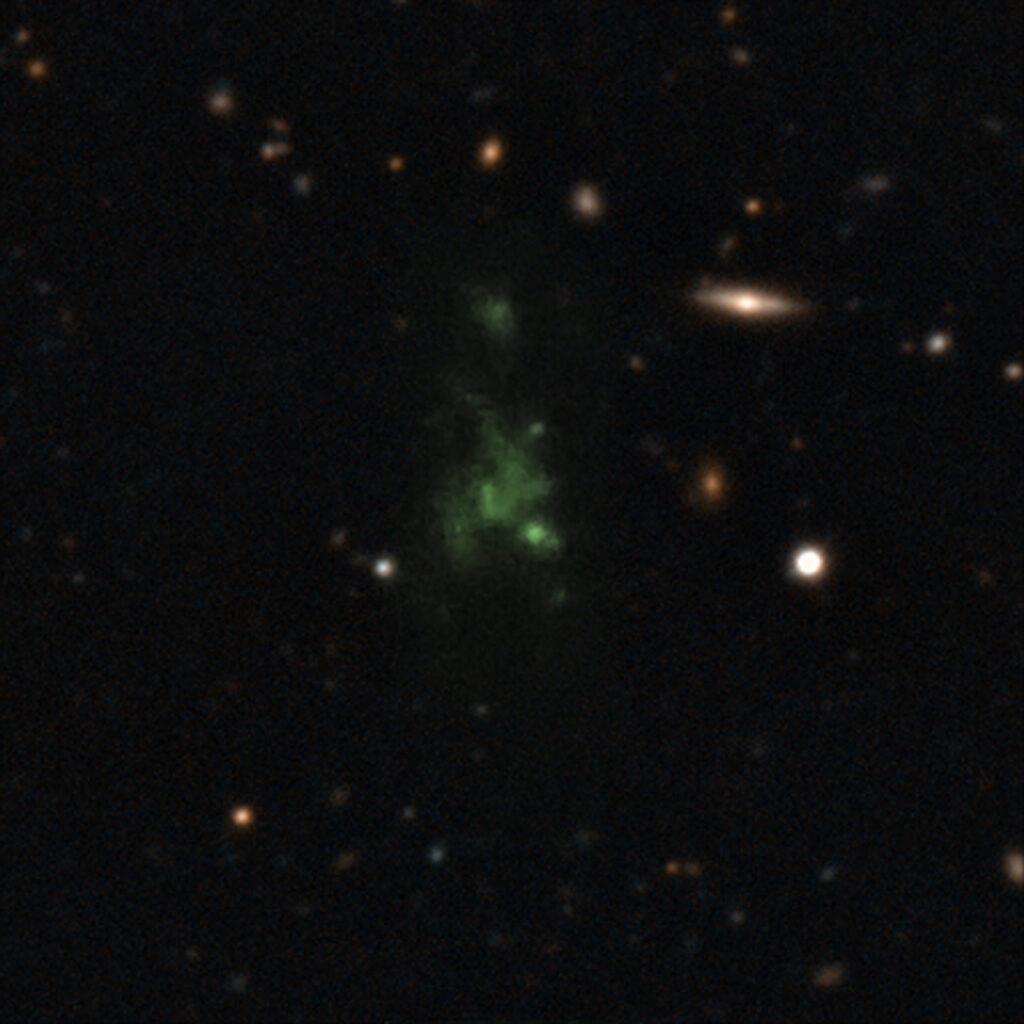
Some of the largest single objects known are not galaxies but clouds. A Lyman alpha blob is a cloud of hydrogen gas lit up in ultraviolet light, and the catalogued examples stretch across tens to more than a hundred kiloparsecs, which is a few hundred thousand light years at the upper end. One blob refuses to behave. It glows like the others, yet it spans at most 5 to 8 kiloparsecs, about the size of a modest galaxy, and a new spectrum has now fixed how far away it lies.
Researchers at the Centro de Estudios de Física del Cosmos de Aragón and the Instituto de Astrofísica de Canarias report the measurement in Astronomy & Astrophysics, published online on 26 October. They used EMIR, a near infrared spectrograph on the 10.4 metre Gran Telescopio Canarias in La Palma, for four hours on a single target: a faint patch of light labelled SHARDS20018464. The patch was described in 2025, after the SHARDS survey picked it up in one narrow filter centred near 551 nanometres, in the green, and in nothing else.
Pinning down a distance means catching a spectral line whose rest wavelength is known. Lyman alpha itself is awkward for the job, because its photons scatter again and again inside the gas before they escape, which distorts the line. So the team went looking instead for the pair of oxygen lines astronomers write as [OIII], emitted at 4959 and 5007 angstroms. At the expected distance those land in the near infrared Ks band, where EMIR works. Both appeared, faintly, with signal to noise ratios of 5.3 and 8.7. Their measured brightness ratio was 2.92 against the 2.98 that atomic physics predicts, the kind of internal check that makes a weak detection worth believing.
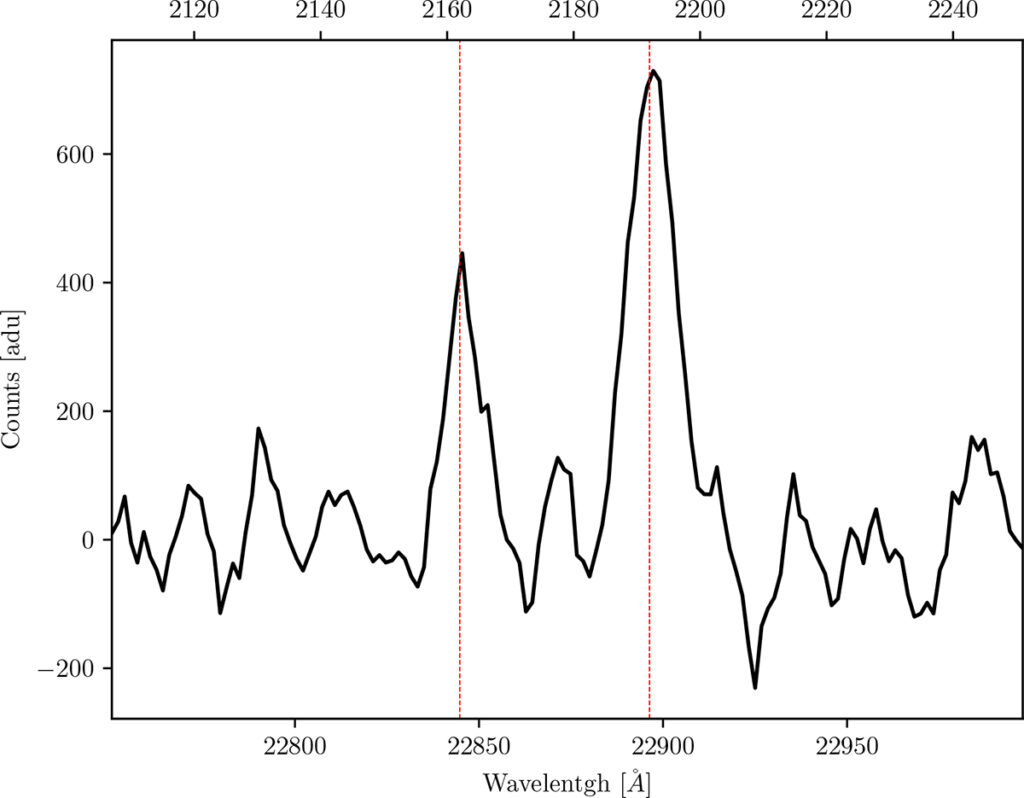
The lines put the blob at a redshift of 3.59, plus or minus 0.01. That is a little further than the photometric estimate of 3.49 drawn from survey colours, though the two agree within their uncertainties. What matters more is what the correction leaves alone. Recalculated at the new distance, the blob still measures 5 to 8 kiloparsecs across, and its companion galaxy still sits 5.6 kiloparsecs away. The numbers barely move.
Size is the point of the story. Lyman alpha blobs tend to turn up in the crowded regions of the early Universe, where galaxies are assembling in groups: one survey of a single field found 33 of them, roughly 90 per cent in overdense patches. Explanations for the glow have ranged from a quasar buried in dust, to a burst of star formation driving gas outwards, to hydrogen radiating as it cools and falls into a growing galaxy. A blob well under a tenth the width of the classic examples asks for none of that. The 2025 analysis measured a Lyman alpha luminosity near 1043 erg per second and a rest frame equivalent width of about 111 angstroms, both within reach of a young cluster of massive stars in the galaxy next door, somewhere between 10 million and 20 million solar masses of stars aged 2 to 4 million years, forming at around two solar masses a year. The new spectrum sits comfortably with that reading.
The case for a new class of compact Lyman alpha emitters, which is how the authors frame it, rests on one object. No continuum light was detected at all, so everything hangs on two faint emission lines gathered in four hours through seeing of about one arcsecond. The source is near 27th magnitude in Hubble’s F606W filter, which explains why sharper observations are hard to come by. Until a survey finds more small blobs, the class has one member and no statistics.
That is usually how categories begin. The giant blobs were noticed first because they are impossible to miss, sprawling green across deep images once cosmic expansion has stretched their ultraviolet light into visible wavelengths. A compact one, powered by stars a few million years old and visible through a single filter, is the sort of thing a survey stumbles into and a spectrograph confirms by sitting still for four hours. If others exist, they have been hiding inside data nobody thought to question.
