

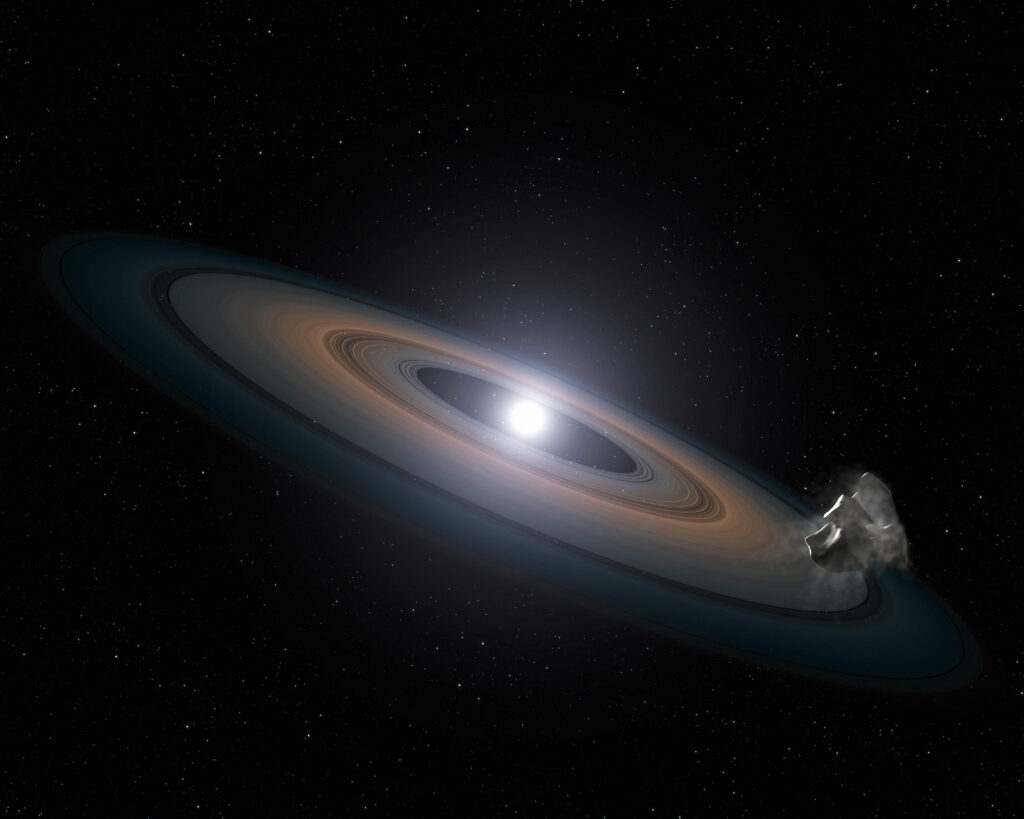
When a star like the Sun dies, its planets do not simply disappear. Some survive the star’s swelling and collapse, others are torn apart, and the wreckage ends up circling the white dwarf left behind, a dense stellar ember roughly the size of Earth. Astronomers usually detect that rubble through the metals it rains onto the star. Now a white dwarf debris disc has turned up with a structure never seen before: two separate rings of glowing gas. The simplest explanation is two planetary bodies still orbiting inside the debris.
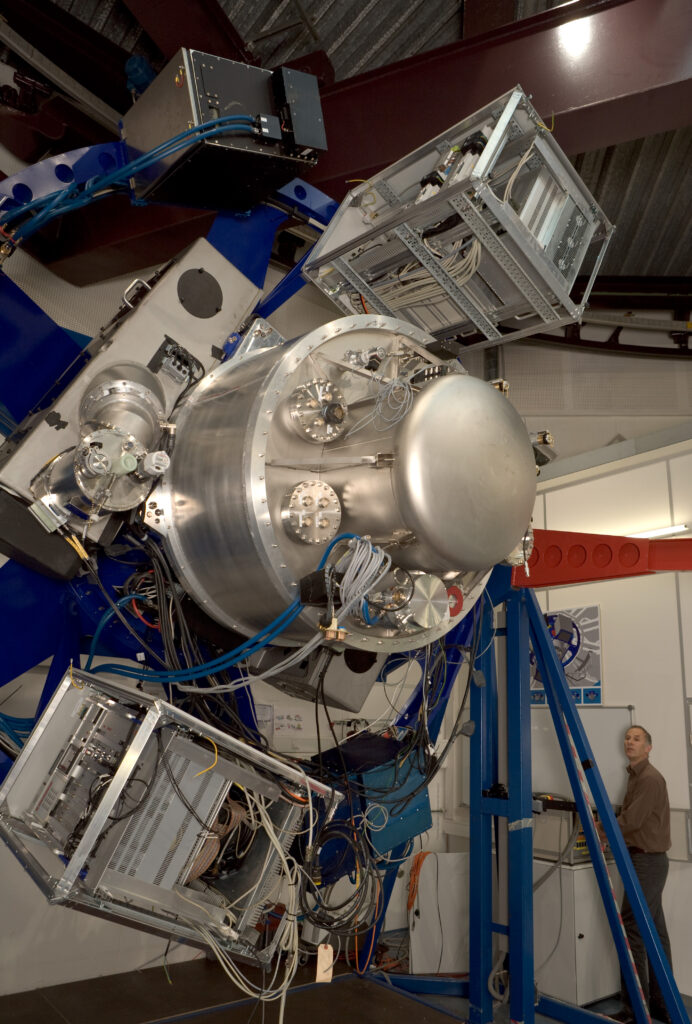
The star, catalogued as WD J1328-1450, was first flagged as a likely white dwarf from its distance and colour in data from the European Space Agency’s Gaia mission. Infrared surveys then showed it shining more brightly than a bare white dwarf should, the usual sign of warm dust nearby. A team led by Nicola Pietro Gentile Fusillo, with collaborators including Detlev Koester of the University of Kiel, followed up with 10 spectra from the X-shooter instrument on ESO’s Very Large Telescope (VLT) in Chile, taken between 2021 and 2023. The results were published in Nature Astronomy on 26 October 2026.
Gas orbiting a star gives itself away through emission lines, bright spikes at the precise wavelengths where elements such as calcium shine. One side of a disc moves towards us and the other away, so the Doppler effect stretches each line into a characteristic pair of peaks. All 21 gas discs previously found around white dwarfs show exactly that double hump. This one shows four. Its calcium lines, and lines from oxygen, each split into two nested pairs: a wide pair from fast gas close to the star and a narrower pair from slower gas further out.
Modelling those line shapes, the team placed the inner ring between 0.14 and 0.34 times the radius of the Sun from the white dwarf, and the outer ring between 0.54 and 1.93 solar radii, with a clear gap in between. The system is tilted at about 77 degrees, so we see it close to edge on. The two rings also seem to differ in make-up. Magnesium emission comes only from the inner ring, and the magnesium polluting the star is scarce compared with silicon, at a ratio of about 0.2 against the 0.85 to 1.2 typical of polluted white dwarfs.
Why two rings rather than one disc with a hole in it? The team’s preferred answer leans on a precedent. In 2019 astronomers reported in Science a planetesimal, a solid fragment of a former planetary system, circling inside the gas disc of the white dwarf SDSS J1228+1040 every two hours, with a stream of gas tracking its orbit. If one embedded body can feed one gas disc, two discs point to two bodies on concentric orbits.
Gravity sets limits on what those bodies can be. Anything too large or too loosely held together would be pulled apart by the white dwarf’s tides, so each must have some internal strength. The inner object could be up to tens of kilometres across, while the outer one, depending on its exact distance and density, might be as large as Ceres or even Pluto. The authors also tested alternatives, including a single disc with a gap and an unseen second white dwarf, and found them a poorer fit.
This matters because white dwarfs are the best laboratories for the fate of planetary systems, eventually including our own. Debris discs are usually pictured as smooth, single structures fed by one shredded asteroid. A system with two distinct rings, each possibly kept alive by its own surviving body, suggests the wreckage around dead stars can be more ordered and more crowded than current models allow. The paper’s authors describe the double disc as a new challenge for those models.
The catch is that nobody has seen either body. Both planetesimals are inferred from the shape of spectral lines, and the team says plainly that it cannot determine their exact orbits. Several disc parameters are degenerate, meaning different combinations fit the data equally well. The magnesium measurement rests on a single line that may be blended with emission, and the dust model does not fully reproduce the star’s near-infrared glow. A repeating signal in the gas, like the two hour rhythm at SDSS J1228+1040, would turn a strong inference into a detection.
Until then, WD J1328-1450 offers an odd kind of afterlife. Around 73 million years after it became a white dwarf, two fragments of whatever once orbited the star appear to be still going round, each trailing its own ring of vaporised rock.
The planets are gone. Their leftovers are still keeping time.
