

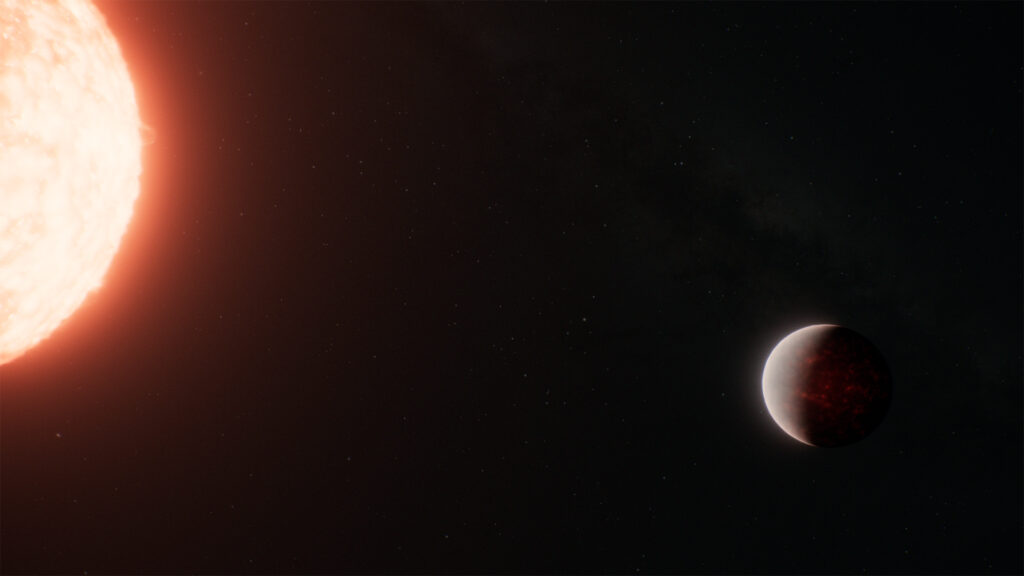
A planet that circles its star in under 11 hours should be bald. At that range the starlight is fierce enough to melt rock into a global ocean of magma, and any gas the planet started with ought to have boiled away long ago. Yet a new analysis of 37 hours of James Webb Space Telescope (JWST) data finds that the lava world TOI-561 b keeps an atmosphere, and a bright one at that: it appears to bounce roughly three-quarters of the incoming starlight straight back into space.
The study, led by Samuel Boucher of the Université de Montréal and the University of Waterloo, appears in The Astronomical Journal (paper; preprint), and was announced by the University of Birmingham on 27 October 2026. TOI-561 b lies about 280 light-years away. It is about 1.4 times the width of Earth and a little over twice its mass, giving a density of 4.3 grams per cubic centimetre, low for a rocky planet. Its host is at least 10 billion years old and poor in iron, a member of the Milky Way’s thick disc (an old, puffed-up population of stars).
Webb watched the system without a break from 1 to 3 May 2024, catching the planet slip behind its star four times and cross in front of it three times. A first look at the eclipses alone, published in December 2025, found the dayside far cooler than bare rock should be. The new work uses the whole phase curve: the steady rise and fall in infrared brightness as the planet turns its blazing dayside, then its darker nightside, towards Earth. Comparing the two tells astronomers how much energy the planet absorbs and how much it carries round to the night.
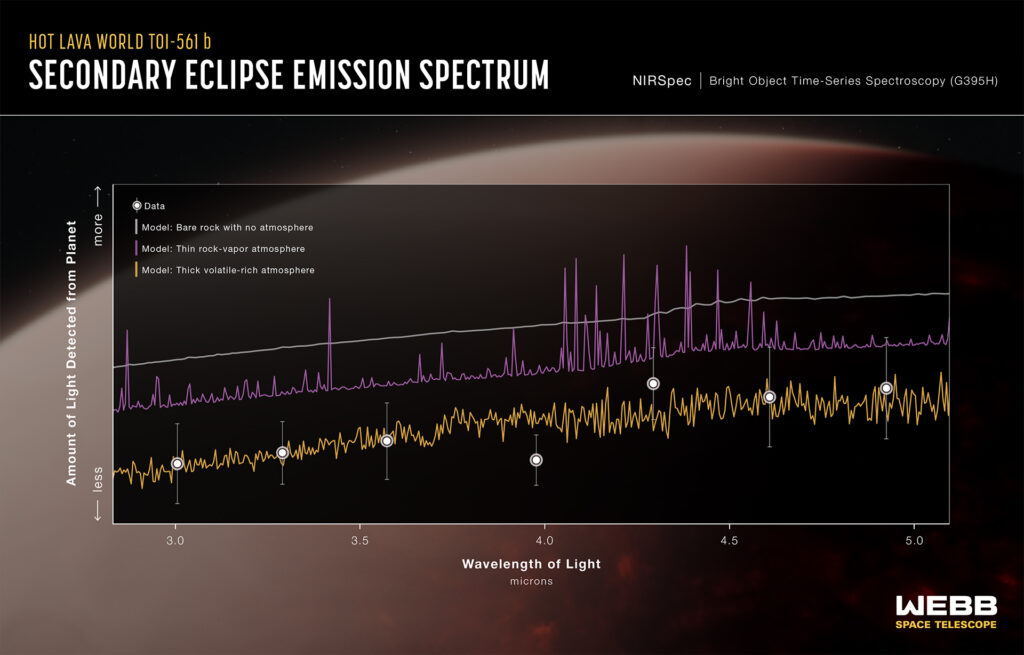
The answer is lopsided in an instructive way. A dark, bare rock this close to its star should reach about 3,200 kelvin (roughly 2,900°C) on its dayside. Webb measured about 2,050 kelvin (roughly 1,800°C). The nightside cannot account for the missing energy, because the team found only modest heat transport around the planet. Their energy balance points instead to a Bond albedo (the fraction of all incoming starlight reflected) of about 0.74. That is comparable to Venus. Molten rock, by contrast, should be dark.
Getting there meant beating the star at its own noise. The surface of a star like this churns with convection cells, and their flicker changed its brightness by around 55 to 62 parts per million on timescales of 20 to 25 minutes. The planet’s dayside glow is smaller still, about 35 to 47 parts per million depending on wavelength. Because the observation ran unbroken across four orbits, the team could model the stellar flicker and the planet’s signal together rather than mistake one for the other.
Climate simulations reinforce the picture. A bare rock produces a day to night contrast far larger than Webb saw, while models with an atmosphere of 1 to 10 bar at the surface (Earth’s is about 1 bar) fit much better, provided the planet is highly reflective. The likely mirror is cloud. On a dayside with a mean surface temperature near 2,600 K, rock vapour can condense near the planet’s morning edge into clouds of silica (SiO2) and magnesium silicate (MgSiO3). On Earth, silica is the stuff of sand and quartz. On TOI-561 b it may be weather.
The result matters beyond one odd planet. Ultra-short-period worlds are among the best rocky planets on which to look for air, because their heat makes them bright in the infrared, and theory expects them to be stripped bare. TOI-561 b suggests the outcome depends on what a planet is made of and how its interior trades gas with the sky above. The authors argue the atmosphere must be resupplied from the magma below, and that reflective clouds may help it survive by cutting the energy that drives escape.
Plenty remains unsettled. Nobody yet knows what the atmosphere is made of: it could resemble a far hotter Venus, rich in carbon dioxide, or carry sulfur dioxide like Jupiter’s volcanic moon Io, and the dayside spectrum hints at carbon dioxide only tentatively. Webb’s two detectors disagree somewhat, which the team traces to how well each pins down the star’s flicker and slow drifts, and the models overpredict the nightside glow at shorter wavelengths. In the team’s own estimate, silica clouds supply only part of the needed reflectivity. How the planet kept its air at all is also open; the authors list a volatile-rich birth, slower loss of gas released from the interior, a late move inward and gas stored in the mantle then released, and suspect a mix.
The next test is already proposed: a look with Webb’s Mid-Infrared Instrument at 15 micrometres, where carbon dioxide absorbs strongly, alongside a transit spectrum the team will analyse separately. Until then TOI-561 b stands as a useful embarrassment for theory. Its star is at least 10 billion years old, and the planet orbits close enough to melt. Somehow it still wears a sky, and that sky shines with clouds of what, on Earth, would be sand.
