

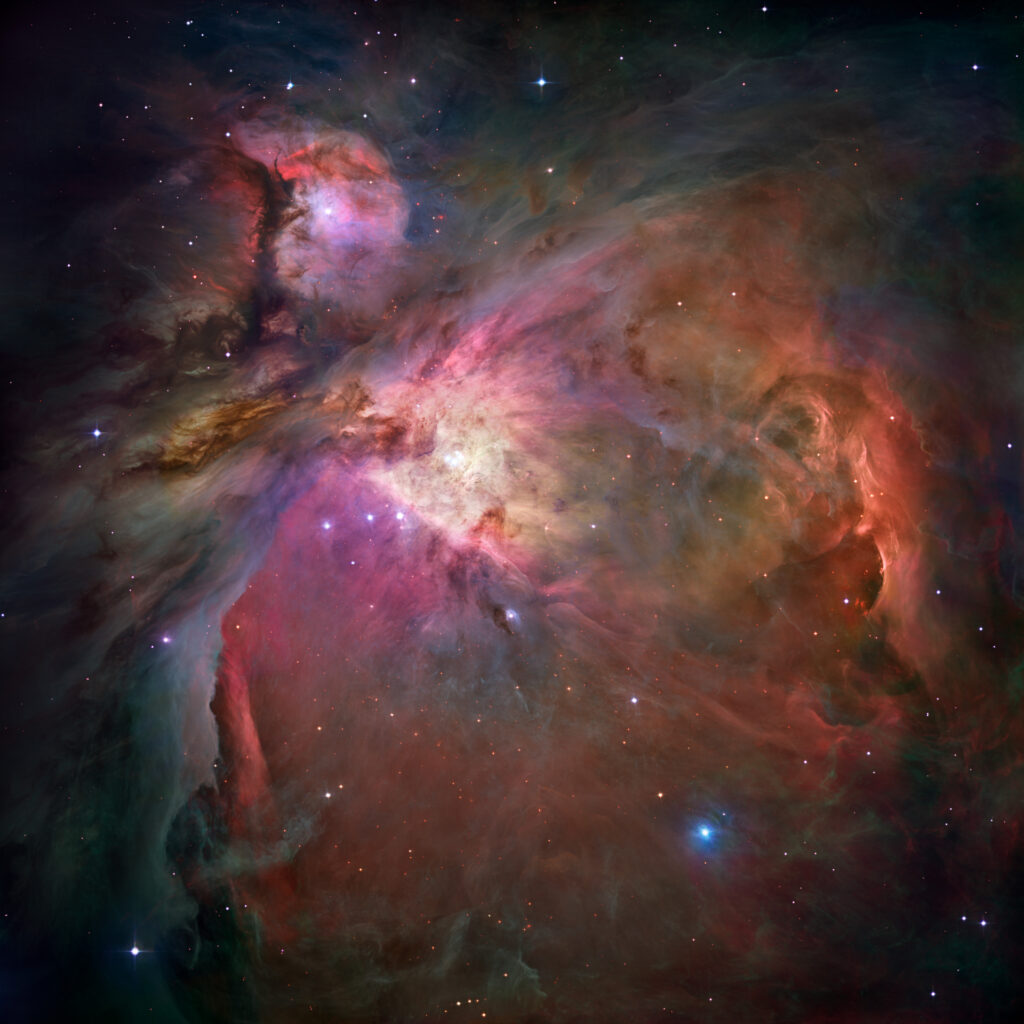
The Orion Nebula has a timing problem. Its stars are around one million years old, yet the dusty discs around many of them, the raw material for future planets, are being stripped away so fast that they should have vanished long ago. The glowing shell of gas that encloses the Orion Nebula looks young too, as if it was blown outwards only a few hundred thousand years ago. A new study offers one answer to both puzzles: the nebula’s most powerful star may be the product of two stars colliding, an event that happened, in astronomical terms, the day before yesterday.
Maite Wilhelm and Simon Portegies Zwart of Leiden Observatory carried out the work with Alessandro Trani of the University of Concepción in Chile, reporting it in a paper now available from Astronomy & Astrophysics. Leiden University announced the result on 23 October 2026. Their suspect is θ1 Orionis C1, the heaviest member of the Trapezium, the tight knot of massive stars at the heart of the nebula. Its ultraviolet light does most of the work of making the gas glow. It is also the main threat to the young discs around it.
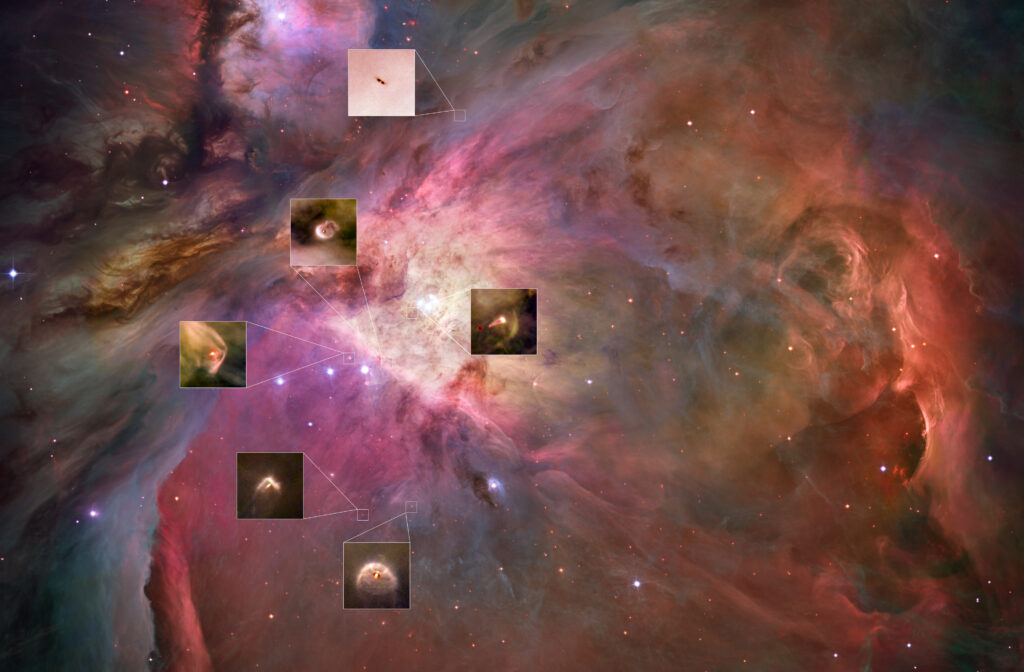
Those discs are known as proplyds, a contraction of protoplanetary discs, and they are among the best known sights Hubble has recorded. Close to θ1 Orionis C they appear as bright teardrops with tails pointing away from the star, because its radiation heats their outer layers and drives the gas off. The paper puts the losses for the hardest hit at up to about one millionth of a solar mass every year. Rates like that sit badly with a cluster a million years old, and astronomers have argued about this proplyd lifetime problem for decades.
The proposed fix rests on the company the star keeps. θ1 Orionis C1 has a companion, C2, of about 12 solar masses on an elongated orbit that takes roughly 11 years. The team suggests C1 began life as a close pair of stars weighing about 33 solar masses together. Over time, C2’s gravity stretched the inner pair’s orbit through von Zeipel-Lidov-Kozai oscillations, a slow trade between the tilt and the elongation of an orbit that occurs in triple systems. Eventually the two inner stars came close enough to merge. Because a massive star’s brightness climbs steeply with its mass, one large star outshines two smaller ones of the same combined weight.
By the paper’s estimate, the merger raised the star’s ionising output by about a factor of 10. That roughly triples the rate at which the discs evaporate and shortens their lives by a similar amount. Before the merger the discs sat in gentler light and could survive; afterwards they began to erode quickly. Fitting models to the shell, which has a radius of about 2.5 parsecs (roughly eight light-years) and expands at 13 kilometres per second, the team places the brightening between about 150,000 and 300,000 years ago. The stars themselves can still be close to a million years old.
If the idea holds, it changes how astronomers read young clusters. Ages based on disc survival or shell growth would measure the time since a merger, not the time since the stars formed. Such events need not be rare either. Many massive O-type stars have close companions, and the authors cite estimates that roughly 70 per cent belong to triple or larger systems. A merger could also account for two oddities of θ1 Orionis C1 itself: a magnetic field tilted at a steep angle, and a reported slight excess of nitrogen at its surface.
The scenario has gaps, and the authors say so. To reproduce the shell, the star’s wind power needs to have jumped by a factor of at least 100, but a merger can supply at most about 30. They suggest cool gas evaporating from the proplyds mixes into the hot shell and supplies the missing push, an idea that still needs testing.
Timing is another weak point. About half of their 1,992 simulated triples merged within a million years, but many did so within a few hundred or thousand years, far too early. Tides, rotation or close passes by neighbouring stars might delay the collision; that remains to be shown. The nitrogen excess is disputed too, since one earlier analysis could not confirm it.
One smaller question is settled by the simulations. A proposed companion of about one solar mass, said to circle the pair every 61 days, almost certainly does not exist. In 1,995 of 2,000 runs it merged, typically within about 135 years. The Trapezium is a hard place for a small star to keep its distance.
For any planets still trying to form in Orion’s discs, the story is one of poor timing. They spent their early years beside a quieter star. Then two neighbours became one, and the light turned harsh.
