

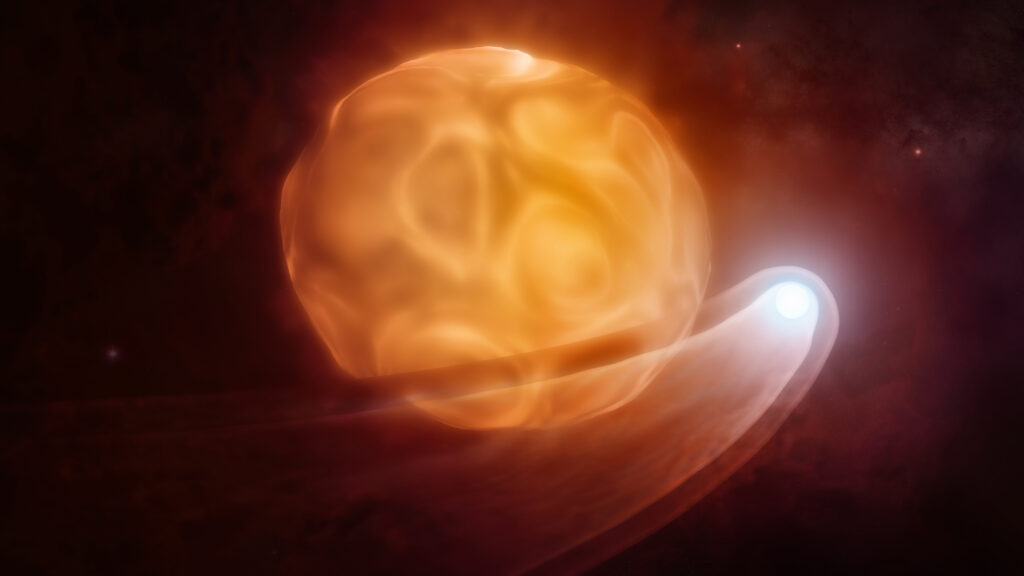
For a star that has been watched for centuries, Betelgeuse still manages to surprise the people who study it. The red supergiant on Orion’s shoulder faded to its faintest in more than a century of records during late 2019 and early 2020, and it has since turned out to have a small partner hiding in its glare. New radio images now suggest what that Betelgeuse companion is doing in there. As it orbits, the giant’s outer atmosphere stretches into an egg shape and then relaxes again, in step with the smaller star’s position.
Lynn Matthews of MIT Haystack Observatory led the work, with colleagues at the Center for Astrophysics | Harvard & Smithsonian, the University of Manchester and the European Southern Observatory (ESO). Their paper in The Astronomical Journal, announced by the US National Radio Astronomy Observatory (NRAO) on 26 October 2026, combines two very different instruments. The Karl G. Jansky Very Large Array (VLA) in New Mexico and the Atacama Large Millimeter/submillimeter Array (ALMA) in Chile observed the star at seven frequencies between 22 GHz and 485 GHz, from 2021 to 2026. The full analysis is also available as a preprint on arXiv.
Radio waves of different frequencies escape from different depths, and the whole method rests on that. Betelgeuse’s atmosphere extends to several times the radius of its visible surface, and the higher the frequency, the deeper the telescopes see. Stacking the seven bands gives something like a core sample taken from the outside. Gas at roughly 2.7 times the star’s radius sits at about 3,500 K, close to the temperature of the visible surface, while the deepest layer ALMA reached, at about 1.2 stellar radii, is nearer 2,220 K. That confirms a long suspected cool layer between the surface and the hot chromosphere above it, overlapping a shell of molecular gas that infrared astronomers call the MOLsphere.
Those data also record a star getting over a bad few years. In 2019, just before the Great Dimming, an earlier study led by Matthews found the atmosphere’s radio brightness unusually low, which the team linked to a shock wave driven by convection, the churning of hot gas that carries energy outward. That episode is thought to have thrown a large mass of material off the surface. The new measurements show the radio brightness back at more typical levels. For now, Betelgeuse has recovered.
Evidence for the companion began with a rhythm. Besides its shorter pulsations, Betelgeuse brightens and fades over a cycle of about 2,100 days, and in 2024 researchers proposed that an orbiting star could explain it. In 2025 a NASA-led team reported a tentative sighting with the Gemini North telescope and gave the object the name Siwarha, meaning “her bracelet”. This year ESO’s Very Large Telescope produced the clearest image yet, suggesting a companion of about two to three times the mass of the Sun, heavier than first assumed. Its exact nature is still debated.
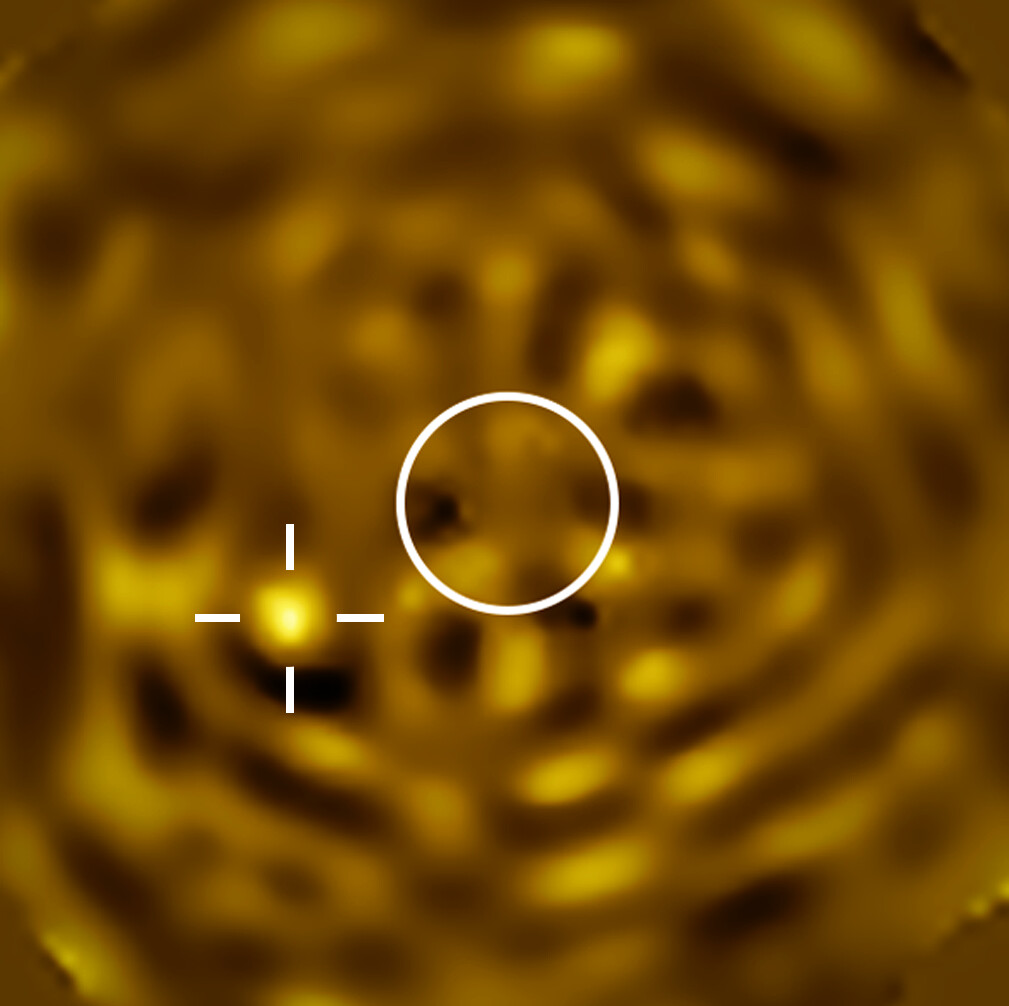
What the radio maps add is a different kind of evidence: an effect rather than a picture. The companion orbits at only about 2.3 times Betelgeuse’s radius, which puts it inside the giant’s extended atmosphere; in Matthews’s words, it “actually passes through its extended atmosphere”. When the team compared the star’s shape at each epoch with the companion’s predicted position, a pattern appeared. The atmosphere looked most elongated, by up to about 10 per cent, when the companion sat near its greatest apparent distance from the star, and close to round when it passed in front of or behind it. A smaller star ploughing through that gas should leave a disturbed wake, and ultraviolet spectra analysed by co-author Andrea Dupree’s group point the same way.
This matters beyond one famous star. Red supergiants shed huge amounts of gas before they explode, and the way that material leaves shapes the environment any later supernova will blast into. Many massive stars have companions, so a partner churning through the envelope could be a common influence on that process rather than a curiosity. As the closest red supergiant to Earth, at roughly 220 parsecs (about 720 light-years), Betelgeuse is one of the few whose disc radio arrays can resolve into an actual shape.
Parts of the case are still thin. The ellipticity pattern rests on a handful of epochs, the scatter between them is significant, and the companion itself is tens to hundreds of times too faint at radio wavelengths to be seen directly. The authors cannot rule out other radio emission from it, and the orientation of the stretching differs from band to band in a way that only more observations can explain; it may trace a three-dimensional wake. Pinning down the cool layer precisely will also need ALMA’s two highest frequency bands, which this study did not use.
November 2027 offers the next good chance, when Siwarha swings back to its widest separation and should be easiest to spot. Future facilities such as the proposed Next Generation Very Large Array could make this kind of monitoring routine. Until then, the best evidence for the companion is the shape of the air around the star. The bracelet stays out of sight, but the hand it circles keeps changing shape.
