

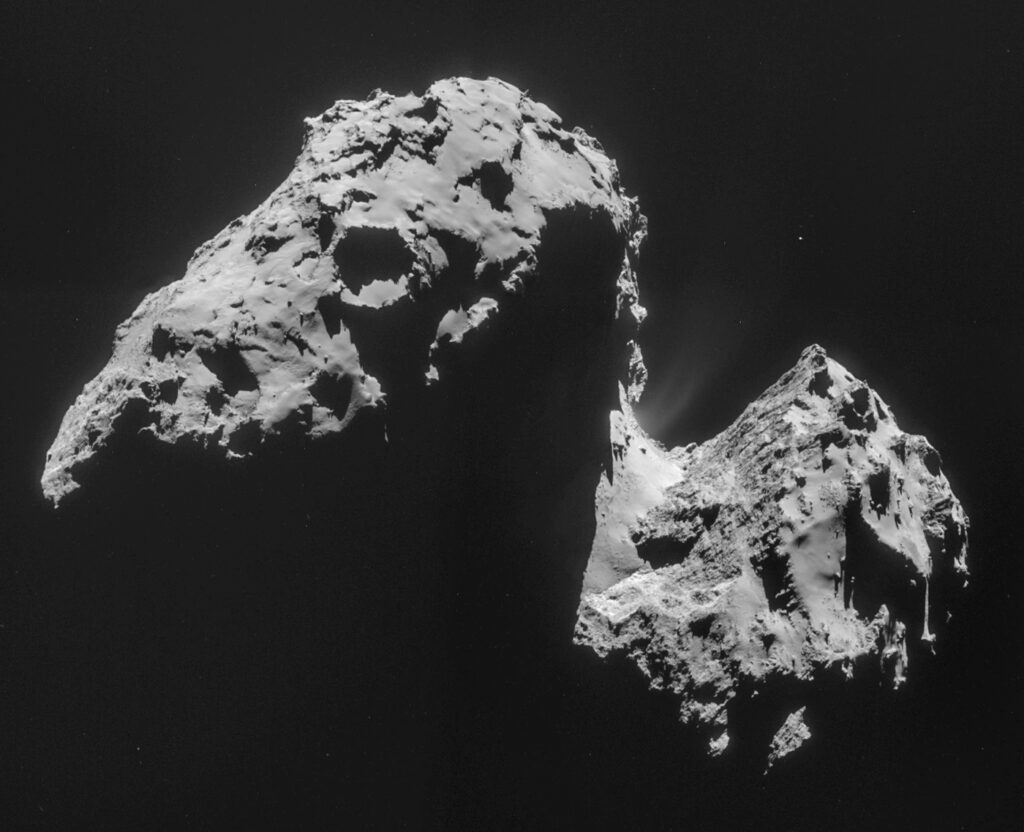
Comets have long been a favourite suspect in the story of the origins of life on Earth. They are rich in hydrogen cyanide (HCN), a small, reactive molecule that turns up in many laboratory routes towards the building blocks of biology. Drop enough of it into a pool on the young Earth, the argument goes, and chemistry could do the rest. New modelling suggests the delivery would almost always arrive in pieces.
The study, led by Richard Anslow of the Institute of Astronomy at the University of Cambridge, appears in Scientific Reports and was announced by the university on 28 October 2026. The team combined recent work on three problems: how comets behave on impact, how they interact with an atmosphere on the way down, and where comets come from and how their orbits change over time. The question was simple. How often could a comet land HCN intact, in useful amounts?
Rarely, it turns out. Speed is the main problem. An earlier study by Anslow and colleagues in Proceedings of the Royal Society A found that comets must strike at below 15 km/s for organic molecules to survive. Most comets reaching Earth travel faster than that and come in at steep angles, so their HCN would almost certainly vaporise. Even when some survived, impacts that left a useful concentration behind were extremely uncommon. Timing adds to the problem, because comet impacts declined rapidly over Earth’s first 500 million years, leaving at most a handful of chances. Anslow calls a successful delivery “a one-in-a-million occurrence”.
Mars does slightly better. Its smaller size and thinner atmosphere let comets reach the ground more easily, yet the authors still rate delivery there as highly unlikely, and think it more probable that it happened on neither planet. Any HCN that did land would not stay concentrated for long, so prebiotic chemistry would have needed to move very quickly.
That points attention elsewhere. HCN could have formed in the aftermath of asteroid impacts, which were far more frequent, or through chemistry on Earth itself. The catch is that this is a modelling result about events nobody observed, and the team is careful to say comet delivery cannot be ruled out completely.
The idea survives further afield. In tightly packed planetary systems, neighbouring planets can pass a comet between them and slow it down, which could help astronomers choose targets for future telescopes such as the proposed Habitable Worlds Observatory. On Earth, though, the comets may well have brought the ingredients and burnt them on the doorstep.
