

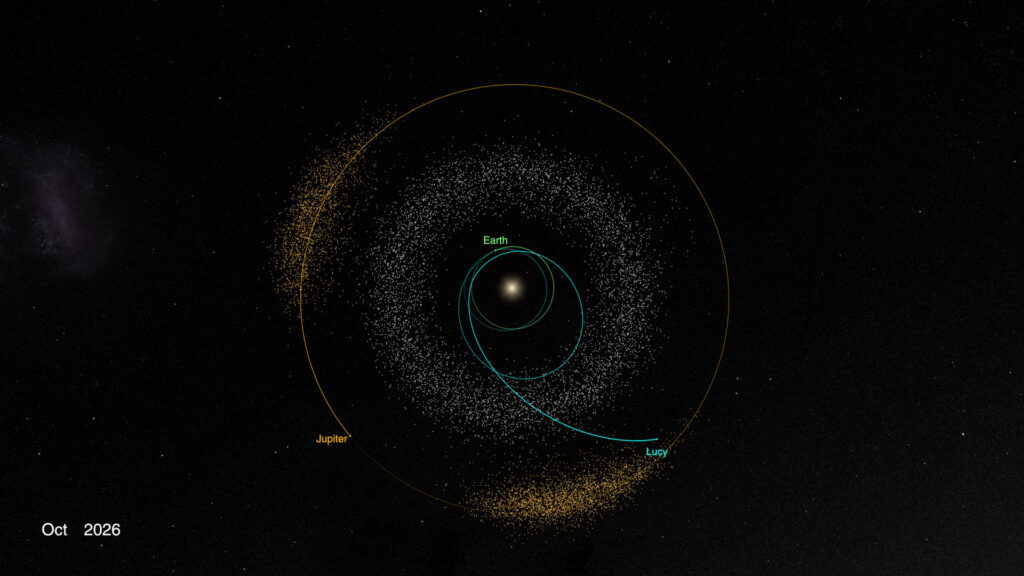
Jupiter does not travel alone. Two swarms of dark asteroids share its path around the Sun, one running ahead of the planet and one trailing behind, and they have been held there for billions of years. Until this week no spacecraft had visited either group. On 28 October 2026 NASA reported that its Lucy spacecraft has reached the Trojan asteroids that lead Jupiter, five years after launch.
Lucy left Earth on 16 October 2021 and has since covered more than 3.5 billion km (2.2 billion miles), according to a mission update by Katherine Kretke of the Southwest Research Institute. On the way it passed the main belt asteroid Dinkinesh, which turned out to have a moon made of two lobes pressed together, and later Donaldjohanson. The probe is now more than five times farther from the Sun than Earth is. Its instruments are working as expected while the light fades and temperatures drop.
The Trojans gather around two Lagrange points, places where the pull of the Sun and Jupiter keeps a small body moving in step with the planet. The leading group sits at the point called L4 and the trailing group at L5. Both lie about 780 million km (484 million miles) from Jupiter, roughly as far as Jupiter is from the Sun. Calling them swarms is generous. Neighbouring Trojans are on average nearly 10 million km apart, and the team tracks Lucy using radio signals and images of background stars.
The appeal is age. These rocks have sat in Jupiter’s orbit for billions of years, and scientists expect them to test theories of how the planets formed about 4.5 billion years ago and how they moved into their present arrangement. NASA’s mission plan takes in eight Trojans out of 11 asteroids in total, a record for a single spacecraft.
Arrival is not yet discovery. Nothing close up happens until 11 August 2027, when Lucy flies past Eurybates and its small moon Queta. Polymele follows in September 2027, then Leucus in April 2028 and Orus in November 2028. Each pass will be quick, at up to about 25,700 km/h (16,000 mph) and a closest approach of roughly 480 to 970 km. After a final gravity assist from Earth in 2030, the spacecraft heads for the trailing swarm and the binary pair Patroclus and Menoetius in March 2033.
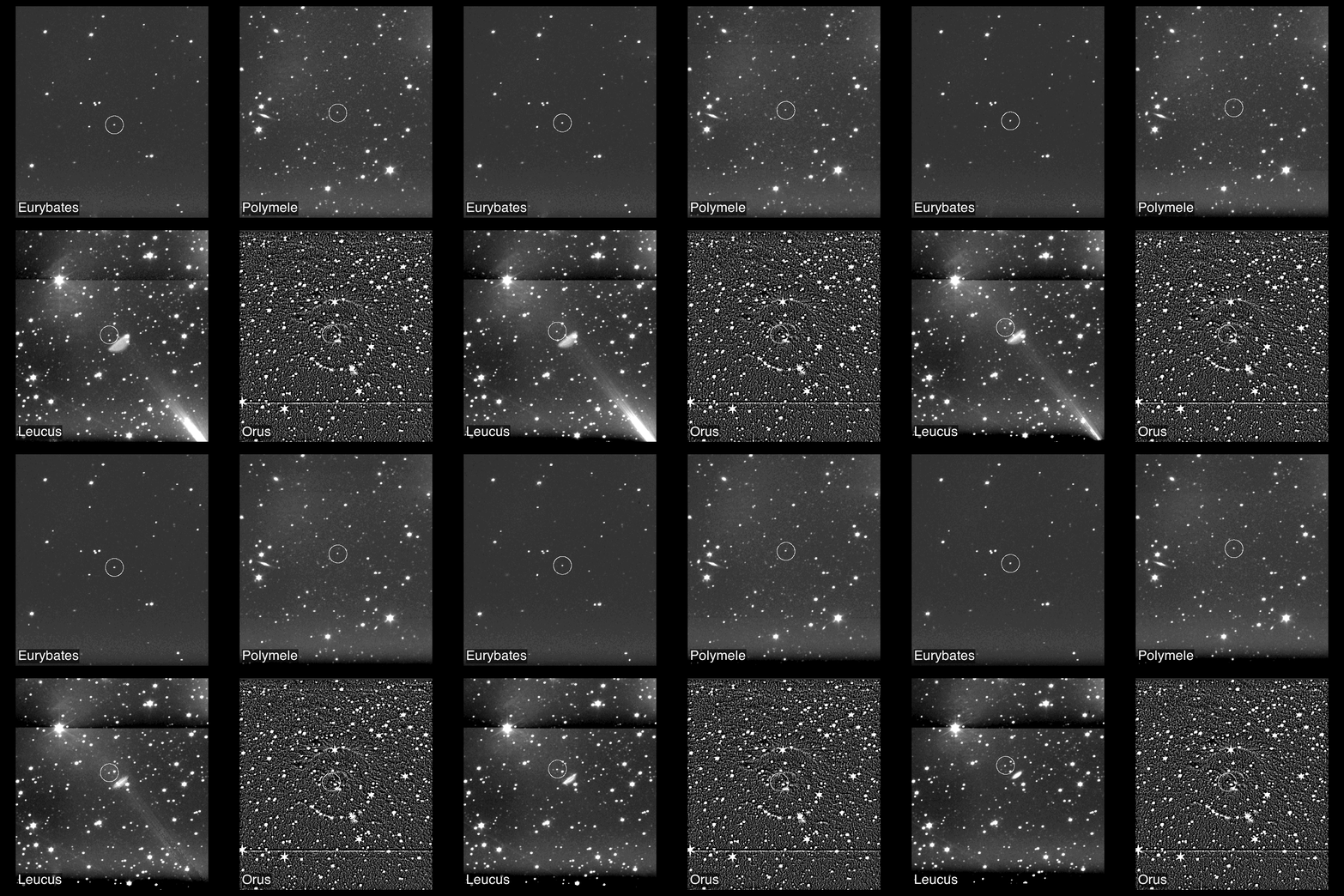
For now the team is finalising plans for the first encounter, less than a year away. Lucy has crossed five years of empty space to reach a neighbourhood where the houses are still millions of kilometres apart. The interesting part is knocking on the first door.
