

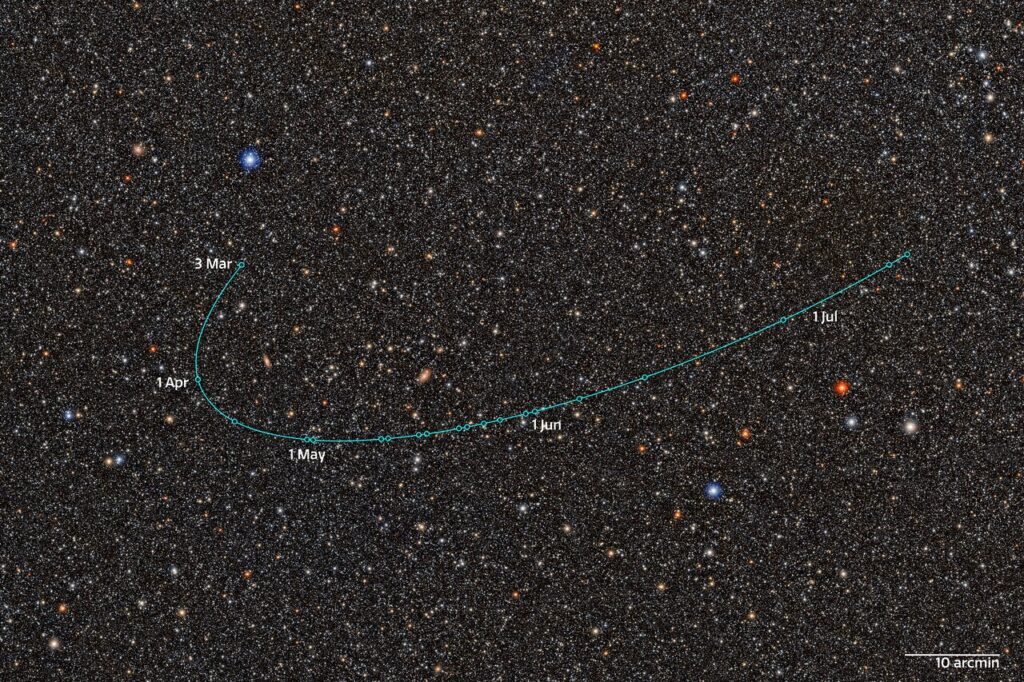
The inventory of the Solar System’s largest bodies was meant to be close to finished. Three decades of surveys have combed the region beyond Neptune for icy worlds, and few astronomers expected anything of planetary size to be left hiding there. One seems to have slipped through. On 27 October 2026 the NSF-DOE Vera C. Rubin Observatory announced 2026 ED138, a dwarf planet candidate perhaps 1,000 kilometres across, picked out of the observatory’s first months of survey data.
Word came through an electronic circular from the International Astronomical Union’s Minor Planet Center, and the result was presented the same day at the Division for Planetary Sciences meeting in Spokane, Washington. Matthew Holman of the Center for Astrophysics | Harvard & Smithsonian spotted it on the evening of 13 October, running Rubin’s detections through search code he wrote with Kevin Napier. Mario Jurić of the University of Washington then went back through Rubin’s catalogues and images and found 20 more observations stretching back to early March.
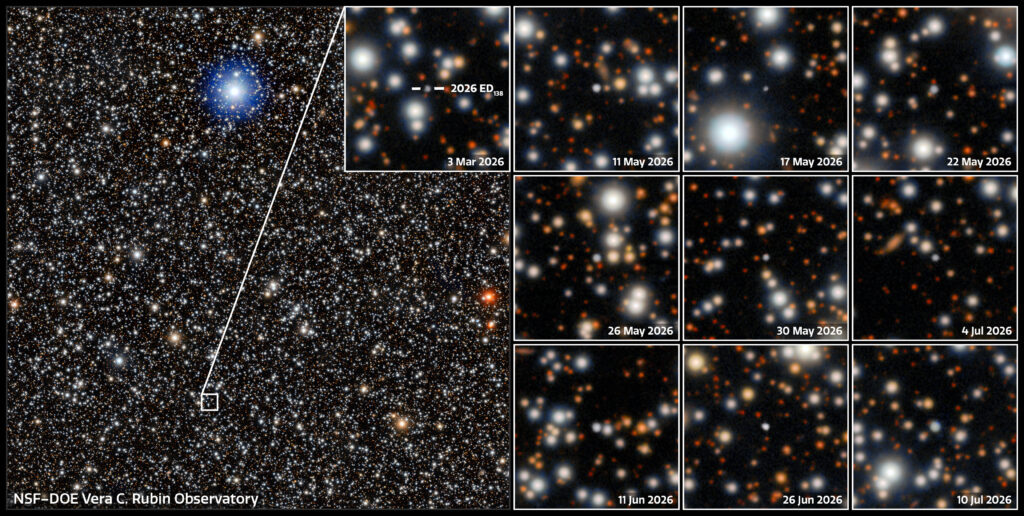
Finding a faint, slow point of light among billions of detections is a problem of joining the dots. A body this distant shifts only slightly from night to night, so the software has to decide which specks, scattered across weeks of images, belong to one object on a sensible orbit. Rubin caught ED138 30 times over 20 nights between 4 March and 11 July 2026. Archival frames from the Dark Energy Camera (DECam) in Chile, located with the Asteroid Institute’s ADAM Precovery service, pushed the record back to 2016. That gave the team more than 10 years of orbit to work with.
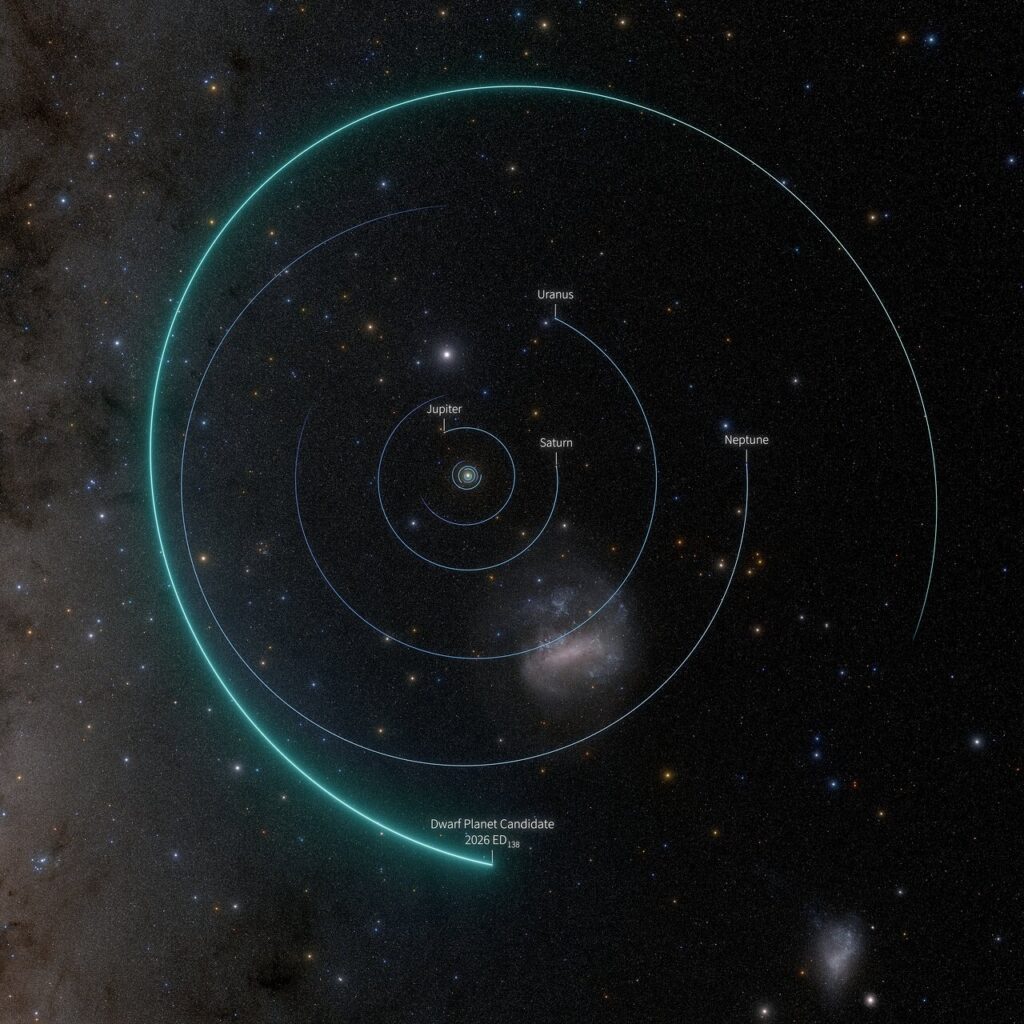
The circular’s orbit puts ED138 on a moderately stretched path averaging about 43 astronomical units from the Sun, where one astronomical unit (au) is the distance from Earth to the Sun. It swings between roughly 37 au and 49 au, takes about 281 years to complete a lap, and is tilted almost 25 degrees to the plane in which the planets travel. Today it sits about 46 au out, beyond Pluto’s average distance of 40 au. The Rubin team classes it as a hot classical trans-Neptunian object. Here “hot” describes the orbit, not the temperature: a steep, disturbed path, possibly stirred up by encounters with Neptune.
Why did nobody see it sooner? Location is most of the answer. ED138 lies in a patch of sky close to the plane of the Milky Way, where millions of background stars crowd every frame and a dim moving dot is easy to lose. Rubin’s camera, the largest ever built, revisits the same fields again and again, so even crowded regions can be searched systematically. A survey that sees everything repeatedly has fewer blind spots to hide in.
If confirmed, ED138 would join a very short list, since the IAU recognises only five dwarf planets: Pluto, Ceres, Eris, Haumea and Makemake. The find is also an early sign of what the Legacy Survey of Space and Time (LSST), which began in June 2026, can do. In April, working from preliminary data, the Rubin team submitted more than 11,000 new asteroids to the Minor Planet Center, including about 380 trans-Neptunian candidates found in under two months. Roughly 5,000 such objects had been catalogued in the previous 30 years, and Rubin expects to raise that number by nearly a factor of 10. Every one is a leftover from the disc that built the planets, and the orbits of the big ones record how Neptune pushed its neighbours around.
The catch is the size. Nobody has measured ED138 directly, so the range of 600 to 1,500 kilometres is inferred from its distance, its brightness and an assumption about how reflective its surface is: a bright, icy surface would make it small, a dark one would make it large. Dwarf planet status also depends on the body being massive enough for gravity to pull it round, which the team expects at this size but has not shown. Infrared observations, which pick up the heat the surface gives off, are needed to settle the size. Formal recognition will take longer still.
Jurić described a find of this size as “something that happens maybe once in a generation”. Rubin has been surveying for barely five months. If one world this large was sitting unnoticed in the busiest part of the sky, the outer Solar System may turn out to be less thoroughly mapped than anyone assumed.
